To visit the Musée d’Orsay in 2026, forty years after its inauguration, can sometimes feel like visiting a holiday resort. Its main promenade, a vista of elegantly muted grey, beige and onyx pavilions punctuated by monumental marbles and bronzes, accommodates bustling crowds eager to traverse the echoing vastness of the former station to reach the more intimate – and invariably teeming – upper galleries devoted to Impressionism. In 2024, Orsay welcomed over 3.75 million visitors, making it the second-most-popular museum in France. Such success – and the practical consequences that have resulted for what is generally described as the “visitor experience” – was scarcely imagined by the curatorial team charged with Orsay’s original conception and display. As its first director, Françoise Cachin, remarked soon after its opening, “We wanted to create a tranquil [serein] museum,” in which “the works speak for themselves through their power.”1 The point was echoed in the press release issued for the inauguration: “The exhibition room should erase the memory of exterior activity and reserve for visitors havens which are conducive to contemplation.” To enhance this sense of communion, artworks were presented with minimal background information: explanatory panels and contextual materials were pared back to highlight the formal qualities of the works on display. Indeed, both Cachin and Michel Laclotte, who had been seconded from the Louvre to coordinate the museum’s installation, insisted that Orsay’s mission was to reassert authentic aesthetic value in the face of fashionable promotion of academic masters by out-of-touch specialists and a mercenary art market. As Laclotte would later insist, Orsay had contributed “to reestablishing hierarchies of value and restoring major artists and movements to their rightful place.”2 Cachin summarized the curators’ guiding principle: “At Orsay, the visitor’s eye must remain sovereign.”3 Artistic excellence, elevated as an indisputable touchstone, offered a valuable refuge from the everyday, where the mind could be refreshed through the inspiring power of aesthetic quality.
The connoisseurial ethos behind such a vision sits awkwardly with what Orsay has become in an age of mass tourism: a spectacle elevated less for its specific contents than for its prominence in the symbolic imaginary of international travel. Whatever it is today, Orsay is certainly not a peaceful haven for undistracted contemplation. Its original curators conceived of art as essentially autonomous, appealing to an individual sensibility shorn, at least for a privileged moment, of constricting ties to time, place, gender or class. Cachin’s sovereign eye is implicitly predicated on a neutralized conception of both the mind and body that contain it: a universal, disembodied viewer sustains this belief in the transcendent value of art.
Orsay’s founders implicitly viewed their celebration of artistic quality as reinforcing the claim for Paris as the undisputed capital in which modern art – and indeed modernity itself – had been forged, a narrative developed earlier in the twentieth century at the expense of those conservative currents somewhat grudgingly accommodated as context in Orsay’s galleries. Yet, in the 1980s, such positions were already under pressure from scholars who looked outside the inherited canon and beyond Paris to embrace (as Robert Rosenblum put it) “the total internationalization of the history of 19th-century art.”4 Both through purchases and exhibitions, the museum has steadily modified this initial elevation of Paris and its familiar roster of modern French masters, albeit unevenly. Orsay has expanded its geographical scope (though France’s provinces largely remain terra incognita),5 with excellent shows on, for example, Switzerland and the Baltic states. Yet barely 20 % of its exhibitions have covered foreign nations or artists, with countries such as Spain and much of central Europe largely unexplored. As art history has heeded Rosenblum’s call, rewriting the period in ways that expand received geographies and redefine the contours of modernism, Orsay’s nineteenth century remains – in part for understandable logistical reasons – massively francocentric.
At the same time as they questioned the topography of their discipline, art historians also critiqued self-sufficient histories of art that favored study of canonical artists and the formal analysis of exceptional works at the expense of interrogating the art world’s historical functioning and the cultural and political environment that shaped artistic production. An echo of this shift came in August 1981 with François Mitterrand’s appointment of historian Madeleine Rebérioux to Orsay’s leadership team, with instructions to “define the new historical direction of the programs.”6 Rebérioux prioritized broadening Orsay’s public through outreach to unions and comités d’entreprise. She also championed a robustly interdisciplinary vision, proposing an expanded range of exhibits capable of evoking the century’s dynamism, conflict and contradictions. As a model, she pointed to an exhibition held at the Martin-Gropius-Bau, Berlin, in 1981, entitled Preußen – Versuch einer Bilanz (fig. 1), which assembled 2,500 objects “to present the elements which characterized the evolution of Prussian society in the field of arts and in the domain of social and political change,” thus presenting “a truly comprehensive view of the past.”7 In the end, though, such radical ambitions proved unequal to a curatorial consensus that, as Cachin insisted, “history, in an art museum, means art history.”8 In its original incarnation, Orsay’s accommodation of history was safely consigned to vitrines in the basement and a “Passage des dates” in one of the corridors. As Rebérioux pointedly remarked: “Curators unanimously believe that a museum is a place for appreciating a work of art in a particular setting. Nothing in that setting should distract viewers from their enjoyment. Juxtapositions and comparisons are unnecessary, even harmful. For my part, I have a different conception of aesthetic enjoyment. It begins with understanding, and therefore with explanation.”9
Fig. 1

Installation view of Preußen – Versuch einer Bilanz [The Prussia Exhibition] at the Martin-Gropius-Bau, Berlin, from 15 August to 15 November 1981. Bundeszentrale für politische Bildung.
Photo © Konrad Giehr-DPA / Photononstop
Rebérioux was diplomatic in assessing her brush with the curatorial world, though her efforts to “make it clear that beauty is not something eternal” had clearly fallen on deaf ears.10 Laclotte’s assertion that “this museum is, and will remain, an art museum”11 arguably serves as an epitaph to a missed opportunity. Beyond the patronizing dismissal of Rebérioux as an ideologue intent on cluttering the galleries with industrial relics, such a response ducked the challenge of reconceiving the museum’s remit more fundamentally and, in so doing, offering a view of the nineteenth century more far-reaching than could be achieved simply by adding academic art to the overall mix. In retrospect, this curatorial defense of aesthetic autonomy seems like a last stand mounted in the face of growing challenges – both from within the discipline of art history and, more insidiously, from an incipient neoliberalism that viewed institutions such as Orsay as cost centers in a competitive market of cultural entertainment.
The 1980s marked the apogee of a vigorous debate over art history’s appropriate methodologies, objects of study, ideological ramifications and interdisciplinary reach. What had been a rather somnolent, well-mannered discipline became increasingly divided between traditionalists, who typically treated the art object as a privileged focus of study, and a new generation of scholars who adopted a variety of theories – from feminism to semiology, from Marx to Freud – to develop new ways of interpreting an expanded field of visual production. As Orsay’s leadership was aware, such efforts had little time for the serenity and delectation they sought to celebrate. Instead, the so-called “new art history,” which proved particularly appealing to scholars of the nineteenth century, demythologized concepts such as genius and artistic autonomy, insisting instead on the material practices surrounding the production, reception, diffusion and consecration of visual art. Disruptive voices were loudest in the United States, Britain and Germany, yet in France, too, signs of methodological heterodoxy were increasingly apparent.12 As early as 1977, the collective Histoire et critique de l’art mounted a trenchant appraisal of the French art-historical establishment from a Marxist perspective, and in 1979 Pierre Bourdieu initiated a series of special issues of Actes de la recherche en sciences sociales introducing French readers to art historians such as Erwin Panofsky, Francis Klingender, Michael Baxandall and Enrico Castelnuovo.13 French historians also demonstrated a renewed interest in material culture, from Michel Vovelle’s investigation of revolutionary imagery to Maurice Agulhon’s analyses of Republican statuary.14 From all directions, it seemed, the boundaries that defined art history as a discrete discipline were being eroded.
A particular challenge to students of the nineteenth century came from what was commonly known as revisionism – an ideologically diverse and methodologically disparate current that challenged the modernist narrative, investigating vast swathes of visual production that had been largely relegated to museum reserves and scholarly opprobrium in the decades around World War I.15 Beginning in the late 1960s, exhibitions in Germany, America and France rediscovered once-celebrated masters whose fortunes had rapidly waned with the institutionalization of modernism.16 On one level, Orsay reflected these changes – indeed one of its curators, Geneviève Lacambre, had played a central role in salvaging lost works for the seminal exhibition Le musée du Luxembourg en 1874 (Grand Palais, 1974). Under Anne Pingeot, the curatorial team responsible for Orsay’s sculpture collection was similarly committed to revealing the rich variety of a medium long dominated by the reputation of Rodin. “One must compare in order to judge,” Pingeot declared, adding “‘we ‘provide the opportunity to see’” – trusting viewers to draw their own conclusions from a display that embraced unfamiliar and neglected works.17 Cachin and Laclotte, by contrast, expressed diffidence about the museum’s range, emphasizing the care taken to display canonical paintings safely apart from Salon works. As Laclotte insisted, looking back on his career in 2003, “Orsay never participated in this reactionary reversal, in this perverse or self-serving revisionism.”18
Shortly before Orsay’s inauguration, publication of La norme et le caprice, a French translation of English art historian Francis Haskell’s study on the malleability of artistic taste in the nineteenth century,19 cast a different light on curatorial certainties about the timeless values they so confidently defended.20 With elegance and economy, Haskell demonstrated the contingency of artistic taste. Rather than inhering to the object itself, aesthetic worth was negotiated by viewers in a constantly evolving process (a phenomenon tacitly recognized by Cachin and Laclotte’s fears that, without guidance, museumgoers might fail to distinguish excellence from mediocrity). Another indication that values were in flux came in fall 1986 with an exhibition (coinciding with Orsay’s opening and held barely a kilometer away) at the École des beaux-arts, displaying winners of the Academy’s Prix de Rome painting competition, chosen from the period 1797 to 1863.21 Habitually treated as the acme of tedious academicism, the show suggested that a reappraisal of such works, and the tradition they served to perpetuate, was well underway.
The first significant sign of Orsay responding to this current occurred only in 1997 with an exhibition devoted to the history painter Jean-Paul Laurens (1838–1921), an event that Cachin’s successor, Henri Loyrette, welcomed as “presenting a body of work, in all its diversity, as powerfully inventive and executed with consummate technical mastery.”22 Seemingly aware of how contentious this reappraisal of a long-neglected “pompier” might appear, co-curator Alain Daguerre de Hureaux asked “Why an exhibition devoted to Jean-Paul Laurens?” and largely dispensed with the equivocations previously reserved for such art. Noting that “the various areas of nineteenth-century French art have not received equal attention,”23 his answer was simple: Laurens and his ilk were integral to historical understanding of the period and aesthetically satisfying in their own right. Special pleading was unnecessary: the work itself justified its rediscovery.
Fig. 2
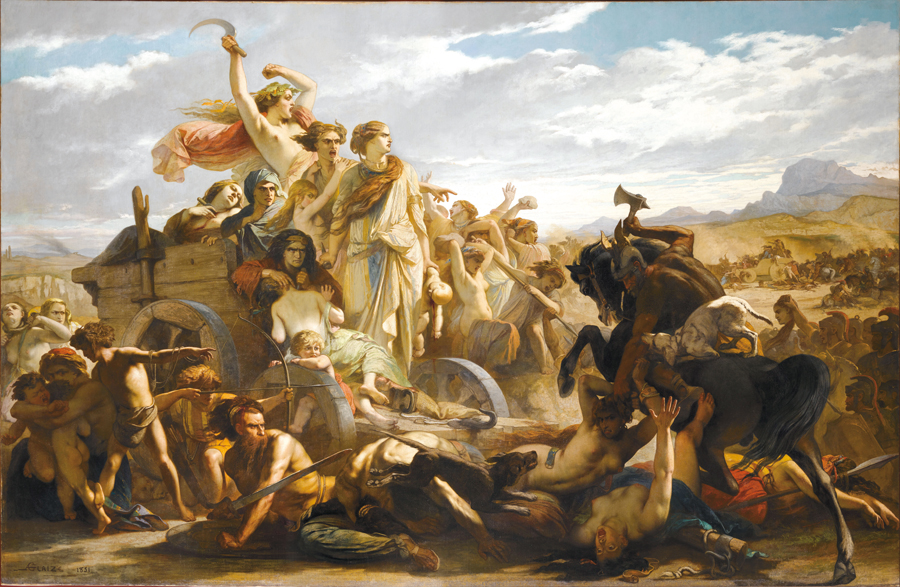
Auguste Glaize, The Gallic Women: Episode from the Roman Invasion, 1851, oil on canvas, 424 × 651 cm, Paris, Musée d’Orsay, purchase from Auguste Glaize, 1853, RF 1983 96.
Photo © Musée d’Orsay (dist. GrandPalaisRmn) / Patrice Schmidt
Comparable shows have remained a rarity at Orsay – Gérôme (2010), Doré (2014) and Gleyre (2016) stand as notable exceptions. However – and particularly since the museum’s reorganization under Guy Cogeval – the diversity of works presented, and the complexity of the narrative they relate, has significantly increased. A campaign to restore monumental history paintings such as Auguste Glaize’s The Gallic Women (fig. 2), and their display in an imposing space dedicated to grandes machines, suggests a new commitment to presenting “academic” artists on a more equal footing with their avant-garde contemporaries. The example set by Orsay, and its willingness to offer major works on loan, has helped encourage the rehabilitation of provincial collections which, for most of the twentieth century, had relegated non-canonical nineteenth-century art to musty reserves. Galleries in cities such as Besançon, Lille, Nantes and Amiens, where the gigantic The Age of Augustus by Jean-Léon Gérôme dominates the renovated Grand Salon, restored in the late 2010s (fig. 3), present a spectrum of nineteenth-century visual production far broader than forty years ago. Provincial museums – as well as the Petit Palais in Paris (host to the groundbreaking Bouguereau show in 1984) – have also organized important surveys of artists such as Jules Breton (Arras, 2002), Alexandre Cabanel (Montpellier, 2010), Jules-Eugène Lenepveu (Angers, 2022) and Luc-Olivier Merson (Rennes, 2008). In contrast to the reactionary, antimodernist overtones of some earlier exercises in revisionism, recent exhibitions more judiciously recognize the need to analyze visual culture from a variety of perspectives, exploring topics such as artistic training, critical reception, social networks, the international exhibition circuit and the role of the art market.
Fig. 3
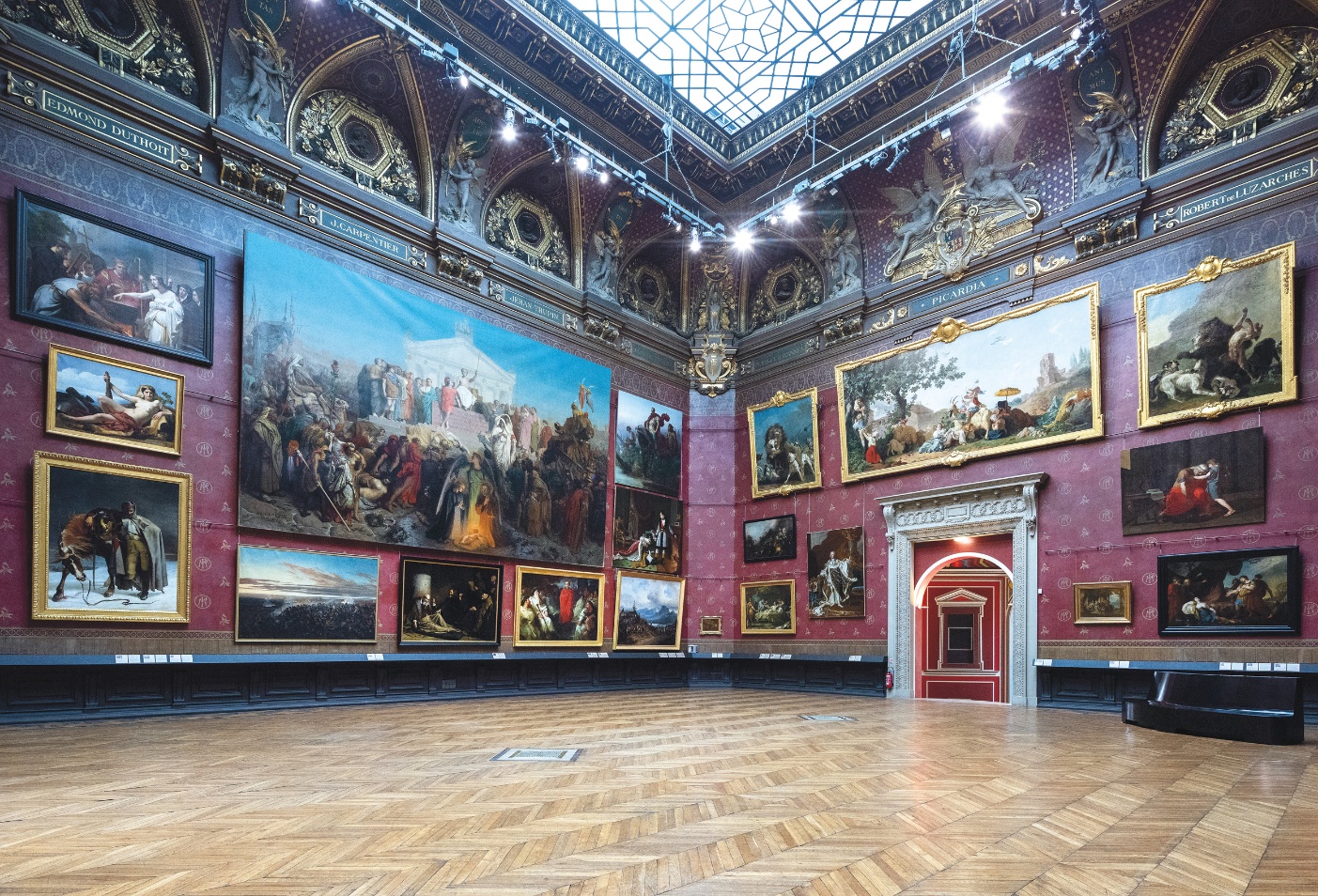
View of the Grand Salon at the Musée d’Amiens, including Jean-Léon Gérôme’s The Age of Augustus, 1855 (photograph taken in 2022).
Photo © Musée de Picardie / Alice Sidoli
As Orsay has come to embrace “the other nineteenth century” with greater equanimity, so it has shown greater willingness to consider artworks not simply as sources of aesthetic delectation but equally as witnesses to life in the past (and, indeed, interlocutors with the present). Tensions between Rebérioux and the curatorial team had focused on including historical material in a museum environment both to illuminate individual works’ meaning and to underscore ways in which artworks could offer insights about the society in which they were created. For Rebérioux, France’s emergence as an industrial economy during the years covered by Orsay was fundamental to understanding the period’s culture – hence her much-derided suggestion to exhibit a locomotive in the former station. Neither this, nor her proposal for an exhibition investigating the representation of women in visual culture, met with curatorial approval.24 Indeed, to imply that artworks could serve as historical evidence was anathema to Cachin and Laclotte, who disdained the notion that an object’s formal qualities could be eclipsed by a supposedly reductive interest in its content as a “document.” For Laclotte, “privileging the image over the work of art” ignored an artwork’s aesthetic specificity, reducing it to an “‘artistic ‘product’” in which “everything is liable to be placed on the same level.”25 Such an instrumental use of art – allegedly practiced by historians, sociologists and ethnologists – had, Laclotte maintained, even blinded art historians to the importance of identifying formal quality as the foundational purpose of their discipline.
These concerns were clearly prompted by the international prominence of the social history of art – an insurgent movement in 1986, which, by the time Laclotte looked back on his years at Orsay in 2003, had won broad institutional recognition, even in France.26 In retrospect, it seems the worm was already in the bud: with a series of “dossier” exhibitions, presented on the margins of the museum far from consecrated masterpieces, Orsay accommodated media such as caricature, book illustration and graphic imagery, as well as interdisciplinary excursions into literature, music and popular cultural topics such as bohemianism and the cabaret. Suspended in October 1997, the dossier exhibitions’ disappearance in some ways ended any attempt to integrate mass culture into the museum’s institutional narrative, a retreat that ironically coincided with art historians’ growing awareness of the historical significance of visual media, broadly conceived, and the nineteenth century’s centrality in their proliferation.27 Yet, despite their demise, the dossier exhibitions’ legacy continues to inform major thematic exhibitions that have punctuated Orsay’s program since La jeunesse des musées in 1994. With exhibitions such as Crime et châtiment (2010), Sade. Attaquer le soleil (2014) and Le modèle noir de Géricault à Matisse (2019), Orsay not only broke the taboo of mixing art with other media (books, scientific instruments, everyday objects) but embraced the notion that the museum could present artworks to advance an argument and stimulate debate. Thus Guy Cogeval, introducing Masculin-Masculin : L’homme nu dans l’art de 1800 à nos jours (2013), flatly announced: “In this exhibition, the works are indeed considered from the perspective of social and cultural history or contemporary political issues,” before paying homage to “the Anglo-American field of gender studies,”28 an accolade unlikely during Orsay’s early years. This overt break with the past was made succinctly, but with a telling choice of words, in Cogeval’s claim in 2015 that the show Splendeurs et misères. Images de la prostitution 1850-1910 (fig. 4) demonstrated Orsay’s commitment to renewing understanding of the nineteenth century with “a daring programming policy that invites visitors to think as well as to enjoy.”29 Though the smoothing irons and pile drivers allegedly proposed by Rebérioux thirty years earlier had never materialized, the show’s curatorial team did include a plethora of “documentary objects,” including a “pleasure chair,” a “box of condoms” from 1898, and a “cylindrical jar” of similar vintage. Times had indeed changed.
Fig. 4
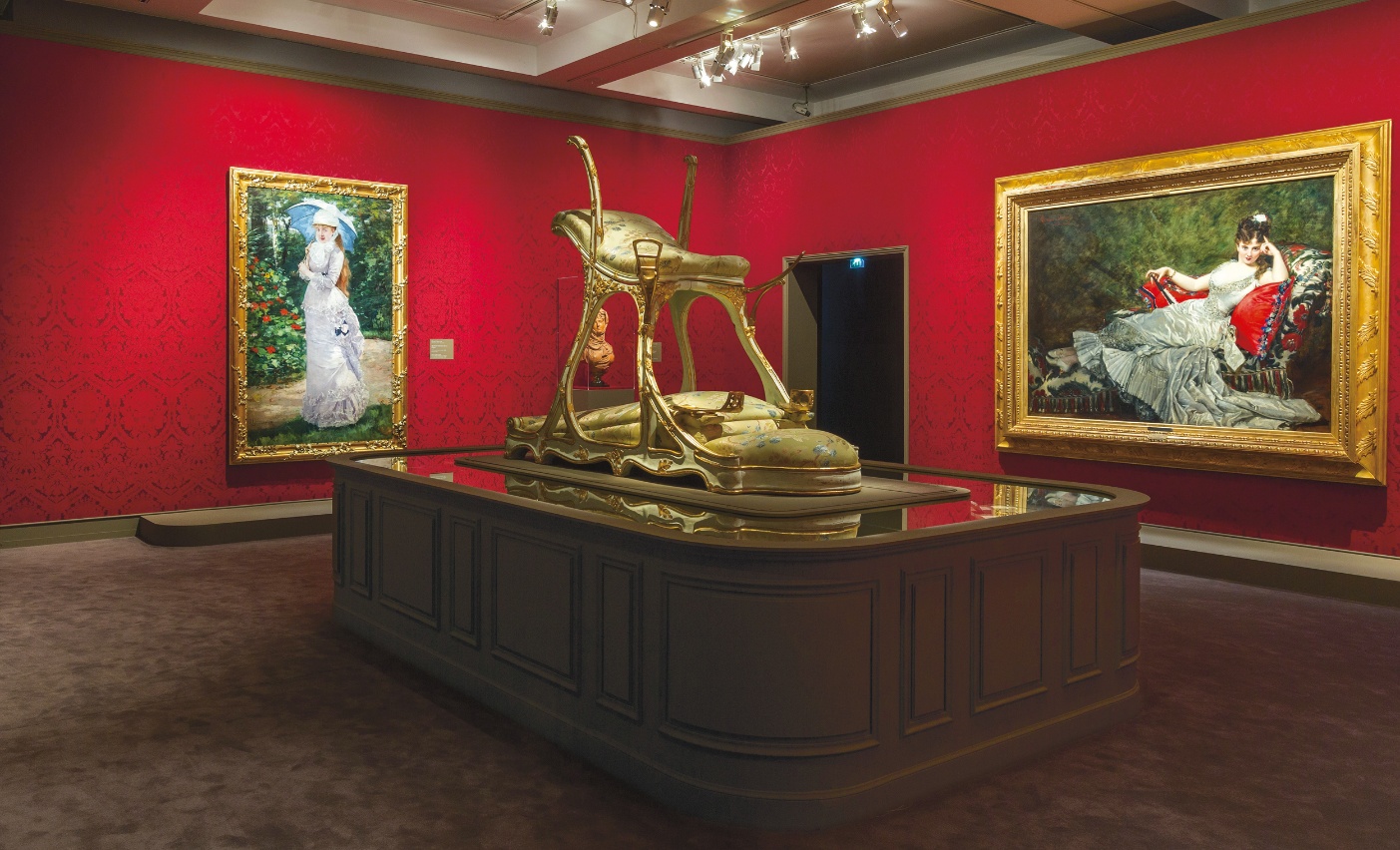
Installation view of Splendeurs et misères. Images de la prostitution, 1850-1910 at the Musée d’Orsay, held from 22 September 2015 to 17 January 2016. Room presenting Fauteuil d’amour or chaise de volupté (ca. 1890), Paris, Maison Soubrier, Madame Valtesse de La Bigne by Henri Gervex (1879, Paris, Musée d’Orsay) and the Portrait de Julia Tahl, dite Mademoiselle Alice de Lancey by Carolus-Duran (1876, Paris, Petit Palais – Musée des Beaux-Arts de la Ville de Paris).
Photo © Musée d’Orsay / Sophie Crépy
More recently, exhibitions such as Le modèle noir and Les origines du monde. L’invention de la nature au xixe siècle (2021) have embraced not only interdisciplinary perspectives but also a commitment to grappling with issues of contemporary concern. Tying the 2021 show to the climate emergency, Orsay’s president, Laurence des Cars, spelled out her belief that “art history, far from being an isolated discipline, very often mirrors the history of ideas, sensibilities and representations,” and that “a fine arts museum must engage with the major issues of its time.”30 Thus understood, the past is reanimated to speak to the present: the investigation of nature and its despoliation by industry, dual legacies of the nineteenth century, confronts viewers with a narrative in whose future unfolding they themselves are implicated. In 2025, on the eve of the museum’s fortieth anniversary, Orsay’s president Sylvain Amic, working with the curator Servane Dargnies-de Vitry, extended this activism with a project, “100 œuvres qui racontent le climat” – a joint operation with provincial galleries that used the collection to highlight how landscape imagery of the past alerts us to the devastating transformation currently underway. Once again, Amic was adamant that the museum’s role was to offer something other than a refuge from modern life: “This project is based on a firm conviction: museums have an essential role to play in connecting the public with the major issues of our time. . . More than an opportunity for reflection, this project is also a call to action.”31 Delectation has given way to debate; more than an autonomous form soliciting abstracted contemplation, the work of art stands as a witness rich in historical meaning, to be carefully decoded to unlock its revelatory significance as a spur to action.
As Orsay has become more receptive to the historical complexity of visual culture, so the museum has encouraged colleagues in neighboring disciplines to engage with the collection. In 2014, Cogeval tapped literary historian Annie Le Brun to curate the Sade exhibition, while Les origines du monde was directed by neurologist and historian of science Laura Bossi. With the Eurocentric focus of art history under increasing scrutiny, in 2021 Orsay approached Pierre Singaravélou, a specialist in the history of colonialism and globalization, to coordinate a project that, as Laurence des Cars observed, was intended to “resituate the period’s artistic production in its contexts.” Other than a publication – Les mondes d’Orsay – Singaravélou participated in a brief lecture series involving such eminent historians as Christophe Charle, in which global cultural exchange was analyzed from multiple angles.32 Though a step in the right direction, such outreach risks seeming little more than a superficial gesture in which history is introduced as a temporary theme rather than as a methodological – and museological – cornerstone, as Rebérioux had initially proposed. Appeals to historians to provide missing “context” also suggest a striking failure to recognize how far art historians have come in recent decades, proving themselves increasingly capable of addressing visual culture’s historical meanings through their own research and methodologies.
As a discipline, art history has experienced substantial change over the last forty years. The ideological conflicts of the 1980s have largely dissipated, though explorations of gender, race and sexuality have become newly contentious in the face of mounting intolerance and intellectual obscurantism. In recent decades, the nineteenth century has been overshadowed by the study of contemporary art, but the ferment that marked exploration of the period continues to inspire new approaches. In France, generational change has fostered what art historian Pierre Wat has described as a rising cohort of young scholars committed to “a history of art that is decompartmentalized – open.”33 Orsay has played a constructive role in nurturing this process, both through its Friends’ support of doctoral students and through the establishment in 2006 of the Prix du Musée d’Orsay, which subsidizes publication of outstanding dissertations in areas covered by the collection. The range of awards made over almost twenty years demonstrates the vigor of nineteenth-century studies, but also indicates how new methodologies – notably drawing on visual culture, quantitative history, reception studies and digital humanities – are fundamentally challenging received narratives in ways that seemed unlikely in such a setting forty years ago. Béatrice Joyeux-Prunel, award winner in 2007, for example, has cogently argued for decentering Paris as artistic “capital of the nineteenth century” in favor of a more fluid and complex reading of professional interactions, concluding that “the center of modernity around 1900 was […] not a city (Paris), but a social network” – a contention, buttressed by extensive statistical and prosopographic research that stands in marked contrast with the museum’s founding ethos.34 Similarly, Léa Saint-Raymond, laureate in 2019, challenges received ideas of the Parisian art market and its relation to artists’ career trajectories across the key decades from 1830 to 1939, through interdisciplinary research that engages with economic analysis and sociological theory.35 These and other projects supported by Orsay demonstrate the untapped potential of a discipline willing to look beyond outdated definitions of what art historians’ legitimate concerns should be – a potential that the inauguration in 2027 of the expanded Centre de ressources et de recherche Daniel Marchesseau will further advance.
Fig. 5
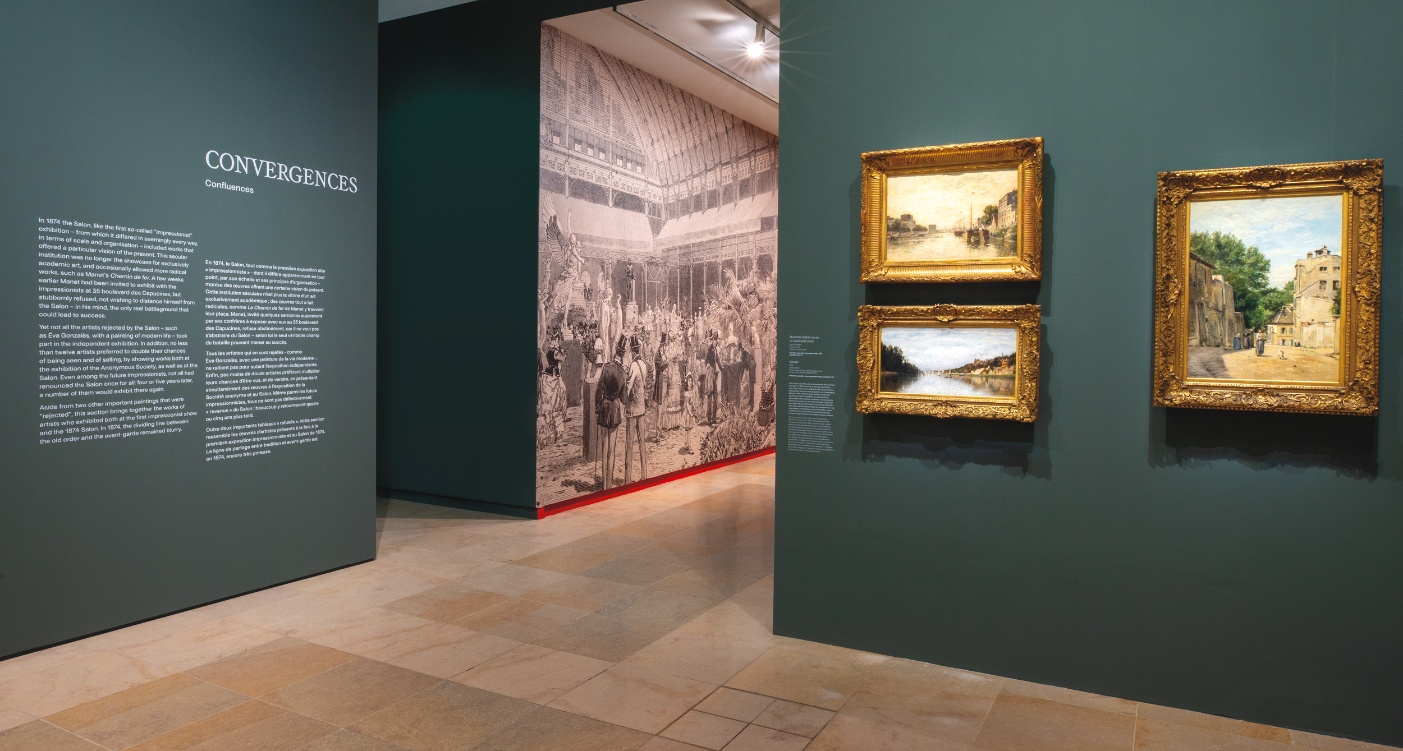
Installation view of the exhibition Paris 1874. Inventer l’impressionnisme, organized in Paris at Musée d’Orsay, from 26 March to 14 July 2024. The “Convergences” room brought together works by artists exhibited both at the first Impressionist exhibition and the Salon of 1874, showing a porous boundary between tradition at the avant-garde in 1874. Hung at right are three works by Stanislas Lépine: The Canal Saint-Denis (ca. 1876–1882, private collection); Landscape (1869, Paris, Musée d’Orsay), and Montmartre, rue Saint-Vincent (1873–1878, Paris, Musée d’Orsay).
Photo © Musée d’Orsay / Sophie Crépy
In some ways, the 2024 show Paris 1874. Inventer l’impressionnisme (fig. 5) highlighted the distance travelled by the Musée d’Orsay since 1986. The Impressionist collection, previously transferred in 1947 to the unsatisfactory setting of the Jeu de Paume, had indeed provided the key motive for converting Victor Laloux’s station into a museum and was the curatorial cynosure of the whole operation. Carefully displayed in splendid isolation on the fifth floor, the Impressionists were physically and metaphorically elevated above their contemporaries, whose reputed antagonism to the liberation of painting by the avant-garde lent them an aura of disapproval that the museum’s founders did little to dissipate. Almost forty years later, this heroic narrative has been side-lined by a nuanced contextualization that discredited many previous pieties and idées reçues. Emphasizing overlaps, continuities and equivocations, the show broke inherited taboos by bringing Impressionist canvases into proximity with Salon art, arguing that the aesthetic demarcations and reputational distinctions that accompanied the Impressionists’ elevation to the modernist canon needed a fundamental overhaul. Albeit belatedly, the exhibition drew on work from recent decades by historians and art historians whose scholarship has mapped out a new understanding of the Impressionists and their contemporaries, often in the face of withering criticism in France.36 Following some years of diminished activity, the exhibition built upon renewed interest among French scholars, such as Ségolène Le Men, and initiatives like the Normandie Impressioniste festival, initiated in 2010, pointing the way for renewed study of the period and serving as an exemplary instance of synergy between the international academy and museums. Beyond delectation (though by no means disdainful of it), Paris 1874 amply fulfilled Rebérioux’s insistence that, in an institution like Orsay, true pleasure derives from comprehension and explanation.
Forty years on, then, things have changed – and, I would argue, have done so for the better. Yet, as is probably inevitable for an institution of its size and prominence, Orsay can still give the impression of grappling with its foundational contradictions. After initially rebuffing any meaningful integration of history, the museum has gradually, though haltingly, begun to approach its contents as part of a century whose sociopolitical forces inevitably shaped their nature as cultural products appealing to a market, rather than as hermetically sealed expressions of the artist’s individual sensibility. Yet, if the formalist values bequeathed by Cachin and Laclotte have retreated, their rarefied approach to art has proved less vulnerable to the intrusion of history than to what Cachin lamented, during a final interview in 2011, as the growing dominance in the museum world of “a business-oriented, if not downright commercial, mindset.”37 Aesthetic contemplation as well as historical rumination have been subordinated to market forces as private sponsorship eclipses state support, and the sovereignty of the eye is usurped by the unblinking gaze of the cell phone, avidly pursuing culture as spectacle and shareable moment.