Orsay Before Orsay: Historiographical and Museological (Re)visions of Nineteenth-Century Painting in France

  • Orsay avant Orsay. (Ré)visions historiographiques et muséales de la peinture du XIXe siècle en France

DOI : 10.54390/r4814.152

Translated from:
Orsay avant Orsay. (Ré)visions historiographiques et muséales de la peinture du XIXe siècle en France

Abstracts

This article explores the intellectual and historiographical antecedents of the Musée d’Orsay project by surveying the main discourses that informed nineteenth-century art history in France during the fifty years before the museum’s opening. A comparative examination of publications, articles and museum displays produced by curators and art historians reveals a dominant narrative centred on the avant-gardes and constructed as a genealogy of modernity. At the same time, alternative narratives developed alongside this: inclusive, nostalgic or local reinterpretations, as well as those prompted by the need to save works from physical deterioration, emerged around academic and official artists. Seen in the context of these developments, the Orsay’s programme can be reassessed in terms of both rupture and continuity, the expansion beyond a canonical corpus and the persistence of a specifically modernist interpretative framework.

Cet article explore les origines intellectuelles et les antécédents historiographiques du projet du musée d’Orsay en dressant un panorama des principaux discours ayant façonné, en France, l’écriture de l’histoire de l’art du xixe siècle au cours des cinquante années précédant son ouverture. L’étude croisée des ouvrages, articles et présentations muséales réalisés par les conservateurs et historiens de l’art met en évidence un récit dominant centré sur les avant-gardes et construit comme une généalogie de la modernité. Toutefois, des contre-récits s’élaborent en parallèle : des relectures inclusives, nostalgiques, locales ou liées à la nécessité de sauver les œuvres d’une dégradation matérielle, émergent autour des artistes académiques ou officiels. Situer le programme d’Orsay dans le prolongement de ces développements invite à reconsidérer ses positions de rupture et de continuité, entre élargissement d’un corpus canonique et persistance d’une grille de lecture moderniste.

Outline

Text

‘No, we can rest assured: Manet and Cézanne no longer have to fight Bonnat and Gérôme’,1 writes Michel Laclotte in his Souvenirs, recalling the debates surrounding the 1986 opening of the Musée d’Orsay, whose early development he oversaw. With this remark, he underscores the endeavour’s symbolic significance and alludes to criticism from those who viewed the juxtaposition of so-called academic art with the avant-gardes as a challenge to the latter’s superiority. These categories are loaded, conveying moral and ideological values. The term ‘academicism’ emerged in 1840 as a critique of the systems and ideals of the Académie des Beaux-Arts, which at the time opposed Romanticism and sought to curb departures from tradition.2 Its pejorative meaning became more pronounced during the Second Empire, particularly in the writings of art critics.3 Official art, meanwhile, denotes works that received state approval.4 Often conflated, these concepts soon came to encompass a wide range of artists and were grouped under the disparaging term ‘art pompier’,5 at least from the 1880s onwards,6 in contrast to developments considered avant-garde. Originating in military and then political vocabulary, this latter expression entered the artistic register through art criticism in the 1880s.7 ‘Avant-garde’ implies a position of defiance vis-à-vis official institutions and a rejection of artistic norms inherited from the past. At the beginning of the twentieth century, this began to occupy a higher position in the value hierarchies of historical narratives.8

The dichotomy between academicism and the avant-garde remains structural in histories of nineteenth-century art in France, as it does in the Musée d’Orsay’s programme. Artists regarded as academic and official are represented there, but are distinct from the avant-garde, which ‘remain a unit’.9 Although their coexistence prompted debate when the museum opened,10 this ‘reconstruction’11 of the nineteenth century had in fact been under way, less conspicuously, since the 1950s. This article seeks to qualify the widely accepted narrative that entire areas of nineteenth-century painting attracted little interest before the Orsay opened by identifying historiographical and museological moments in which a fuller and more complex picture of the period began to emerge.

Examining the discourse in France around painting from the period 1848 to 1914, among art historians and curators during the fifty years preceding the Musée d’Orsay’s opening, this article considers the intellectual antecedents of the museum’s programme. While acknowledging that debates on the nineteenth century developed internationally,12 this study focuses on France, and primarily on its capital, while including noteworthy examples from museums elsewhere in the country that may qualify or contradict the dominant Parisian narrative. This choice attests to the central place occupied by collections exhibited in Paris as both reflections and vehicles of an artistic hierarchy, as well as the major role played by Parisian institutions in formalising a narrative structured around the avant-gardes and in training the first protagonists of the Musée d’Orsay. By focusing on the tension between academic art and the avant-garde, the study situates the Orsay project in a longer history of historiographical and museological visions and revisions of nineteenth-century painting, understood here as critical reassessments of the canon and artistic hierarchies.13

Before Orsay: Knowledge, Expectations and Visibility of the Late Nineteenth Century?

At the beginning of the twentieth century, accounts of painting from the second half of the nineteenth century were generally structured around major figures associated with what were interpreted as ruptures in the chronology: Gustave Courbet and Realism around 1855, Édouard Manet at the Salon des Refusés in 1863 or, in the 1870s, Claude Monet and Impressionism. In 1914, in his introduction to Du romantisme au réalisme, Léon Rosenthal explained his decision to discuss ‘mediocre canvases’ alongside famous works because of their ‘documentary function’, and to cite contemporary criticism of the works so as to avoid judging them according to ‘[his] own feelings or the esteem in which [they were then] held.’14 In other surveys, such as one by Louis Vauxcelles and André Fontainas, both defenders of the avant-gardes of their day in 1922, the nineteenth century’s academic side was mentioned in only a few lines, the authors ‘justly and deliberately passing over it in silence’.15 Other books nevertheless devoted more space to these artists, treating them with varying degrees of severity: in 1926, Louis Dimier described the characteristics of Ernest Meissonier and Jean-Léon Gérôme, whom he associated with the ‘minor genres’,16 without crediting them with much originality; two years later, Henri Focillon devoted substantial passages, though not without value judgements, to academic artists in a chapter on ‘eclecticism’;17 and in 1930 René Schneider gave over a chapter to ‘idealist art’,18 even expressing cautiously positive opinions of certain paintings by Gérôme and Paul Baudry.19 These early narratives either convey an overall negative judgement of academicism or omit it altogether.

Over the following decades, academic artists were increasingly relegated to the margins of publications and museum displays, while Impressionism began its emergence as a recognised part of France’s artistic heritage at the Orangerie des Tuileries in 1927. The Musée Claude Monet was created there to house the artist’s grandes décorations, which he donated to the state and which initially met with a mixed reception.20 In the 1930s, the museum also organised retrospectives devoted to representatives of the movement. Following the 1937 closure of the Musée du Luxembourg, which since 1818 had exhibited works acquired by the state from living artists, the museum’s collections were distributed among various institutions. Of those transferred to the Louvre, Impressionist and Post-Impressionist works were selected for display at the Galerie du Jeu de Paume, renamed the ‘Musée de l’Impressionnisme’ in 1947. Another portion of the collections was displayed at the Musée National d’Art Moderne starting that same year, while works considered less important were either placed in storage or dispersed among museums, churches, town halls and prefectures in cities across France. This was the case, for instance, with Henri Lévy’s Sarpédon,21 acquired by the state for the Musée du Luxembourg in 1874, deposited at the Musée de Chambéry in 1926 and then at the city’s courthouse between 1958 and 1974,22 before being assigned to the Musée d’Orsay in 1983. A significant proportion of academic works followed similar trajectories.23 Parisian museums therefore presented a truncated and fragmented nineteenth century, reduced to key figures illustrating the idea of rupture within a stylistic evolution.

Yet the isolation of the Impressionist collections on the other side of the Tuileries was not necessarily perceived as a mark of enhanced status at the time. As early as 1945, Rose Valland, an assistant at the Musée du Jeu de Paume, lamented this separation from the rest of the Louvre’s collections, fearing it might seem that the institution was ‘rejecting [Impressionism], or at least underestimating it.’24 Only gradually did this distance acquire a positive connotation in the writings of Louvre curators such as René Huyghe, Germain Bazin and Michel Florisoone, as Impressionism increasingly became an instrument of French cultural influence, associated with values of independence and freedom in the immediate post-war period.25 The presentation of this series of paintings in a separate building was then justified by its exceptional nature, positioning it both as a body of work that broke with the art preceding and contemporary with it and as a pivotal moment in the emergence of modern art.26 Successive changes to the museum display – greater spacing between works, pale walls and natural lighting (fig. 1) – reinforced this association with modernity.27 This arrangement contrasted sharply with that of the Musée du Second Empire, inaugurated at the Château de Compiègne in 1953, where works by Franz Xaver Winterhalter, Alexandre Cabanel and Alfred Stevens28 were instead incorporated into reconstructions of historical galleries (fig. 2).

Fig. 1
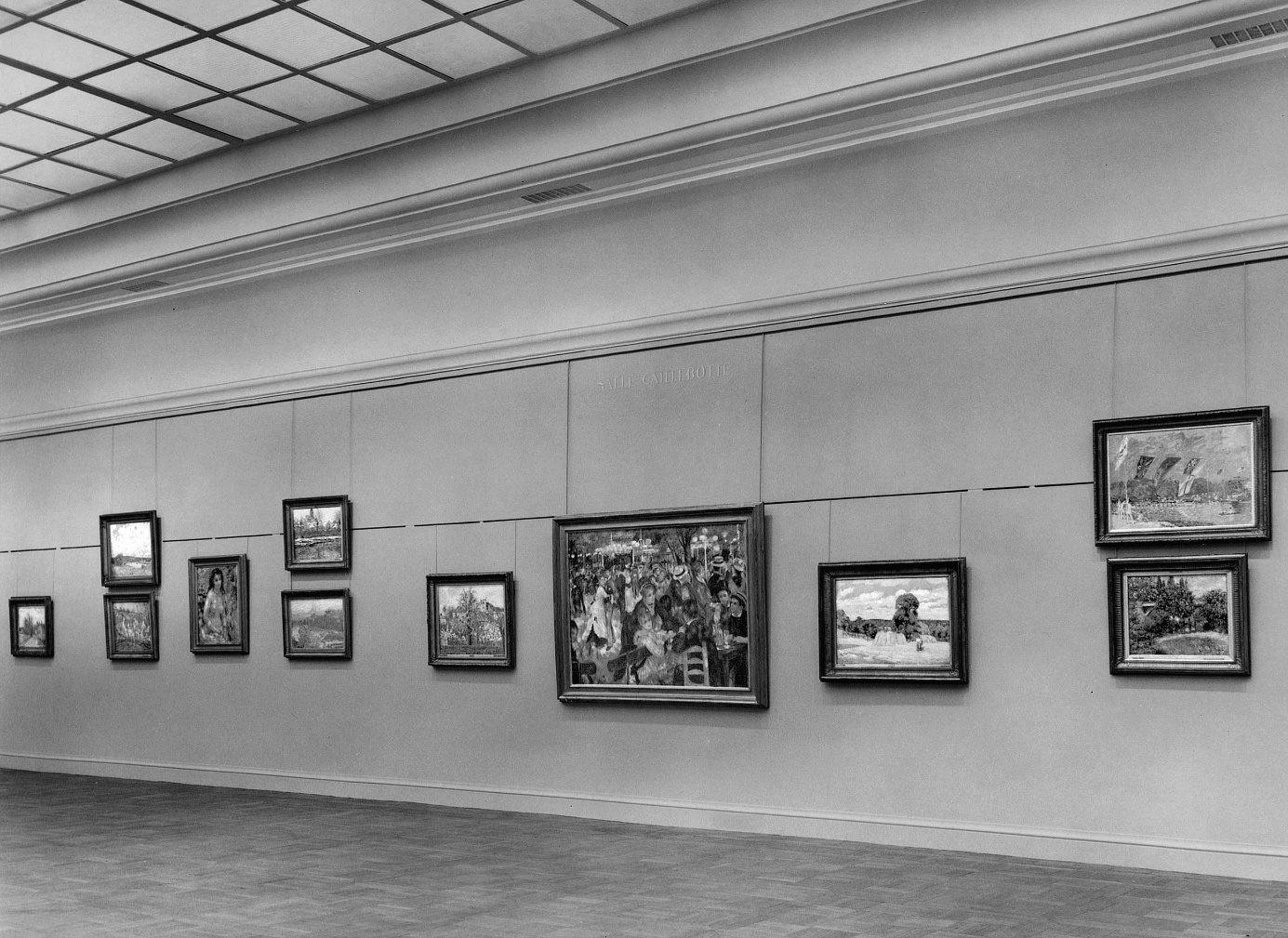
This old black-and-white photograph shows the wall of a light-coloured museum room. About ten Impressionist paintings are arranged on the wall. Among them are a few by the painter Renoir, including the famous Bal du moulin de la Galette. The top of the wall bears the inscription “Salle Caillebotte”. On the ceiling, the panes of a glass roof can be made out.

View of the Galerie Caillebotte on the first floor of the Musée de l’Impressionnisme, Galerie du Jeu de Paume, 1958, photographs from the Musée du Jeu de Paume et de l’Orangerie, gelatine silver print on paper [dimensions unknown], photograph by Agraci, Pierrefitte-sur-Seine, Archives Nationales, 20144659/160.

Photo All rights reserved

Fig. 2
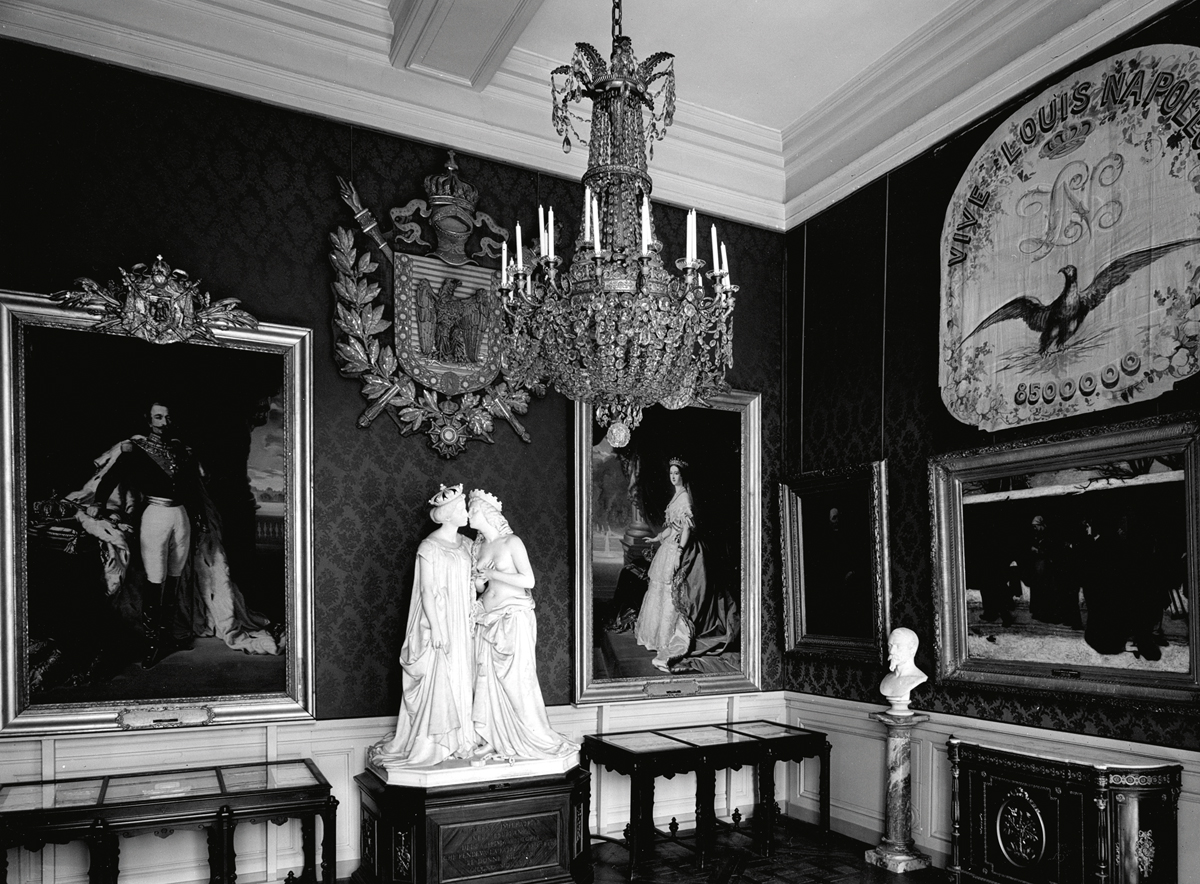
This old black-and-white photograph shows a museum exhibition space with the appearance of an old aristocratic drawing room. The walls are covered with a wall hanging decorated with regular floral motifs, mouldings are visible on the walls and ceiling, and an immense chandelier hangs in the middle of the room. On the walls are hung various nineteenth-century paintings, including imperial portraits, as well as the imperial coat of arms, and various sculptures and display cases are presented in the room. Between two paintings on the back wall is a large sculpted group showing a couple in a hieratic pose, dressed in long drapery and wearing crowns on their heads, embracing. The whiteness of the sculpture contrasts with the dark atmosphere of the room.

View of the Italy room at the Musée du Second Empire in Compiègne, between 1964 and 1969, photographic print, Compiègne, Château de Compiègne Archives.

Photo © GrandPalaisRmn (Domaine de Compiègne)

The polarisation between art regarded as academic and the avant-garde intensified in the 1950s. At the time, studies of art in the second half of the nineteenth century often followed a logic that set out a genealogy of modernity, influenced in particular by John Rewald’s accounts of Impressionism and Post-Impressionism.29 By the late 1960s, however, ‘the other nineteenth century’ was sometimes being reintegrated into the dominant narrative. In 1969, Bernard Dorival, a former director of the Musée National d’Art Moderne, wrote in Histoire de l’art. Du réalisme à nos jours (a volume of the Encyclopédie de la Pléiade) that, ‘unlike [what is done in] most other histories’,30 he intended to ‘recall [the] existence [of academic artists]’ and ‘briefly [define] the movement to which they belonged’, a task he considered ‘thankless’ but also ‘indispensable’. A year later, a generously illustrated chapter was devoted to ‘pictorial academic naturalism’31 in L’art et le monde moderne, edited by Huyghe and Jean Rudel. Academic art was thus gradually incorporated into the structure of a history whose writing remained to some extent the prerogative of curators at the leading Parisian institutions.

Re-visions of the Nineteenth Century: Parallel Counter‑Narratives

Alongside this discourse favouring a modernist reading, another history was developing, albeit less visibly, centred on the academic and official artists of the Second Empire and Third Republic. In 1922, Paul Alfassa organised the large-scale exhibition Le décor de la vie sous le Second Empire at the Musée des Arts Décoratifs in Paris, believing that historical distance made it possible to recognise the period’s significance.32 Alfassa laid the foundations for an initial retrospective reassessment of this body of work and began to develop a more inclusive vision33 of the period by displaying official and avant-garde artists together, reconstructing interiors and creating an atmospheric setting using colourful period damasks.34 A similar approach did not re-emerge until 1953, with the exhibition Le temps des crinolines.35 Once again, different aesthetics were brought face to face: Courbet’s The Spring36 and Cabanel’s The Birth of Venus37 were shown together in the introductory room devoted to the feminine ideal, with the aim of ‘understanding the evolution of society and morals’.38 That same year, Un siècle d’art français used the Petit Palais collections to present a section on official art during the Third Republic, bringing together Baudry, Léon Bonnat and Carolus-Duran. The catalogue explained that these artists could be of value to us ‘by bearing witness […] to their era’.39 Before being appreciated for their artistic qualities, these paintings appear to have been considered for their documentary value.

Similar initiatives multiplied between the 1950s and 1970s. In 1957, Le Second Empire. De Winterhalter à Renoir at the Musée Jacquemart-André brought together ‘painters who all lived at the same time, but belonged to two different classes’,40 this time to reconsider the notion of rupture. Intended to attract more visitors and ‘provide [this museum] with the resources essential for restoring the premises and collections’,41 the exhibition conveyed a nostalgic and positive view of the period.42 Following a similar typological approach, exhibitions were organised in Nice and Vichy in 1960 and 196143 to commemorate historical events. At the same time, some towns chose to pay tribute to ‘forgotten’ artists born locally, such as Léon Belly in Saint-Omer, on three occasions,44 and Amaury-Duval in Montrouge.45 This perspective on the nineteenth century can be described as circumstantial: it enabled municipal institutions to promote local history and collections, and even to restore certain works,46 while requesting loans of works outside the modernist canon.47 Legitimated by their connection to place and often associated with the political history of the Second Empire, these narratives differed from the reassessments developing simultaneously in the United States, which proposed an aesthetic reconsideration of a more diverse and expansive nineteenth century.48 Some approaches remained more ambiguous, moreover, and the term équivoque in the titles of two presentations at the Musée des Arts Décoratifs in Paris and then the Musée des Beaux-Arts de Bordeaux, in 1973 and 1975, may reflect uncertainty surrounding this new appreciation.49

During the 1960s, a more incisive reassessment developed in France. Some art historians and curators, including Thérèse Burollet, then working at the Musée d’Art Moderne de Paris and later the Musée Cognacq-Jay, openly questioned Impressionism’s supremacy. In the 1965 edition of the Musée de l’Impressionnisme’s collection guide, she argued that the institution ‘could more justifiably be called the “Museum of the Late Nineteenth Century” [Musée de la Fin du xixe siècle] if it did not completely neglect the representatives of official art’50 and asserted that ‘Monet’s Women in the Garden [fig. 3] is scarcely more modern than Winterhalter’s The Empress Eugénie Surrounded by Her Ladies-in-Waiting [fig. 4].’51 Her article ‘Antidisestablishmentarianism’, published two years later, defended these artists’ stylistic diversity and technical skill while condemning the neglect with which their works were conserved.52 At the same time, Bruno Foucart repeatedly spoke out against the destruction of a disparaged nineteenth-century legacy; the 1971 dismantling of Victor Baltard’s pavilions in Paris fed this rhetoric of a heritage under threat.53

Fig. 3
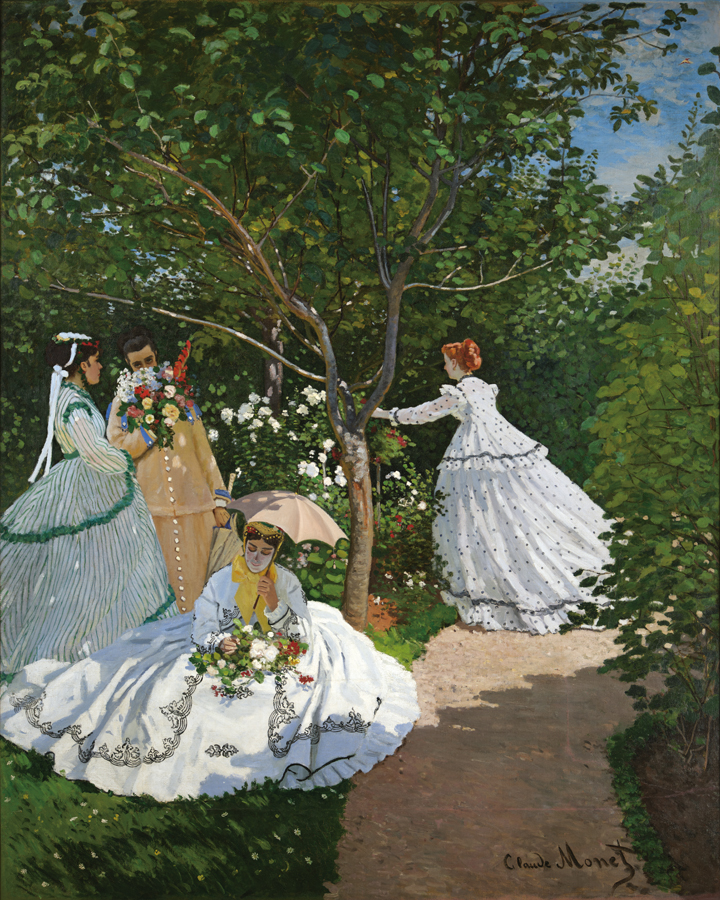
This large colour painting depicts an outdoor scene, in a garden of which we see a path, a lawn, a tree and a few thickets. The scene is brightly lit by the sun. Four people are visible, in simple summer clothes in light colours, each seeming caught in the moment. In the foreground, a woman sits on the lawn: she holds a parasol above her head and looks down at the bunch of flowers she has set on the large embroidered white skirt of her dress. Another, at the far end of the path, seems to be moving away and has her back to us. Behind the seated woman, a man and a woman seem to be talking. The man’s face is partly hidden by the bunch of flowers he holds in front of him. The scene seems captured from life, the brushwork is broad, and motifs are suggested by quick touches, characteristic of the Impressionist style.

Claude Monet, Women in the Garden, ca. 1866 (1867?), oil on canvas, 255 × 205 cm, Paris, Musée d’Orsay, state purchase from Monet for the Musée du Luxembourg in 1921, RF 2773.

Photo © Musée d’Orsay (dist. GrandPalaisRmn) / Laëtitia Striffling-Marcu

Fig. 4
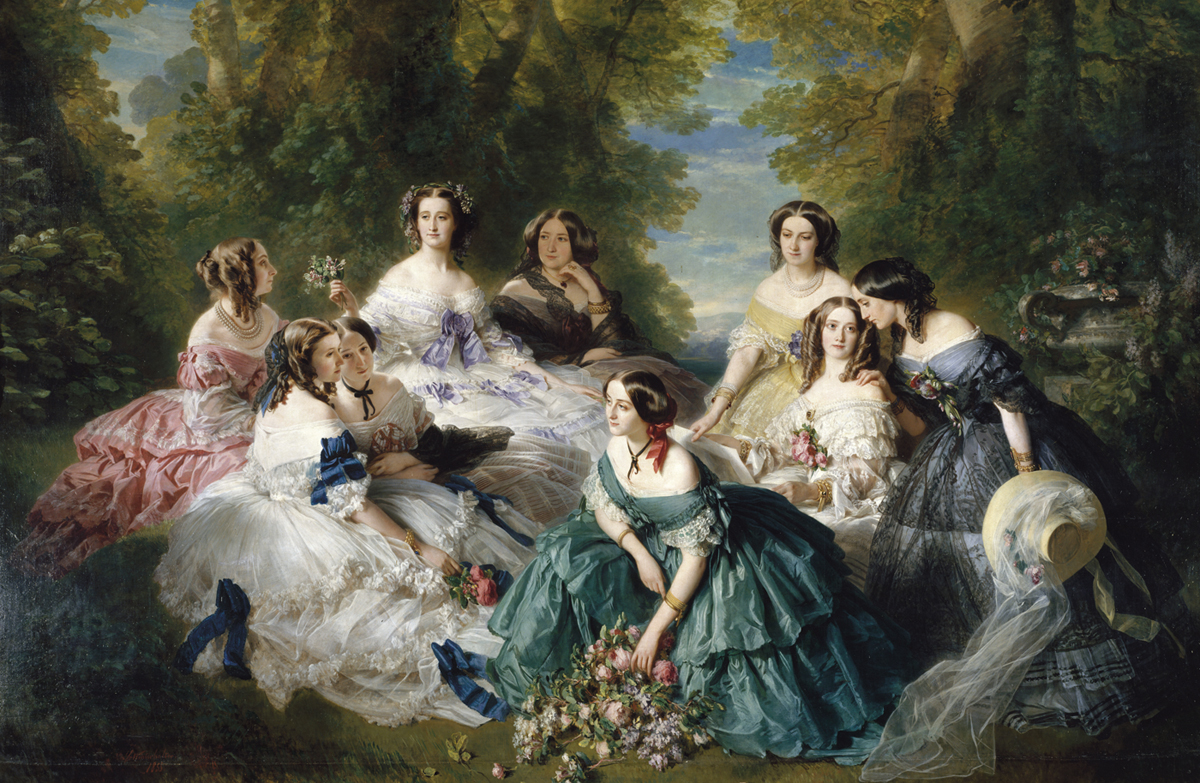
This colour painting depicts a clearing in a forest in the middle of which nine women are seated in a circle, as if in a setting. Their luxurious dresses of precious fabrics in varied colours, with flounces, bows and lace, as well as their sophisticated hairstyles, suggest that they belong to the very highest ranks of the aristocracy. Many of them hold flowers. Their various poses animate the scene, but the whole remains solemn, as if they were preparing themselves before the painter’s brush to form a coherent scene. On the right, the empress stands slightly more majestically. The brushwork is very meticulous, and the whole is painted with great precision and numerous details, notably the transparency of certain veils and garments.

Franz Xaver Winterhalter, The Empress Eugénie Surrounded by Her Ladies-in-Waiting, 1855, oil on canvas, 295 × 420 cm, Compiègne, Musée National du Château de Compiègne, gift of Baroness d’Alexandry d’Orengiani to the Musée de Malmaison and deposited in Compiègne in 1952, MMPO 941.

Photo © GrandPalaisRmn (Domaine de Compiègne) / Daniel Arnaudet

It was in this context, in 1974, that Centenaire de l’impressionnisme shared the Grand Palais with the exhibition Le musée du Luxembourg en 1874. Peintures, installed in the other wing.54 The latter was directed by Geneviève Lacambre, curator of paintings at the Louvre, who hoped that the two exhibitions’ simultaneity would make it possible to ‘revise the image we have of nineteenth-century art’.55 This presentation of the period’s official art was underpinned by meticulous research: each of the catalogue’s 240 entries included an artist biography and an account of the work’s history, and this was the first time that many of the paintings in it had appeared in print. Five years later, Lacambre co-organised L’art en France sous le Second Empire, again at the Grand Palais, seeking an ‘entirely new and fairer appreciation’56 of a period that ‘exists, artistically speaking’.57 This revisionist undertaking also translated to monographic retrospectives in the 1980s.58

All these varied initiatives offered a broader vision than the dominant corpus founded on figures regarded as heralding twentieth-century art. In the 1970s, these positions were grouped under the term ‘revisionism’, encompassing highly diverse methodological approaches and ideological foundations.59 Yet hybrid forms of these revisionist approaches had appeared as early as the 1950s, complicating a categorization that describes an effort to deconstruct the canon and rehabilitate artists excluded from it.

The Orsay’s Position: Revision, Expansion or Reformulation of the Modernist Narrative?

The Musée d’Orsay’s decision to exhibit academic artists therefore did not emerge ex nihilo; rather, it crystallised these earlier reassessments and broadened the visible corpus of nineteenth-century art while retaining a modernist hierarchy. This compromise was apparent even in the development phase. The curatorial team in charge of planning the museum’s programme was assembled by Laclotte, who was responsible for its scholarly direction. From 1978 onwards, he brought several advocates of academic artists – Lacambre, Jacques Thuillier, Bruno Foucart and Jacques Foucart – onto the governing boards,60 alongside specialists in Impressionism and Post-Impressionism such as Hélène Adhémar, Sylvie Patin and Anne Distel, curators at the Musée de l’Impressionnisme and the Orangerie.

The decree of 20 March 1978 stipulated that the museum was to present ‘artistic production from the second half of the nineteenth century and the early years of the twentieth century’.61 Several chronological boundaries and display schemes were considered. One proposal discussed in 1983 was to devote the first rooms to the Salons of the 1860s, both the official Salon and the Salon des Refusés. Bruno Foucart argued that ‘popular expectations […] focus on art pompier’,62 which Thuillier likewise believed ‘foreign visitors’63 wanted to see. This comment alluded to approaches developed outside France, where Thuillier observed greater interest in academic art.64 Examples abounded: individual retrospectives of Gérôme and William Bouguereau developed earlier in the United States, where these artists found a place in museums without being positioned as a counterpoint to the avant-gardes.65 In the minds of those planning the Orsay, academic art was something the public expected to find at the new museum.

Fig. 5
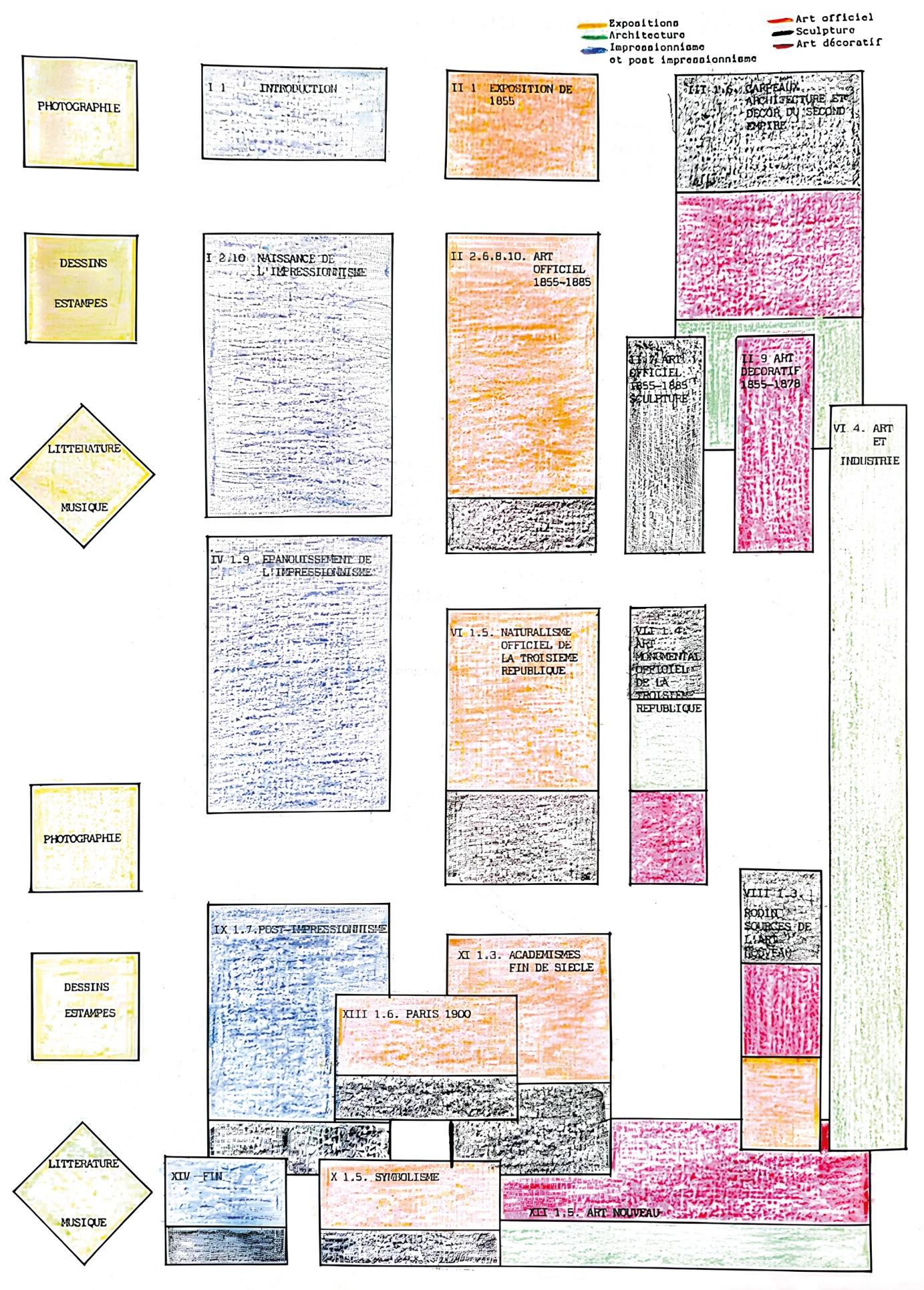
This image is a schematic plan showing rectangles in which are written, typed on a typewriter, the names of the artistic movements that will be represented in the corresponding rooms, for example “épanouissement de l’impressionnisme”, “académismes fin de siècle”, “Paris 1900”, “post-impressionnisme”, “symbolisme”, “art officiel”, “art et industrie”, etc. At the top, a rectangle with the word “Introduction”. At the bottom, another with the word “Fin”. On the left, smaller rectangles with “photographies”, “dessins estampes”, “littérature musique”. These rectangles are coloured in by hand, in coloured pencil, so as to correspond to a classification given in the legend: yellow for exhibitions, green for architecture, blue for Impressionism and Post-Impressionism, red for official art, black for sculpture, black and red for decorative arts.

[Michel Laclotte?], Hand-drawn diagram showing the distribution of the exhibitions and the themes of architecture, Impressionism and Post-Impressionism, official art, sculpture and decorative arts in the Musée d’Orsay’s museographic programme, 1979, Pierrefitte-sur-Seine, Archives Nationales, 19950142/2.

According to a 1979 diagram (fig. 5), one of the earliest display proposals balanced Impressionism and Post-Impressionism (in blue) against ‘official art’ (in orange), which encompassed everything outside the former movements. It was already clear that these two groups would remain distinct, like parallel paths. In 1986, the display gave material expression to the superiority of the former movements, placed beneath the glass roof on the building’s top floor, while academic works were hung more densely in the artificially lit ground-floor rooms (fig. 6). Laclotte acknowledged this, explaining ‘The fact that we placed Cézanne, Gauguin and Monet in very good light and in much more spacious galleries unmistakably reflects our hierarchy.’66 This arrangement carried on museographic traditions that treated the two sides of the nineteenth century separately.

Fig. 6
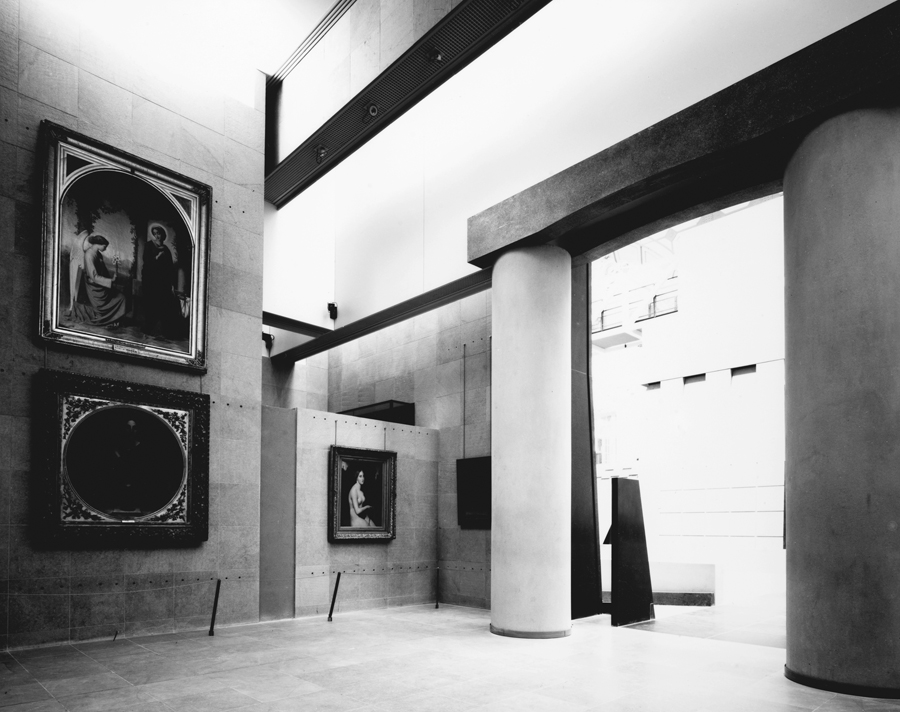
This old black-and-white image shows a museum room. The walls are light in colour, with large blocks of stone. The various gallery walls, the door, the ceiling… show rather massive architecture. The entrance to the room is framed by two heavy columns and topped by a thick lintel. The whole gives a rather pared-down effect with strong lines. Four paintings are hung on the walls, three of which are recognisable as by Ingres.

Jim Purcell, Gallery Devoted to Ingres and Ingresque Art, 1986, gelatine silver print, 21 × 27 cm, Paris, Musée d’Orsay Documentation, ODO 1996 22 1158 T. From left to right: The Annunciation (1860) by Amaury-Duval; The Virgin Adoring the Host (1854) and Venus at Paphos (1852) by Ingres.

Photo © Musée d’Orsay (dist. GrandPalaisRmn) / Jim Purcell

The modernist canon nevertheless opened up to other movements whose integration attracted less attention than that of academicism, with which they had initially sometimes been associated. Honoré Daumier, Jean-François Millet and the Barbizon School, Symbolism, Pierre Puvis de Chavannes and the Nabis all found a place at the Orsay following initial reassessments from the 1950s to the 1970s. The breakdown of the academicism-versus-avant-garde binary was also accompanied by an expansion beyond the national framework. Since the closure in 1946 of the Musée des Écoles Étrangères, housed at the Jeu de Paume, works by non-French artists that had entered the national collections at the beginning of the century had received only limited and fragmented visibility, divided between the Musée National d’Art Moderne, certain regional museums and storage. Although European painting was regularly the focus of temporary exhibitions in Paris,67 acquisition policies paid it only marginal attention until Laclotte arrived at the Louvre in the 1970s.68 In 1978, his list of gaps in the collections included the following note: ‘Munch/Klimt/Belgians Khnopff Ensor/Swiss Hodler/importance in themselves and in relation to French art’.69 This international approach to the period also had precedents, such as Les sources du xxe siècle,70 an exhibition presented by Jean Cassou and Albert Châtelet at the Musée National d’Art Moderne in 1960, which called for a renewed history of European art in the tradition of Focillon’s work.71

The clearest point of tension in discussions of the programme concerned the integration of historical context into the presentation of the works. The historical reference points and documentary displays devised by Madeleine Rebérioux and Chantal Georgel were not presented alongside the works but in dedicated spaces72 because the curatorial team feared that the intrusion of history would deprive the works of their autonomy.73 This disagreement had less to do with the museum’s content than its methodological approach: the dominant methodologies – those of the Parisian curators – remained attached either to a psychological reading, in the case of Huyghe and Dorival, or, for Adhémar and Patin for example, to biographical and contextual analyses that paid close attention to documents. The museum nevertheless opened at a historiographical turning point, characterised by the coexistence of recent studies that used divergent methodologies to address previously under-explored subjects: the role of prints for Michel Melot,74 artistic sociability for Jean-Paul Bouillon75 and, for Marie-Claude Genêt-Delacroix, analysis of the artistic field’s institutional, social and ideological structures.76 Among these studies, Pierre Vaisse’s 1980 doctoral dissertation examined relations between public authorities and painting during the Third Republic; in considering the conditions under which artworks were produced and their institutional contexts,77 he placed himself in the tradition of a foundational figure such as Rosenthal.78 In the United States, a critical overhaul of methods was undertaken earlier and along lines distinct from French historiography: while Timothy J. Clark foregrounded the historical and ideological structures at work in artistic production through a Marxist approach,79 Albert Boime documented the history of academic training and the careers and artistic ideals associated with it.80 These methodologies led many to reconsider academic painting and underscored the importance of context, in its multiple senses, for understanding works, while dismantling certain myths of the discipline. At the Musée d’Orsay, contextual issues were confined to ancillary display spaces separate from the works, suggesting a possible gap between the institution’s timeframe and the historiographical paradigms developing at universities and across the Atlantic.

The opening of the Musée d’Orsay provided a forum for debates concerning methods and hierarchies, historical relativism and the documentary or aesthetic value assigned to works. Previously confined to a community of art historians who shared broadly similar conceptions of their profession and discipline, these questions now encountered other epistemological approaches. As Françoise Cachin, the museum’s first director, observed, ‘it was not a new theoretical vision of the nineteenth century that gave rise to the museum but […] a fortuitous coincidence that made it possible to show in a single space what had formerly been scattered across different places.’81 The Orsay continued both circumstantial and conservation-driven reassessments, as well as approaches that included academic artists while maintaining the superiority of the avant-gardes. Although the canon was broadened at the Orsay, the museum did not constitute a rupture but instead extended a modernist paradigm demonstrating both the stability of the methods favoured by Parisian curators and their way of defining nineteenth-century art, its museum and its history.

Bibliography

Archives

ACC, 1952
Archives du Château de Compiègne. File ‘Louvre (Dépôt des peintures)’.

AN 19950142/24, 1978
Archives Nationales. Pierrefitte-sur-Seine. Archives de la Direction des Musées de France, Établissement Public du Musée d’Orsay (1926–1995). File 19950142/2 ‘Conseil d’administration de l’Établissement Public du Musée d’Orsay. 1978–1979 à 1982’. 2nd subfile ‘Réunion du Conseil d’Administration du 30 octobre 1978’.

AN 19950142/24, 1979
Archives Nationales. Pierrefitte-sur-Seine. Archives de la Direction des Musées de France, Établissement Public du Musée d’Orsay (1926–1995). File 19950142/2 ‘Conseil d’administration de l’Établissement Public du Musée d’Orsay. 1978–1979 à 1982’. 4th subfile ‘Réunion du Conseil d’Administration du 7 mars 1979’.

AN 19950142/24, 1983
Archives Nationales. Pierrefitte-sur-Seine. Archives de la Direction des Musées de France, Établissement Public du Musée d’Orsay (1926–1995). File 19950142/2 ‘Conseil d’administration de l’Établissement Public du Musée d’Orsay. 1983–1986’. 1st subfile ‘Conseils d’Administration 1983’. 2nd folder ‘Conseil d’Administration du 4 juillet 1983’.

AN 20070183/113, 1974
Archives Nationales. Pierrefitte-sur-Seine. Archives de l’Établissement Public du Musée du Louvre. Département des Arts graphiques (1895–1996). File 20070183/113 ‘Travail scientifique. Expositions. Gestion administrative et scientifique des expositions. Expositions en province. Bou-Cho’. 3rd subfile ‘Brest’. 3rd folder ‘Exp. Amaury-Duval. Montrouge Salon de la Mairie. 2 mai – 2 juin 1974’.

AN 20144795/44
Archives Nationales. Pierrefitte-sur-Seine. Archives des Musées Nationaux. File 20144795/44 ‘Musée du Jeu de Paume. 1926–1973. Organisation, historique, administration, sécurité’. 1st subfile ‘Organisation et historique’.

AN 20150044/90
Archives Nationales. Pierrefitte-sur-Seine. Archives des Musées Nationaux. File 20150044/90 ‘Prêts aux expositions; projet et organisation d’expositions. 1957–1959’. 12th subfile ‘Prêt pour l’exposition du Second Empire au musée Jacquemart André d’œuvres provenant des musées de Fontainebleau, Versailles, Compiègne, Sèvres, du département des Peintures et du département des Sculptures’.

Journal Officiel, 1978
Decree no. 78-357 of 20 March 1978 establishing the Établissement Public du Musée d’Orsay, in Journal officiel de la République française, no. 68, 21 March 1978, 1230–1231.

WPA, 1957
Anonymous, 13 views of the exhibition Le Second Empire. De Winterhalter à Renoir (Paris, Musée Jacquemart-André, May–June 1957), [1957], digitised photographs [dimensions unknown], Wildenstein Photothèque Archives [aq5uqeuj], Wildenstein Plattner Institute, Inc., inv. Vault ID: 58993 and Photothèque no. WIR611 (online: https://digitalprojects.wpi.art/archive/search/detail?id=41924-installation-view-13-works, accessed 5 November 2025).

Articles and books

Ackerman and Evans, 1972
Gerald M. Ackerman and Bruce H. Evans (eds.), Jean-Léon Gérôme, exh. cat., Dayton, Dayton Art Institute, 10 November–30 December 1972; Minneapolis, Minneapolis Institute of Arts, 26 January–11 March 1973; Baltimore, Walters Art Gallery, 6 April–20 May 1973 (Dayton: Dayton Art Institute, 1972).

Adhémar and Clark, 1974
Hélène Adhémar and Anthony Clark (eds.), Centenaire de l’impressionnisme, exh. cat., Paris, Grand Palais, 21 September–24 November 1974; New York, Metropolitan Museum of Art, 12 December 1974–10 February 1975 (Paris: Réunion des Musées Nationaux, 1974).

Baldwin, 1974
Carl R. Baldwin (ed.), ‘The Impressionist Epoch’ (unpublished exhibition brochure, New York, Metropolitan Museum of Art, 12 December 1974–10 February 1975, Metropolitan Museum of Art, 1974). Watson Library Archives, Metropolitan Museum of Art, New York. Clippings Collection ‘The Impressionist Epoch, set of labels and written material accompanying the exhibition’. Box 304/F28.

Banville, 1880
Théodore de Banville, ‘Contes fantastiques. Le pompier’, Gil Blas, 12 November 1880, 1.

Beyer et al., 1979
Victor Beyer, Kathryn B. Hiesinger, Jean-Marie Moulin and Joseph Rishel (eds.), L’art en France sous le Second Empire, exh. cat., Philadelphia, Philadelphia Museum of Art, 1 October–26 November 1978; Detroit, Detroit Institute of Arts, 18 January–18 March 1979; Paris, Grand Palais, 11 May–15 August 1979 (Paris: Éditions de la Réunion des Musées Nationaux, 1979).

Boime, 1971
Albert Boime, The Academy and French Painting in the Nineteenth Century (London and New York: Phaidon, 1971).

Bouillon, 1986
Jean-Paul Bouillon, ‘Sociétés d’artistes et institutions officielles dans la seconde moitié du xixe siècle’, Romantisme, 1986, no. 54, 89–113.

Burollet, 1967
Thérèse Burollet, ‘Antidisestablishmentarianism’, Art News Annual, no. XXXIII, 1967, 89–99.

Burollet and Mathey, 1965
Thérèse Burollet and François Mathey, Le musée de l’impressionnisme (Paris: Fernand Hazan, 1965).

Cassou and Châtelet, 1960
Jean Cassou and Albert Châtelet (eds.), Les sources du xxe siècle. Les arts en Europe de 1884 à 1914, exh. cat., Paris, Musée National d’Art Moderne, 4 November 1960–23 January 1961 (Paris: Musée National d’Art Moderne, 1960).

Chabanne, 2020
Laure Chabanne, ‘Formation de la collection de peintures des musées du Second Empire’, in Jacques Kuhnmunch, Laure Chabanne and Étienne Guibert (eds.), Catalogue des peintures du château de Compiègne. Appartements historiques, musées du Second Empire et collection Dumez (Paris: Réunion des Musées Nationaux – Grand Palais, published online in 2020) (online: https://compiegne-peintures.fr/essais/musees_du_second_empire.php, accessed 10 September 2025).

Chambarlhac, Hohl and Tillier, 2013
Vincent Chambarlhac, Thierry Hohl and Bertrand Tillier (eds.), Léon Rosenthal, 1870–1932. Militant, critique et historien d’art, proceedings of a conference held in Dijon at the Maison des Sciences de l’Homme de Dijon, 22–23 November 2012 (Hermann, 2013).

Clark, 1973a
Timothy J. Clark, The Absolute Bourgeois: Artists and Politics in France, 1848–1851 (London: Thames and Hudson, 1973).

Clark, 1973b
Timothy J. Clark, Image of the People: Gustave Courbet and the 1848 Revolution (London: Thames and Hudson, 1973).

Compiègne, 1953
Le temps des crinolines, exh. cat., Musée National du Château de Compiègne, July–September 1953 (Paris: Éditions des Musées Nationaux, 1953).

Cuno, 2012
James Cuno, ‘When Opening a Museum Mattered: The Musée d’Orsay Then and Now’, in Claire Barbillon, Catherine Chevillot and François-René Martin (eds.), Histoire de l’art du xixe siècle (1848–1914). Bilans et perspectives, proceedings of a conference held in Paris at the École du Louvre, Musée d’Orsay and Institut National d’Histoire de l’Art, 13–15 September 2007 (Paris: Éditions de l’École du Louvre, 2012).

Detroit, 1954
The Two Sides of the Medal: French Painting from Gérôme to Gauguin, exh. cat., Detroit, Detroit Institute of Arts, 28 September–31 October 1954 (Detroit: City of Detroit Printing Division, 1954).

Dimier, 1926
Louis Dimier, Histoire de la peinture française au xixe siècle (1793–1890), 2nd ed. (Paris: Librairie Delagrave, 1926 [1914]).

Dorival, 1969
Bernard Dorival (ed.), Histoire de l’art, vol. 4, Du réalisme à nos jours (Paris: Gallimard, 1969).

Duret, 1867
Théodore Duret, Les peintres français en 1867 (Paris: E. Dentu, 1867).

Faisant, 2020
Étienne Faisant, ‘Les expositions d’art du Conseil de l’Europe’, Encyclopédie d’histoire numérique de l’Europe, published online on 22 June 2020 (online: https://ehne.fr/fr/no de/12306, accessed 10 August 2025).

Focillon, 1928
Henri Focillon, La peinture aux xixe et xxe siècles. Du réalisme à nos jours (Paris: H. Laurens, 1928).

Foucart, 1971
Bruno Foucart, ‘De l’histoire de l’art et de deux de ses idiotismes’, in Madeleine Hours, Bernard Dorival, and Bruno Foucart et al., Quelques problèmes d’histoire de l’art, proceedings of the lecture and discussion of 26 February 1971 (Paris: Bulletin du Groupe des Chercheurs d’Histoire Moderne et Contemporaine du CNRS, 1971), 27–34.

Foucart and Foucart, 1972
Bruno and Jacques Foucart, ‘Éditorial’, Revue de l’art, no. 15, 1972, 4–7.

Fry, 1926
Roger Fry, Transformations: Critical and Speculative Essays on Art (London: Chatto & Windus, 1926).

Fumaroli, 1995
Marc Fumaroli, ‘Les académismes’, in Jacques Fontaine (ed.), Actes des colloques du bicentenaire de l’Institut de France. 1795–1995 (Paris: Fayard, 1995), 87–96.

Fumaroli, 1996
Marc Fumaroli, ‘De l’Académie à l’académisme. Le paradoxe des avant-gardes’, Le Débat, no. 88, vol. 1, 1996, 3–15.

Genet-Delacroix, 1986
Marie-Claude Genet-Delacroix, ‘Vies d’artistes. art académique, art officiel et art libre en France à la fin du xixe siècle’, Revue d’histoire moderne et contemporaine, vol. 33, no. 1, January–March 1986, 40–73.

Genet-Delacroix, 1999
Marie-Claude Genet-Delacroix, ‘Académisme et avant-garde in la peinture française au xixe siècle’, in Patrick Fridenson, Rémi Fabre and Vincent Duclert (eds.), Avenirs et avant-gardes en France. xixe-xxe siècles. Hommage à Madeleine Rebérioux (Paris: La Découverte, 1999), 113–127.

Golan, 1999
Romy Golan, ‘Des sensations océaniques. Les grandes décorations et la peinture murale en France de 1927 à 1952’, in Paul Hayes Tucker (ed.), Monet au xxe siècle, exh. cat., Monet in the 20th Century, Boston, Museum of Fine Arts, 20 September–27 December 1998; London, Royal Academy of Arts, 23 January–18 April 1999 (Paris: Flammarion, 1999), 86–97.

Gombrich, 1960
Ernest Gombrich, Art and Illusion: A Study in the Psychology of Pictorial Representation (New York: Pantheon Books, 1960).

Greenberg, 1961
Clement Greenberg, Art and Culture (Boston: Beacon Press, 1961).

Haskell, 1976
Francis Haskell, Rediscoveries in Art: Some Aspects of Taste, Fashion and Collecting in England and France (Ithaca: Cornell University Press, 1976).

Huyghe, 1950
René Huyghe, ‘L’impressionnisme et son musée’, France-Illustration, 15 July 1950, 61–64.

Huyghe and Rudel, 1970
René Huyghe and Jean Rudel (eds.), L’art et le monde moderne, vol. 1, 1880–1920 (Paris: Librairie Larousse, 1970).

Isaacson, 1974
Robert Isaacson (ed.), William-Adolphe Bouguereau, exh. cat., New York, New York Cultural Center, 13 December 1974–2 February 1975 (New York: New York Cultural Center, 1974).

Jobert, 2024
Barthélémy Jobert, ‘Vers d’autres dix-neuvièmes siècles’, in Olivier Bonfait (ed.), HistoireS de l’art en France, 1964–2024. Lieux, questions, défis (Paris: Le Passage et Comité Français d’Histoire de l’art, 2024), 166–175.

Joly, 2014
Agathe Joly, ‘1985–1997. Fortune critique du Musée d’Orsay. La spécificité du regard anglo-saxon’, unpublished research dissertation in museology supervised by François-René Martin and Michela Passini (Paris: École du Louvre, 2014).

Joyeux-Prunel, 2009
Béatrice Joyeux-Prunel, Nul n’est prophète en son pays ? L’internationalisation de la peinture des avant-gardes parisiennes, 1855–1914 (Paris: Éditions Nicolas Chaudun and Musée d’Orsay, 2009).

Krauss, 1985
Rosalind Krauss, The Originality of the Avant-Garde and Other Modernist Myths (Cambridge: MIT Press, 1985).

Lacambre, 1974
Geneviève Lacambre (ed.), Le musée du Luxembourg en 1874. Peintures, exh. cat., Paris, Grand Palais, 31 May–18 Nov. 1974 (Paris: Éditions de la Réunion des Musées Nationaux, 1974).

Laclotte, 1987
Michel Laclotte, ‘Le projet d’Orsay: Entretien avec Michel Laclotte’, Le Débat, vol. 2, no. 44, 1987, 4–19.

Laclotte, 2003
Michel Laclotte, Histoires de musées. Souvenirs d’un conservateur (Paris: Éditions Scala, 2003).

Lépine and Mathey, 1973
Olivier Lépine and François Mathey (eds.), Équivoques. Peintures françaises du xixe siècle, exh. cat., Paris, Musée des Arts Décoratifs, 9 March –14 May 1973 (Paris: Musée des Arts Décoratifs, 1973).

Maillard, 2007
Clémence Maillard, ‘Du déni du Second Empire à l’ouverture des musées du Second Empire et de l’Impératrice au château national de Compiègne, 1900–1953’, unpublished dissertation in museology supervised by François Hamon and Laure Chabanne (Paris: École du Louvre, 2007).

Mathieu, 1986
Caroline Mathieu, Musée d’Orsay. Guide (Paris: Éditions de la Réunion des Musées Nationaux, 1986).

Matyjaszkiewicz, 1985
Krystyna Matyjaszkiewicz (ed.), James Tissot. 1836–1902, exh. cat., London, Barbican Art Gallery, 15 November 1984–20 January 1985; Manchester, Whitworth Art Gallery, 1 February–16 March 1985; Paris, Petit Palais, 5 April–30 June 1985 (Paris: Petit Palais, 1985).

McWilliam, 1989
Neil McWilliam, ‘Limited Revisions: Academic Art History Confronts Academic Art’, The Oxford Art Journal, vol. 12, no. 2, 1989, 71–86.

Meiss, 1963
Millard Meiss (ed.), Studies in Western Art: Acts of the Twentieth International Congress of the History of Arts (New York, 7–12 September 1961), vol. 4, Problems of the 19th & 20th Centuries (New York: Princeton University Press, 1963).

Melot, 1974
Michel Melot (ed.), L’estampe impressionniste, exh. cat., Paris, Bibliothèque Nationale, 16 October 1974–15 January 1975 (Paris: Bibliothèque Nationale, 1974).

Minneapolis, 1969
The Past Rediscovered: French Painting, 1800–1900, Minneapolis, Minneapolis Institute of Arts, 3 July–7 September 1969 (Minneapolis: Minneapolis Institute of Arts, 1969).

Moffett, 1986
Charles S. Moffett (ed.), The New Painting: Impressionism 1874–1886, exh. cat., Washington, DC, National Gallery of Art, 17 January–6 April 1986; San Francisco, Fine Arts Museums of San Francisco – M. H. de Young Memorial Museum, 19 April–6 July 1986 (San Francisco: Fine Arts Museums of San Francisco, 1986).

Montrouge, [1974]
Amaury-Duval. 1808–1885, exh. cat., Montrouge, Salle des Fêtes, 2 May–3 June 1974 (Montrouge: Dalex, [1974]).

Nice, [1960]
La réunion du Comté de Nice à la France. Le Second Empire, exh. cat., Nice, Galerie des Ponchettes, April–June 1960 (Nice: Imprimerie d’Art, [1960]).

Nochlin, 1966
Linda Nochlin, Realism and Tradition in Art, 1848–1900: Sources and Documents (Englewood Cliffs: Prentice-Hall, 1966).

Novotny, 1960
Fritz Novotny, Painting and Sculpture in Europe, 1780–1880 (Baltimore: Penguin Books, 1960).

Ormond and Blackett-Ord, 1988
Richard Ormond and Carol Blackett-Ord (eds.), Franz Xaver Winterhalter et les cours d’Europe de 1830 à 1870, exh. cat., Paris, Petit Palais, 12 February–7 May 1988; London, National Portrait Gallery, 30 October 1987–10 January 1988 (Paris: Petit Palais, 1988).

Paris, 1922
Le décor de la vie sous le Second Empire, exh. cat., Paris, Palais du Louvre, Pavillon de Marsan, 27 May–10 July 1922 (Paris: Musée des Arts Décoratifs, 1922).

Paris, 1945
Chefs-d’œuvre de la peinture. Musée du Louvre, exh. cat., Paris, Musée du Louvre, July 1945 (Paris: Éditions des Musées Nationaux, 1945).

Paris, 1953
Un siècle d’art français. 1850–1950, exh. cat., Paris, Petit Palais, 20 March 1953–16 May 1954 (Paris: Les Presses Artistiques, 1953).

Paris, 1957
Le Second Empire. De Winterhalter à Renoir, exh. cat., Paris, Musée Jacquemart-André, May–June 1957 (Paris: Musée Jacquemart-André, 1957).

Paris, 1984
William Bouguereau. 1825–1905, exh. cat., Paris, Petit Palais, 9 February–6 May 1984; Montréal, Musée des Beaux-Arts de Montréal, 22 June–23 September 1984; Hartford, Wadsworth Atheneum, 27 October 1984–13 January 1985 (Paris: Petit Palais, 1984).

Persuy, 1999
Sandra Persuy, ‘Les sources du xxe siècle. Une vision européenne et pluridisciplinaire de l’art moderne’, Les Cahiers du Musée national d’art moderne, no. 67, spring 1999, 31–63.

Pomian and Cachin, 1987
Krzysztof Pomian and Françoise Cachin, ‘Orsay tel qu’on le voit. Krzysztof Pomian. Entretien avec Françoise Cachin’, Le Débat, vol. 2, no. 44, 1987, 55–74.

Rebérioux, 1987
Madeleine Rebérioux, ‘L’histoire au musée’, Le Débat, vol. 2, no. 44, 1987, 48–54.

Rewald, 1946
John Rewald, The History of Impressionism (New York: Museum of Modern Art, 1946).

Rewald, 1956
John Rewald, Post-impressionism, from Van Gogh to Gauguin (New York: Museum of Modern Art, 1956).

Rosen and Zerner, 1984
Charles Rosen and Henri Zerner, Romanticism and Realism: The Mythology of the Nineteenth Century (New York: Viking Press, 1984).

Rosenblum, 1967
Robert Rosenblum, Transformations in Late Eighteenth Century Art (Princeton: Princeton University Press, 1967).

Rosenblum, 1987
Robert Rosenblum, ‘Reconstruire la peinture du xixe siècle’, Le Débat, vol. 2, no. 44, 1987, 85–89.

Rosenthal, 1914
Léon Rosenthal, Du romantisme au réalisme (Paris: H. Laurens, 1914).

Saint-Omer, 1974
Autour d’un tableau de Léon Belly, exh. cat., Saint-Omer, Musée de l’hôtel Sandelin, 23 February–8 April 1974 (Saint-Omer: Musée de l’Hôtel Sandelin, 1974).

Saint-Omer, 1977
Léon Belly. Rétrospective, exh. cat., Saint-Omer, Musée de l’Hôtel Sandelin, 5 November–26 December 1977 (Saint-Omer: Musée de l’Hôtel Sandelin, 1977).

Schapiro, 1978
Meyer Schapiro, Modern Art: 19th & 20th Centuries: Selected Papers (New York: George Braziller, 1978).

Schneider, 1930
René Schneider, L’art français, xixe et xxe siècles. Du réalisme à notre temps (Paris: H. Laurens, 1930).

Stef, 2006
Marion Stef, ‘La création du Musée d’Orsay. Fortune critique au travers de la presse française de mars 1973 à décembre 1987’, unpublished dissertation in museology supervised by Catherine Chevillot, Laure de Margerie and Baptiste Lavenne (Paris: École du Louvre, 2006).

[Thuillier], 1974
[Jacques Thuillier], ‘L’impressionnisme. Une révision’, Revue de l’art, no. 25, 1974, 4–7.

Thuillier, 1980
Jacques Thuillier, ‘Pompiers, peinture et sculpture’, in Encyclopaedia Universalis. Supplément (Paris: Encyclopaedia Universalis, 1980), 1177–1180.

Thuillier [1980], 2017
Jacques Thuillier, ‘Peut-on parler d’une peinture “pompier” ?’, [text from ‘Conférence d’intérêt général’ at the Collège de France, 27 March 1980], in Jacques Thuillier, L’art au xixe siècle. Un nouveau regard (Dijon: Éditions Faton, 2017).

Vaisse, 1980
Pierre Vaisse, ‘La Troisième République et les peintres. Recherches sur les rapports des pouvoirs publics et de la peinture en France de 1870 à 1914’, doctoral dissertation in literature under the supervision of Bernard Dorival, Paris, Université Paris-Sorbonne, defended in 1980.

Varnedoe, 1980
Kirk Varnedoe, ‘Revisionism Revisited’, Art Journal, vol. 40, no. 1/2, autumn–winter 1980, 348–352.

Vaudoyer, 1922
Jean-Louis Vaudoyer, ‘Le décor de la vie sous le Second Empire’, L’écho de Paris, 1 June 1922, 4.

Vauxcelles and Fontainas, 1922
Louis Vauxcelles and André Fontainas, Histoire générale de l’art français de la Révolution à nos jours. La peinture (Paris: Librairie de France, 1922).

Vichy, [1961]
D’Ingres à Renoir. La vie artistique sous le Second Empire, exh. cat., [Vichy], Galerie Napoléon, June–August 1961, (s.n., [1961]).

Ward, 2021
Martha Ward, ‘The Museum of Impressionism, 1947’, in André Dombrowski (ed.), A Companion to Impressionism (Oxford: John Wiley & Sons, Ltd, 2021), 583–600.

White and White, 1965
Harrison and Cynthia White, Canvases and Careers: Institutional Change in the French Painting World (New York: John Wiley & Sons, 1965).

Notes

1 Laclotte, 2003, 239. Return to text

2 Fumaroli, 1996, 12. See also Fumaroli, 1995, and Boime, 1971, 7. Return to text

3 For example, Duret, 1867. Return to text

4 The adjective officiel appears in Laclotte’s notes and in the museum’s first collection guides. It was used in this sense at least from the 1870s, and later in books by Focillon for example, and throughout the period studied here. See [Michel Laclotte?], handwritten diagram showing the distribution of the exhibitions and the themes of Architecture, Impressionism and Post-Impressionism, official art, sculpture and decorative arts in the Musée d’Orsay’s museographic programme, 1979, in AN 19950142/24, 1979; Mathieu, 1986, 6, 188, 202, etc.; Focillon, 1928, 256. Return to text

5 For the meanings of these notions, see Thuillier, 1980; Genet-Delacroix, 1986. Return to text

6 Banville, 1880. On the origins of the concept of art pompier, see Thuillier, 1980. Return to text

7 Joyeux-Prunel, 2009, 27–28. Return to text

8 Joyeux-Prunel, 2009, 6–7. On the dichotomy between academicism and the avant-garde, see Genet-Delacroix, 1999; Fumaroli, 1996. Return to text

9 Laclotte, 1987, 8. Return to text

10 Stef, 2006; Joly, 2014. Return to text

11 Rosenblum, 1987, 89. Return to text

12 Influential publications include Fry, 1926; Rewald, 1946; Gombrich, 1960; Novotny, 1960; Greenberg, 1961; Meiss, 1963; White and White, 1965; Nochlin, 1966; Rosenblum, 1967; Boime, 1971; Clark, 1973a and 1973b; Haskell, 1976; Schapiro, 1978; Rosen and Zerner, 1984; Krauss, 1985; Moffett, 1986. Return to text

13 For the term ‘revision’ in the historiography of nineteenth-century art in the 1970s, see [Thuillier], 1974; Varnedoe, 1980; McWilliam, 1989. Return to text

14 Rosenthal, 1914, III. Return to text

15 Louis Vauxcelles, ‘Les Salons et la jeune peinture’, in Vauxcelles and Fontainas, 1922, 251, emphasis original. Return to text

16 Dimier, 1926, 170. Return to text

17 Focillon, 1928, 91. Return to text

18 Schneider, 1930, 28. Return to text

19 Schneider, 1930, 33–34. Return to text

20 On the reception of Monet and his grandes décorations in the 1920s and 1930s, see Golan, 1999. Return to text

21 Henri Lévy, Sarpédon, 1874, oil on canvas, 306 × 234.5 cm, acquired by the state in 1874, Paris, Musée d’Orsay, RF 1984 117. Return to text

22 Lacambre, 1974, 122. Return to text

23 For example, Jules Lefebvre’s Nymphe et Bacchus (ca. 1866, oil on canvas, 188 × 133 cm, Paris, Musée d’Orsay, RF 562), acquired by the state shortly after its creation in 1866, was deposited at the Musée de Lyon in 1889 before returning to state storage in 1952 and then being deposited at Thionville’s town hall, where it remained until 2014. Return to text

24 Letter from Rose Valland to Georges Salles, 20 March 1945, in AN 20144795/44. Return to text

25 For example, Huyghe, 1950. On this subject, see Ward, 2021. Return to text

26 As Martha Ward has shown, Impressionism’s exceptional status was already apparent in the display of the exhibition Chefs-d’œuvre de la peinture au musée du Louvre, designed for the Musée du Louvre in 1945 by Georges Salles and René Huyghe. See Ward, 2021, 585; Huyghe, 1950, 64; Paris, 1945. Return to text

27 On the museum’s display when it opened, see Ward, 2021. Return to text

28 These institutions officially opened their doors more than twenty-five years after the state agreed to establish a museum devoted to this period. See Maillard, 2007, 35; Chabanne, 2020. Return to text

29 Rewald, 1946; Rewald, 1956. Return to text

30 Dorival, 1969, xvii. Return to text

31 Thérèse Burollet and Jean Rudel, ‘Le naturalisme académique pictural’, in Huyghe and Rudel, 1970, 76–85. Return to text

32 Paris, 1922, 1. On the rejection of the Second Empire, particularly between 1870 and 1918, see Maillard, 2007; Jean-Marie Moulin, ‘Le Second Empire. Art et société’, in Beyer et al., 1979, 15–27. Return to text

33 James Cuno considers the idea of an inclusive approach to be close to reassessments bringing lesser-known or academic artists together with the avant-gardes while remaining marked by judgements and a hierarchy favouring the latter. See Cuno, 2012, 177. Return to text

34 Vaudoyer, 1922. Return to text

35 Compiègne, 1953. Return to text

36 Gustave Courbet, La Source, 1868, oil on canvas, 128 × 97.5 cm, Paris, Musée d’Orsay, purchased in 1919, RF 2240. Return to text

37 Alexandre Cabanel, Naissance de Vénus, 1863, oil on canvas, 130 × 225 cm, Paris, Musée d’Orsay, assigned by court ruling from the collection of Napoleon III in 1879, RF 273. Return to text

38 [Max Terrier], ‘Note concernant le dépôt éventuel de tableaux du fonds du Louvre au musée de Compiègne, pour la constitution du “Musée du Second Empire”, et le projet d’exposition consacrée à la Femme sous le Second Empire’, 27 October 1952, in ACC, 1952. For a longer quotation, see Chabanne, 2020. Return to text

39 Paris, 1953, unpaginated. Return to text

40 Paris, 1957, unpaginated. Return to text

41 Letter from Louis Hautecœur to Georges Salles, 4 March 1957, in AN 20150044/90. Return to text

42 Views of the exhibition have been digitised by the Wildenstein Plattner Institute; see WPA, 1957. Return to text

43 Nice, [1960]; Vichy, [1961]. Return to text

44 The 1954 exhibition was not accompanied by a catalogue. See Saint-Omer, 1974; Saint-Omer, 1977, 3. Return to text

45 Montrouge, [1974]. Return to text

46 Saint-Omer, 1977, 3. Return to text

47 See the argument set out in the letter from Louis Hautecœur to Georges Salles, 4 March 1957, in AN 20150044/90. Return to text

48 See, for example, Detroit, 1954; Minneapolis, 1969. Return to text

49 See Lépine and Mathey, 1973; we have found no catalogue for the exhibition Pompiérisme et peinture équivoque, organised by Gilberte Martin-Méry at the Galerie des Beaux-Arts de Bordeaux in 1975 and mentioned by Thuillier, [1980] 2017, 25. Return to text

50 Burollet and Mathey, 1965, 5–6. Return to text

51 Burollet and Mathey, 1965, 9. Return to text

52 Burollet, 1967. Return to text

53 See, for example, Foucart, 1971; Foucart and Foucart, 1972. Return to text

54 Adhémar and Clark, 1974; Lacambre, 1974. Return to text

55 Lacambre, 1974, 11. Return to text

56 Arnold Jolles, Frederick J. Cummings and Hubert Landais, ‘Préface’, in Beyer et al., 1979, 13. Return to text

57 Jean-Marie Moulin, ‘Le Second Empire. Art et société’, in Beyer et al., 1979, 27. Return to text

58 See, in particular, the retrospectives at the Petit Palais directed by Thérèse Burollet: Paris, 1984; Matyjaszkiewicz, 1985; Ormond and Blackett-Ord, 1988. Return to text

59 For an analysis of the ideological connotations of revisionisms, see McWilliam, 1989. Return to text

60 Handwritten note, ‘Topo M[ichel]L[aclotte]. 1er conseil d’administration. E.P. Orsay. 30.10.1978’, in AN 19950142/24, 1978, 1. Return to text

61 Journal Officiel, 1978, 1230. Return to text

62 Minutes of the board of the Établissement Public du Musée d’Orsay, 4 July 1983, in AN 19950142/24, 1983, 12. Return to text

63 Minutes of the board of the Établissement Public du Musée d’Orsay, 4 July 1983, in AN 19950142/24, 1983, 16. Return to text

64 Thuillier, 1980. Return to text

65 For example, Ackerman and Evans, 1972; Isaacson, 1974; and the New York edition of Centenaire de l’impressionnisme in 1974, where rooms were devoted to Salon painting, for which see Baldwin, 1974. Return to text

66 Laclotte, 1987, 9. Return to text

67 For example, La peinture romantique anglaise et les préraphaélites (1972); Ferdinand Hodler (1853–1918) (1983); Symboles et réalités – La peinture allemande (1848–1905) (1985). Return to text

68 Jobert, 2024, 172. Return to text

69 Handwritten note, ‘Topo M[ichel]L[aclotte]. 1er conseil d’administration. E.P. Orsay. 30.10.1978’, in AN 19950142/24, 1978, 2. Return to text

70 Cassou and Châtelet, 1960. See Persuy, 1999. On the Council of Europe exhibitions, see Faisant, 2020. Return to text

71 Focillon, 1928. Return to text

72 Four such spaces were created: ‘L’ouverture sur l’histoire’, with emblematic objects from the period, ‘Naissance du cinéma’, ‘Passage de la presse’ (see fig. 2 of Claire Barbillon’s essay in this issue) and ‘Passage des dates’. Mathieu, 1986, 18–23. Return to text

73 Laclotte, 2003, 232–233; Rebérioux, 1987, 51–52. On this topic, see also Stef, 2006. Return to text

74 Melot, 1974. Return to text

75 Bouillon, 1986. Return to text

76 Genet-Delacroix, 1986. Return to text

77 See Chambarlhac, Hohl and Tillier, 2013. Return to text

78 Vaisse, 1980, 27. Return to text

79 Clark, 1973a; Clark, 1973b. Return to text

80 Boime, 1971. Return to text

81 Pomian and Cachin, 1987, 56. Return to text

Illustrations

  • Fig. 1

    Fig. 1

    View of the Galerie Caillebotte on the first floor of the Musée de l’Impressionnisme, Galerie du Jeu de Paume, 1958, photographs from the Musée du Jeu de Paume et de l’Orangerie, gelatine silver print on paper [dimensions unknown], photograph by Agraci, Pierrefitte-sur-Seine, Archives Nationales, 20144659/160.

    Photo All rights reserved

  • Fig. 2

    Fig. 2

    View of the Italy room at the Musée du Second Empire in Compiègne, between 1964 and 1969, photographic print, Compiègne, Château de Compiègne Archives.

    Photo © GrandPalaisRmn (Domaine de Compiègne)

  • Fig. 3

    Fig. 3

    Claude Monet, Women in the Garden, ca. 1866 (1867?), oil on canvas, 255 × 205 cm, Paris, Musée d’Orsay, state purchase from Monet for the Musée du Luxembourg in 1921, RF 2773.

    Photo © Musée d’Orsay (dist. GrandPalaisRmn) / Laëtitia Striffling-Marcu

  • Fig. 4

    Fig. 4

    Franz Xaver Winterhalter, The Empress Eugénie Surrounded by Her Ladies-in-Waiting, 1855, oil on canvas, 295 × 420 cm, Compiègne, Musée National du Château de Compiègne, gift of Baroness d’Alexandry d’Orengiani to the Musée de Malmaison and deposited in Compiègne in 1952, MMPO 941.

    Photo © GrandPalaisRmn (Domaine de Compiègne) / Daniel Arnaudet

  • Fig. 5

    Fig. 5

    [Michel Laclotte?], Hand-drawn diagram showing the distribution of the exhibitions and the themes of architecture, Impressionism and Post-Impressionism, official art, sculpture and decorative arts in the Musée d’Orsay’s museographic programme, 1979, Pierrefitte-sur-Seine, Archives Nationales, 19950142/2.

  • Fig. 6

    Fig. 6

    Jim Purcell, Gallery Devoted to Ingres and Ingresque Art, 1986, gelatine silver print, 21 × 27 cm, Paris, Musée d’Orsay Documentation, ODO 1996 22 1158 T. From left to right: The Annunciation (1860) by Amaury-Duval; The Virgin Adoring the Host (1854) and Venus at Paphos (1852) by Ingres.

    Photo © Musée d’Orsay (dist. GrandPalaisRmn) / Jim Purcell

References

Electronic reference

Elise Wehr, « Orsay Before Orsay: Historiographical and Museological (Re)visions of Nineteenth-Century Painting in France », 48-14. La revue des musées d'Orsay et de l'Orangerie [Online], 1 | 2026, Online since 17 November 2026, connection on 17 November 2026. 10.54390/r4814.152

Author

Elise Wehr

Elise Wehr is a doctoral candidate in art history at Université Paris 1 Panthéon-Sorbonne and the École du Louvre, as well as the recipient of the 2025 doctoral fellowship awarded by the Fondation des Amis pour le Rayonnement des Musées d’Orsay et de l’Orangerie.

By this author