Essayist, writer, scriptwriter and critic Benoît Peeters recalls his memories of the Musée d’Orsay and the architectural and aesthetic shock triggered by its opening to the public in 1986. A few years before, together with Belgian comic-book artist and illustrator François Schuiten, he had begun publishing the first volumes of The Obscure Cities, a fantasy comic series fuelled by a hybrid imaginary space that echoes the museum’s collections in certain respects. He speaks both as a creator and as an inquisitive, undefinable media theorist attuned to interdisciplinarity, the construction of narratives and the circulation of images.
France Nerlich: The Musée d’Orsay is celebrating its fortieth anniversary in 2026. What associations does the Orsay as a place have for you, given that you knew it prior to its transformation?
Benoît Peeters: The first thing I think of is Orson Welles and his somewhat unpopular film, The Trial [1962], which contains sequences shot in the building when it was still the Gare d’Orsay. Then I remember Sophie Calle’s remarkable performance piece [1978–1981] in the building’s abandoned hotel and the recent exhibition commemorating it, which was both moving and fascinating. Another striking memory is how keenly aware we were, before the decision was taken to preserve it, of the building’s great fragility. Alternative architectural schemes were already well advanced; the details and drawings – particularly those by Le Corbusier – are extensively documented. Today, the building has gained such prominence in Paris, not only in the museum ecosystem of which it’s a part, but more generally as a physical landmark, that it seems like an entirely self-evident element of French heritage, which makes it difficult to imagine how it was once regarded, back in the time when many wished to see it disappear. This history must of course be considered in relation to both the demolition of Baltard’s market halls and the erection of the Tour Montparnasse – a building we’re still saddled with – and the success of the Centre Pompidou’s opening. The Musée d’Orsay is now an obvious presence. What once seemed a relic of decay has since become a monument. And a highly unique feature is that the building’s own architecture counts among the works on display, something few museums can claim. To my mind, the first ‘Orsay effect’ relates above all to the rescue and restoration of the building.
Fig. 1
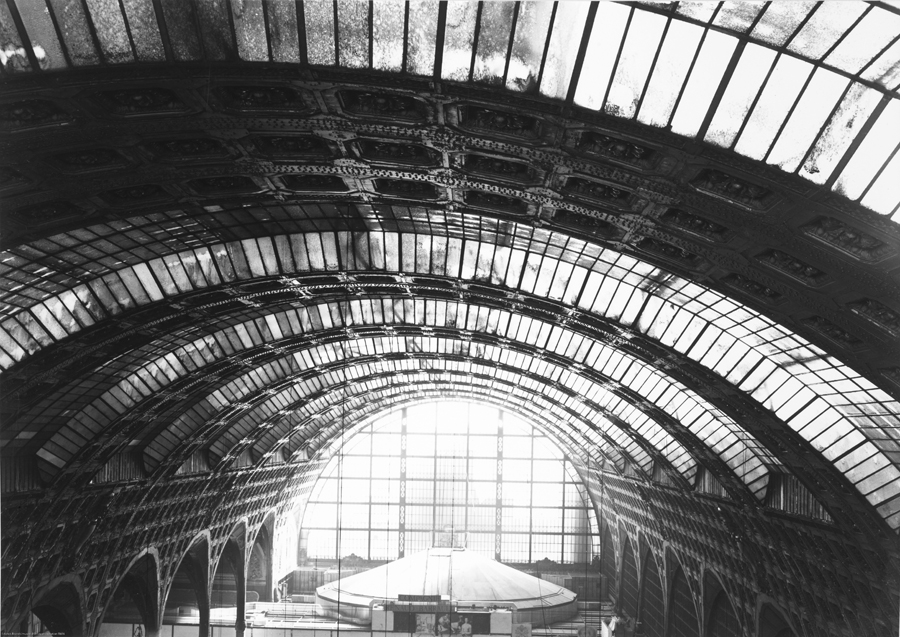
Jim Purcell, The Renaud-Barrault Pavilion at the Far End of the Musée d’Orsay’s Nave, ca. 1980–1981, gelatine silver print, 21 × 27 cm, Paris, Musée d’Orsay Documentation, ODO 1996 22 162 T. The building housed a theatrical venue, known as the Théâtre d’Orsay, used by the Barrault-Renaud troupe between 1972 and 1981.
Photo © Musée d'Orsay (dist. GrandPalaisRmn) / Jim Purcell
This transformation came with all the constraints inherent in turning a railway station into a museum, with the result that the layout is somewhat labyrinthine. For me, the Musée d’Orsay immediately evokes The Obscure Cities, a series that incidentally began in the early 1980s and features architecture prominently.
In the first volume of the series, Samaris [first French edition, Casterman, 1983], you do find the same constant interplay of iron and glass, as well as a strong influence from the visual language of Victor Horta and Art Nouveau via the urban landscape of Brussels, where François Schuiten and I were both living at the time. There are obvious affinities here, linked to the emergence of the trend associated with this world of shapes and materials that later, somewhat irritatingly, was labelled ‘steampunk’. Iron and glass, certainly, but also steam – the steam of the railway. Several such images can be associated with the Musée d’Orsay, whose great strength is that it immediately immerses visitors in the ambiance featured in its art. Right from the start, it brings to mind the railway stations painted by Gustave Caillebotte and Claude Monet. And while the restoration was radical, resulting in a complete transformation from floor to ceiling, I feel that something of the building’s original spirit remains.
Fig. 2
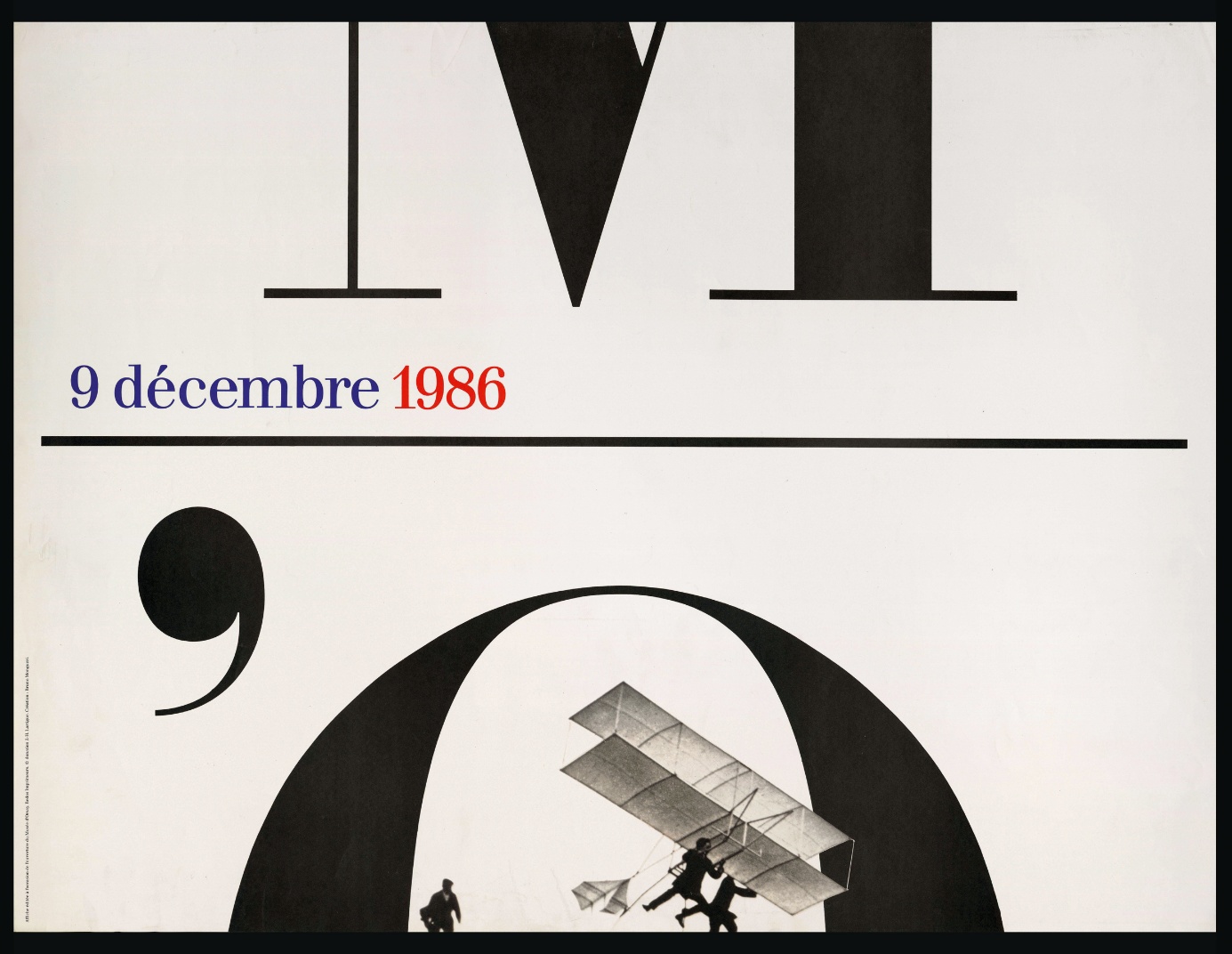
The Musée d’Orsay logo, with two men flying inside the letter O, poster designed by Bruno Monguzzi for the Musée d’Orsay’s opening in 1986, Pierrefitte-sur-Seine, Archives Nationales, archives of Musées de France, Musée d’Orsay, Posters (1980–1995), 20040465/1.
© Jacques-Henri Lartigue
Much like your comic albums – and this is what inspired the comparison – Gae Aulenti’s design for the museum is arguably an example of retrofuturism. There was a lot of talk about this aspect at the time, with the formal and symbolic references to Assyrian and Egyptian forms. The building was likened to a tomb, or a ‘lithic train’ – that is, a stone train one would board to travel through time, with works of art displayed in each of its compartments – or else comic-strip panels. Do you know whether Gae Aulenti ever read The Obscure Cities?
At the very least, there’s a certain synchronicity and shared sensibility, especially when it comes to renewed appreciation for disregarded styles. When Victor Baltard’s market halls, an architectural complex not unlike the Gare d’Orsay in spirit, were torn down, people’s thoughts naturally turned to the Orsay. But over the course of just a few years, from the De Gaulle and Pompidou era to the Giscard d’Estaing period, the way this cultural heritage was viewed changed. Brussels itself destroyed a fair amount of its own heritage, especially when it came to Art Nouveau, which many disparaged and referred to with pejorative terms such as style nouille [noodle style]. In their own way, these shifting paradigms hold useful lessons for the future, so we won’t rush to demolish whatever seems outdated – for example, the architecture of the university campus at Jussieu. But returning to the Gare d’Orsay’s transformation and Gae Aulenti’s design, I think the creation of this museum was a symbolic moment in the way heritage was viewed in the late twentieth century. Aulenti moreover gave the building an almost iconic depth. Railway stations were often described as the cathedrals of the nineteenth century, and the Gare d’Orsay seemed almost anchored in the history of architecture. It embodied an era and a place of mystery conducive to the imagination.
After a planning phase, the museum opened its doors to the public in December 1986. Do you have any specific memories from your first visit to the Musée d’Orsay?
I don’t remember exactly, but it must have been shortly after the opening. The first surprise was in fact the architecture. I was impressed by the museum as a whole, but somewhat unsure about the prominence given to certain schools of painting that had been devalued by modernist approaches − the Orientalists, for example. A certain standardisation troubled me, though at the same time I felt it could give rise to productive inquiries into the history of art and, more broadly, the notion of beauty. William Bouguereau, Jean-Léon Gérôme and Ernest Meissonier were obviously ‘able to paint well’, and didn’t deserve to be ridiculed or relegated to the margins of a history written by the victors – first and foremost the Impressionists and Post-Impressionists. I would say that another of the Musée d’Orsay’s main strengths is that it prompts visitors to engage in a kind of gradual acclimatisation, so to speak, that enables them to understand which works in the production of the period were of real quality and interest, and why. This process also brought up the question of scale: the academic paintings occupied a great deal of space and seemed to triumph simply by virtue of filling it!
Fig. 3
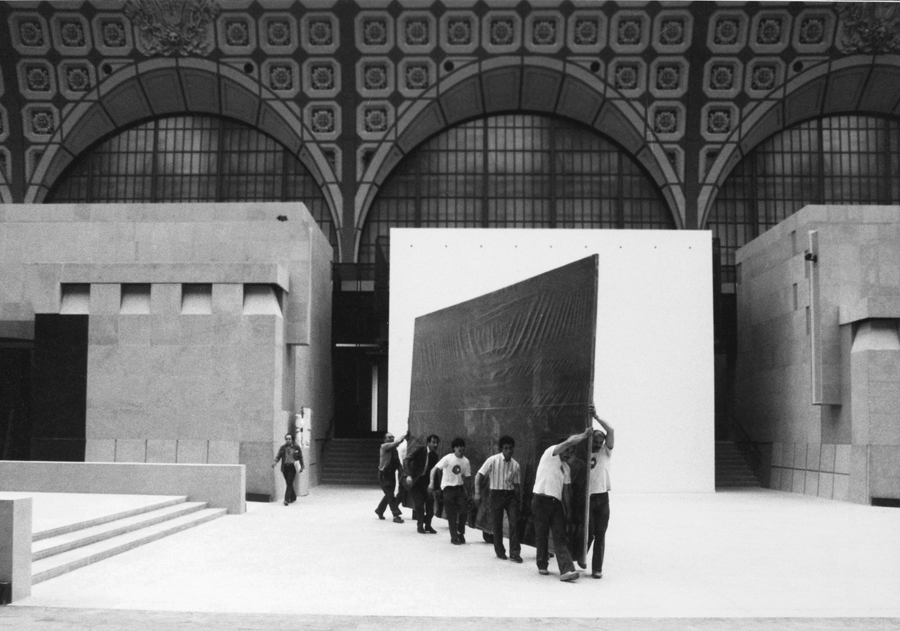
Jim Purcell, A Large-Scale Painting (Gustave Courbet, ‘The Painter’s Studio’?) Being Transported by a Team of Movers, 1986, gelatine silver print, 21 × 27 cm, Paris, Musée d’Orsay Documentation, ODO 1996 22 1106 T.
Photo © Musée d'Orsay (dist. GrandPalaisRmn) / Jim Purcell
Apart from the architectural considerations, did you feel the narrative of the history of nineteenth-century art was being reshaped in some way?
Yes, and this is arguably the Musée d’Orsay’s other major accomplishment, something I see as inseparable from the heritage aspect. It offered the first reinterpretation of the history of nineteenth-century art, an alternative to the canonical route traditionally traced from Jacques-Louis David and Jean-Auguste Dominique Ingres to Eugène Delacroix and Théodore Géricault, and then from Gustave Courbet and Édouard Manet to Pierre Bonnard. This was a fresh perspective on visual production in its entirety – including painting, sculpture, decorative arts, architecture and photography – beyond the perspective of a trajectory pointing directly towards modernity, which in turn was assumed to advance in a straight line towards Cubism and abstraction. The museum provided tools for challenging the idea of the nineteenth century being confined to a ‘preparatory’ role, as if it were a large staircase to modernity with various artists each occupying a step. This approach was puzzling, at times unsettling, and even sparked debates. It has since become ingrained in people’s thinking. Back then, the excessive revaluation of academic art was criticised, but now we find ourselves in an environment where sensitivity to complexity, entanglement and stratification is much more pronounced. The Musée d’Orsay has encouraged this. In the exhibition Paris 1874. Inventer l’impressionnisme, it was again made clear that not all ‘rejected’ artists were necessarily excellent painters, and that the academicism of the Salon hadn’t yielded solely inferior works.
Looking at both your work and your fields of interest, I nevertheless sense that this dichotomy isn’t fully central to your point. Over the course of this long nineteenth century, there seemed to be more of a sprawling and lively kind of energy: a far more fertile and uncontrollable interweaving of fields of knowledge, imaginative worlds and images.
I agree, and I’d even say that what the Musée d’Orsay helped to demonstrate is that, in reality, this division between academicism and modernism doesn’t get to the heart of the matter. It was about something else. The widespread adoption of electricity, the changes brought about by steam energy, the emergence of new materials – particularly in architecture – and the invention of the daguerreotype and related developments: all of these upheavals affected absolutely everyone, without exception. Thinking in terms of these transformations forces us to break away from an overly ‘internalist’ approach to art history, centred primarily on painting, which was disproportionately separated from the histories of sculpture, caricature and photography. These lateral dynamics are so fascinating. In a series of lectures I gave at the Musée des Arts et Métiers in 2016−2017, which I called The Revolution of Images (1830−1914), I focused on these specific phenomena and all the ramifications they entail. I concentrated on certain key figures, at specific moments of convergence – Étienne-Jules Marey, for example, who stood at the junction of science and aesthetics, and Félix Nadar, whom François and I both greatly admire. Fictionalised as ‘Michel Ardan’ in a novel by Jules Verne, Nadar was a writer, journalist, caricaturist, photography pioneer and forerunner in ‘heavier-than-air’ flight; he was both a participant in and observer of these technological changes. His example alone shows how badly the old categories, those that prevailed in art history as it was taught during my youth, needed to be reconsidered and reinvented through interdisciplinary crossovers. There’s no doubt in my mind that the work carried out at the Musée d’Orsay, and during some of the exhibitions presented there, played a decisive role in this.
Fig. 4
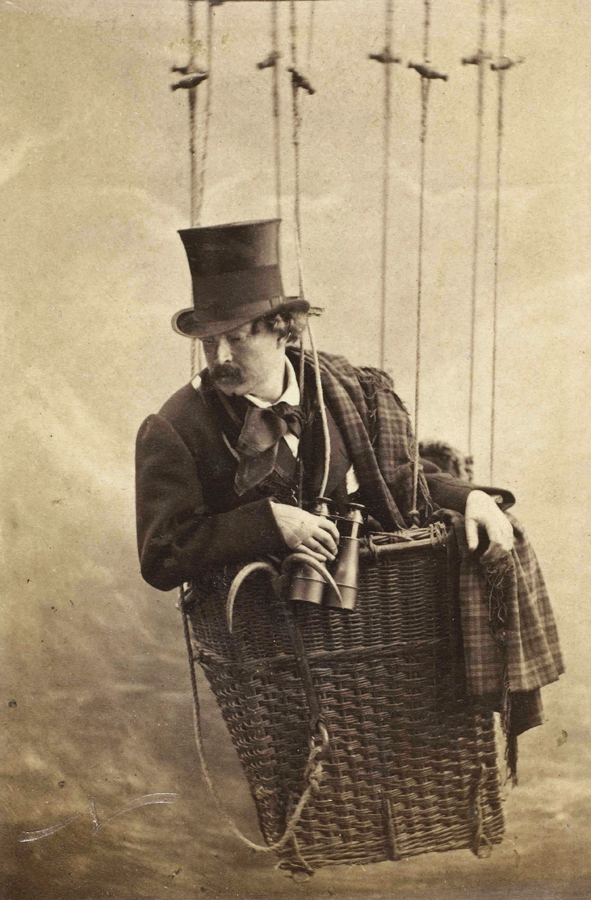
Nadar (Félix Tournachon), Félix Nadar in Gondola of Balloon, ca. 1860–1865, albumen print from a collodion glass negative, 9.5 × 6 cm, Paris, Musée d’Orsay, acquisition, 1995, PHO 1995 6 176.
Photo © Musée d’Orsay (dist. GrandPalaisRmn) / Alexis Brandt
One of the questions raised by the Musée d’Orsay’s opening involved its chronological boundaries. As indicated by the title of the journal associated with it, which is now being revived in a new form, the museum covers the period from 1848 to 1914. How do you view this chronological division?
Pinning down key dates is always a tricky business. The lecture series I just mentioned, The Revolution of Images, started with 1830 – which I think is another potential date of interest, being a very important year. Of course, 1848 was marked by international revolutionary events, but 1830 saw the rise of the press, the battle of Hernani and the start of La Comédie humaine. The year 1839 could also be a candidate in terms of visual considerations, with the invention of the daguerreotype. But 1848 obviously has a specific legitimacy, though we mustn’t forget to consider individual paths alongside identifiable historical and aesthetic events. Returning to Nadar, one of the things that fascinate me is his longevity. He was born in 1820 and died in 1910, late enough to witness Blériot’s crossing of the Channel, the culmination of a challenge he had followed half a century earlier. But in his youth, he had also rubbed shoulders with Dumas, Nerval, Hugo and Daumier. I find it fascinating to see how, beyond the main currents, individuals sometimes spanned different time periods and crossed paths with other figures in surprising ways. Nadar was a walking connection hub, a networker, a friend of both Baudelaire and Marey, who played with the boundaries between disciplines and with chronological limits. Similarly, Haussmann’s transformation of Paris doesn’t line up exactly with the Second Empire; early signs of it can be found before then, and you have to wait until the First World War to see it fully completed, long after Haussmann himself.
Since you’ve mentioned Nadar and photography again, I’d like to talk some more about the original intention for the Musée d’Orsay, which was for it to cover all of the visual arts. However, while photography is represented – like the decorative arts and sculpture, with renewed attention – printed images are absent.
This is indeed a problematic aspect, although of course some temporary exhibitions have compensated for it. Prints, caricature and, above all, comics really didn’t get much attention when the museum first opened. Today, in the era of large-scale digitisation projects, we understand that it’s not just a question of precursors to comics between 1848 and 1914, but rather an international momentum to which France contributed heavily. We realise that comics didn’t emerge only in the United States in the 1890s; they were contemporary with Niépce and Daguerre, starting the 1820s and 1830s, and continued through the following decades. Nadar (there he is again), Cham, Doré and of course many others in Great Britain and Germany, well before the rise of comics in the United States, all played a role in this emergence. The people connected with these fields lived their lives immersed in images. Take Rodolphe Töpffer, for example, the Genevan now credited as the inventor of comics and the first theorist of this art form, who also worked as an art critic. We also see it in caricatures linked to the Salons devoted to painting and the way they were received. I’ve taken a keen interest in Darwinism as well, and the way evolutionary theories were popularised. Poor Darwin was often depicted as an old ape, but such images helped make a particularly complex theory easier to understand. They allowed the theory of evolution to reach the popular imagination.
Fig. 5
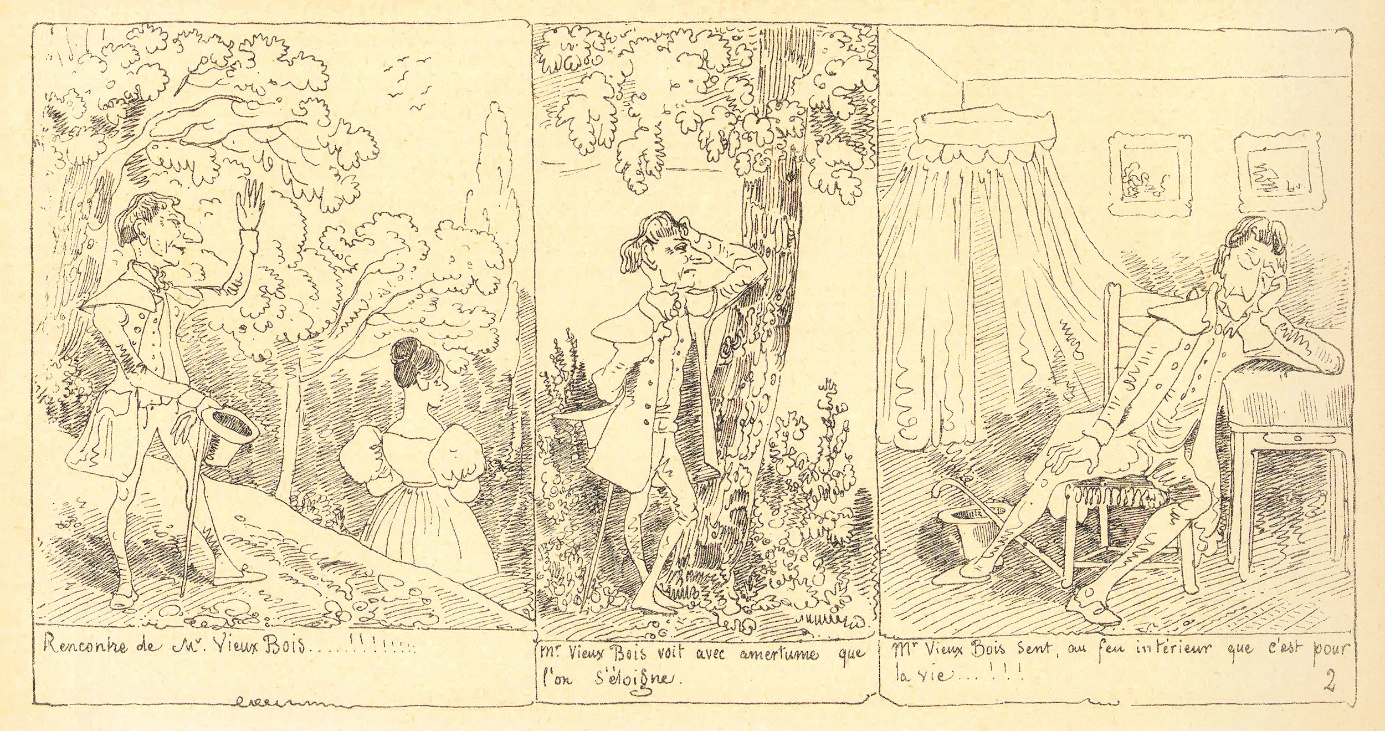
Rodolphe Töpffer, The Adventures of Mr. Obadiah Oldbuck (Geneva, 1837).
This kind of approach also went against a religious understanding of existence, in a context with significant tensions to overcome. You’ve always been interested in phenomena related to the spread of knowledge through images.
Yes. To give another example from further back in time, prints such as those of Honoré Daumier, depicting omnibuses and rail travel, played a vital role in highlighting the cultural impact of a mobility revolution that wasn’t just technical. I’m thinking specifically of social mixing, the new physical proximity that Daumier depicted in his prints. In popular imagery and caricature alike, you find intersections between science, paradigm shifts in thought and aesthetic realms. As I see it, all this material has been touched upon, but not yet fully explored. I’m not an art historian, but in my research I was struck by all these points of connection, and especially by the essential role played by certain pivotal individuals. When the Musée d’Orsay opened its doors, this aspect was somewhat neglected, and today it still needs its place. Of course, it isn’t about defending a purely thematic approach that would flatten individual singularities. It’s a delicate matter. Caricatures and comics have different formats, techniques, audiences and purposes. Still, you can’t separate them completely. The old compartmentalisations no longer work. I recall seeing a Lyonel Feininger exhibition a few years back at the Musée du Havre, and it focused solely on his paintings, ignoring his wonderful comics. Yet placing them side by side reveals fascinating connections.
You’ve raised the issue of a thematic approach. The Musée d’Orsay’s displays are primarily chronological, and it must also contend with the fact that it’s not easy to display photography and graphic arts under the same conditions as sculpture or decorative arts. Finding the right arrangement is really about balancing various constraints, including preventive conservation concerns. Still, it seems the Musée d’Orsay is an institution that has constantly been seeking resonance for forty years. It’s still experimenting, still putting ideas to the test.
I would add that the past several years have seen a great many temporary exhibitions with a thematic focus, going beyond the issue of permanent displays, which bring their own challenges. Whether at the Musée d’Orsay, the Bibliothèque nationale de France, the Musée du Louvre or the Grand Palais, they can either be fascinating or turn out to be problematic. The Louvre exhibition Les choses. Une histoire de la nature morte [2022−2023], for example, brought together works from different periods and statuses based on their genre, much like the Tate Modern in London did in its early days, and that can be very enlightening. But in other cases, a problem with the thematic approach is that it includes works that are weaker aesthetically or sometimes even kitsch. For a less savvy audience, that can have a flattening effect. It can be a bit cruel at times, but I feel the risk is worthwhile because we end up taking a new look at forgotten works and discovering hidden strengths in pieces that are usually left in a storage room. In the long run, this is one of the purposes a museum is meant to serve – to help us reframe our gaze through reflection. But these new approaches are probably less noticeable in the permanent collection. Obviously, at the Musée d’Orsay, you’ll find the most accessible works on the ground floor, and upstairs, the pieces that are sometimes less appealing. The layout is a bit of a maze, leading eventually to many masterpieces on the top floors. This also frees visitors from the automatic habit of heading straight for a museum’s must-sees. Of course, there’s the issue of spaces big enough for the largest works; here we hit an architectural limit. The Musée d’Orsay can’t offer the continuous layout you find in some major museums in the United States, such as the Art Institute of Chicago, which in my view is one of the world’s best galleries. You move very naturally from room to room there.
Speaking of size, you chose to open your Revoir Paris exhibition at the Cité de l’Architecture [2014] – which featured pieces from the album of the same name – with Victor Navlet’s enormous General View of Paris [1855]. Putting it up must have been quite the feat. I got a sense of that from some photos in the museum’s media library, which show the painting being moved.
It was indeed a bit difficult! It’s perceptive of you to mention not just the Revoir Paris comic album but also the accompanying exhibition at the Cité de l’Architecture, since both ultimately cover the period we’re looking at, spilling over more into the twentieth century. The idea was to focus on the moments transitioning from Restoration Paris to Haussmannian Paris and then to modernity via projects and dreams that often never came to fruition. Revoir Paris is a somewhat special story because it isn’t set in the imaginary world of The Obscure Cities but in our real world, where the documentary aspect is much more pronounced. We used a lot of archives and did careful location scouting for certain scenes. It was also a way for us to revisit the history of images, for instance through the Paris of Albert Robida, another absolutely fascinating figure. Later, we were fortunate enough to organise another exhibition, Machines à dessiner [2016–2017], to mark the release of the second volume of Revoir Paris at the Musée des Arts et Métiers, next to the metro station of the same name designed by François Schuiten. At this show, we created a dialogue between the images from our albums and machines selected from the museum’s storage.
Fig. 6
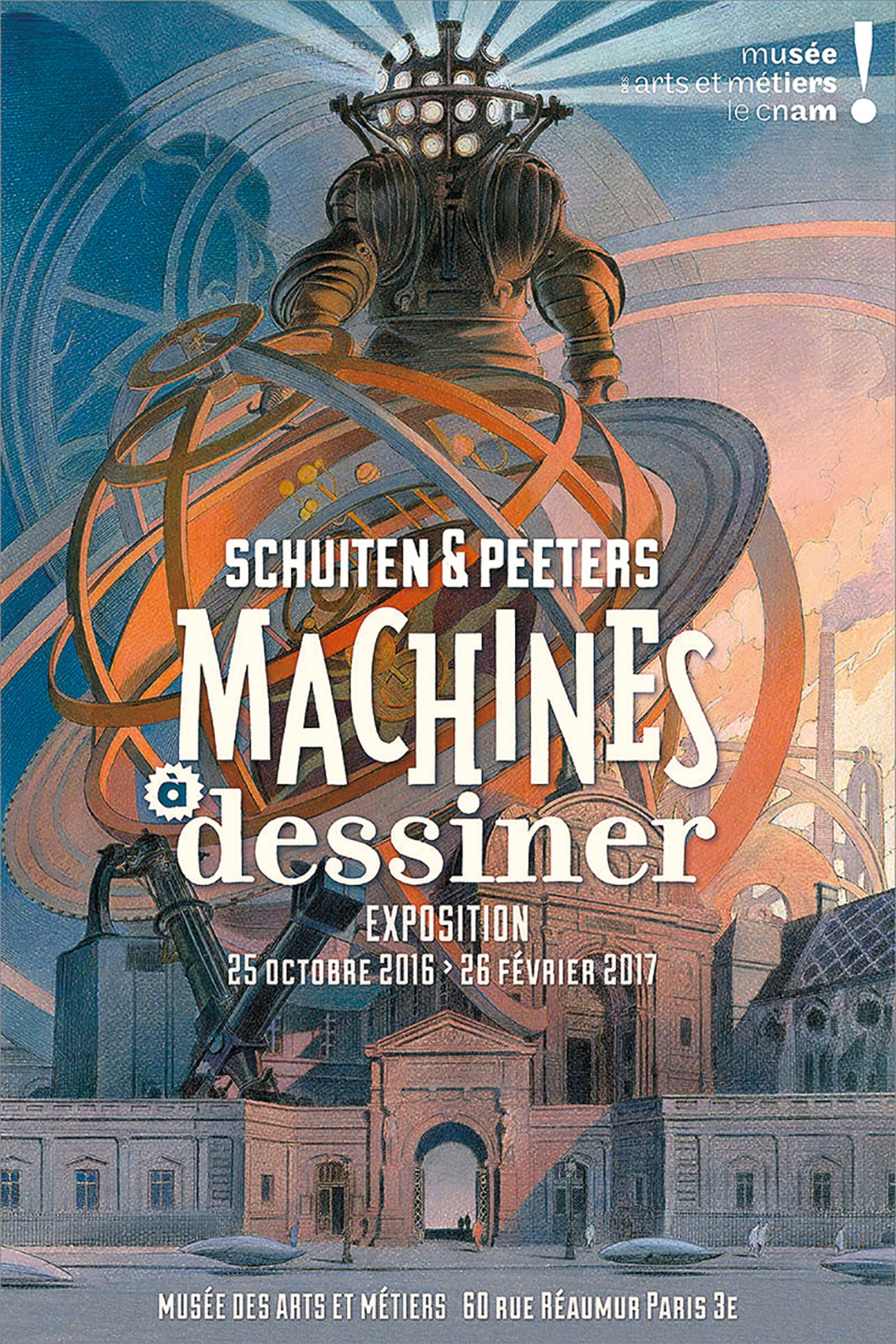
Poster for the Machines à dessiner exhibition (Paris, Musée des Arts et Métiers, 25 October 2016–26 February 2017), drawn by François Schuiten.
Fig. 7
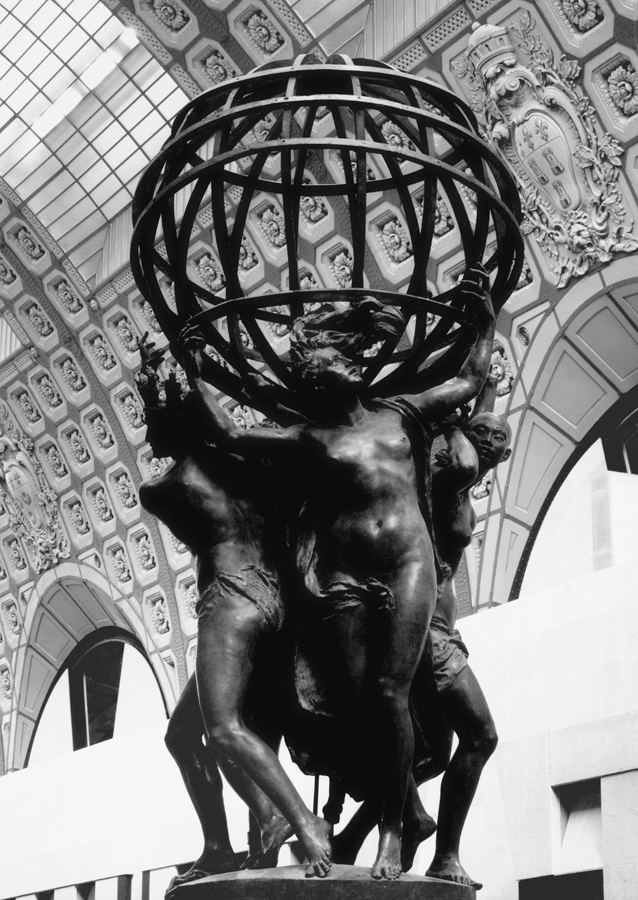
Jim Purcell, Installation of ‘The Four Parts of the World Holding the Celestial Sphere’ (Jean-Baptiste Carpeaux) at the Musée d’Orsay, 1986, gelatine silver print, 21 × 27 cm, Paris, Musée d’Orsay Documentation, ODO 1996 22 1187 T.
Photo © Musée d'Orsay (dist. GrandPalaisRmn) / Jim Purcell
An obsession with machinery is very nineteenth century. And now artificial intelligence seems to be fulfilling those old fantasies – the idea not only of automating certain actions but also of being able to imagine infinities. What I find particularly fascinating about that earlier period is that time and space were no longer barriers. Knowledge made people feel they could free themselves from such constraints.
Here I want to mention someone whose name hasn’t come up yet, though he’s very significant to me and many others: Walter Benjamin. One could easily argue that in its very incompleteness, his Arcades Project is a kind of precursor to the Musée d’Orsay. The spirit guiding this book, with its reflections on photography, railway stations, art, poetry and utopias, is very close to that of the Orsay. The way Benjamin made connections and bypassed the barriers you mentioned was truly forward-looking and innovative for his time; he didn’t position himself strictly in art history or the history of ideas but linked Fourier and Baudelaire to steam power, caricature, lithography, the city and of course the arcades, both covered passages and metaphorical passageways, revealing a type of sensitivity that still has much to teach us. As for my approach, it’s rooted in two perspectives. On the one hand, there’s my collaboration with François on The Obscure Cities, and on the other, my much more theoretical reflections on images and media, which are closer to Benjamin’s intentions. But this approach originally emerged from our work in fiction. We would leaf through books we picked up at flea markets or in François’s father’s library to stimulate our imaginations by bringing forgotten images back to life. Our passion for machines with visible mechanisms – the opposite of today’s smartphone, a magical object whose workings are completely hidden – stems from the same impulse. Fiction and documentation have forever been intertwined. That, in a sense, is what the Orsay is: living material for knowledge and the imagination.