The opening of the Musée d’Orsay in 1986 marked a major shift in the way nineteenth-century sculpture was understood. Much of the groundwork for this reassessment had been laid in the preceding decade by Anne Pingeot, Antoinette Le Normand-Romain and Laure de Margerie. In this interview, we discuss the years during which the Musée d’Orsay was planned and designed, while also revisiting the experience of reinventing sculpture from the second half of the nineteenth century in a vibrant new context.
France Nerlich: At what point did each of you join the Musée d’Orsay project and what stage had it reached at that time?
Anne Pingeot: I’d taken the curator’s exam in 1970 and joined the Musée du Louvre’s sculpture department in 1972. In those days, two architects, Patrick O’Byrne and Claude Pecquet, were working on a somewhat secret mission – finding a way to bring new life to the decommissioned Gare d’Orsay. In 1971, Jacques Rigaud, chief of staff to Jacques Duhamel, minister of cultural affairs under President Georges Pompidou, was the first to get involved.1 His role was crucial because in 1969, France’s historic monuments commission had approved the building’s demolition. In 1970, François Loyer published an article in L’Œil magazine titled ‘Paris assassiné’ (Paris murdered).2 The next year, Prime Minister Jacques Chaban-Delmas spoke out against the station’s destruction, and Duhamel managed to ensure it would be protected. Tastes were changing around that time. In 1967, the English had restored their Neogothic St Pancras railway station. And the public outcry over the summer 1971 demolition of Baltard’s glass and iron market hall structure at Les Halles in Paris ended up saving the Orsay. The building’s hotel shut its doors on 1 January 1973. Then on 8 March, four years after approving its destruction, the historic monuments commission listed the Gare d’Orsay in its supplemental inventory of heritage sites! Michel Laclotte and Pierre Rosenberg then took an interest in the museum project jointly devised by Jean Chatelain, director of the Musées de France, and Jacques Rigaud. My first report dates from this period. I remember our meetings in the Pavillon de Flore at the Louvre. Someone would always bring mini-croissants – just as you’ve done today – and that was something new for us at the time. Then, in 1974, Michel Guy and Bruno Foucart joined the project. Two years later, in 1976, O’Byrne and Pecquet presented a scale model of the future museum to President Valéry Giscard d’Estaing. A photo appearing in Architecture intérieure shows Laure’s father, Emmanuel de Margerie – then-director of the Musées de France – alongside Giscard d’Estaing, Michel Guy, the scale model and, next to it, two young men sporting the long hair typical of the era.3 The official decision to convert the building into a museum was made in October 1977, and in March 1978, the public administrative body for the Musée d’Orsay was legally formed.4 That was when you came onto the scene, Antoinette.
Antoinette Le Normand-Romain: I returned to France from the Villa Medici in October 1976. As I’d worked on sculpture there – my dissertation was about sculptors at the French Academy in Rome between 1824 and 1840 – I was assigned to the Louvre’s sculpture department. Yet I recall never feeling fully part of that team. The real turning point was the creation of the Centre Pompidou and the transfer of certain Palais de Tokyo collections to that new site. A number of works remained in place, including sculptures by Maillol and Bourdelle and paintings by Bonnard, Vuillard and others. Four young curators were then appointed to take charge of them: Claire Frèches, Élisabeth Walter, Marc Bascou and myself. We felt almost like exiles over at the Palais de Tokyo, so far from the Louvre and the Jeu de Paume, where everything was decided. We were responsible for the collections and our primary task was to document them. No one paid much attention to us, so I was able to complete my dissertation. Then at the end of 1977, things sped up. The planning team expanded with the arrival of Henri Loyrette, Françoise Heilbrun and Geneviève Lacambre. Most of us were based at the Palais de Tokyo, though Anne remained at the Louvre and would make her way over to us on her moped. At that time, Hélène Adhémar, chief curator at the Jeu de Paume and the Orangerie, led the team, but she soon retired and Michel Laclotte took over.
Laure de Margerie: I was a student at the École du Louvre when Anne taught a class on nineteenth-century sculpture. True to her habit, she put out a call to the public – and I answered. I did a museology internship with her in 1977−1978, stationed in the documentation section of the Louvre’s sculpture department. Anne, meanwhile, worked in a small office facing the Cour Carrée, with a stack of documentation on nineteenth-century sculpture that must have been over three feet high. Geneviève Lacambre assigned the museology students to organise an exhibition at the Palais de Tokyo, where a small display of plans for the Musée d’Orsay was already in place. We printed a newsletter about the project. Later on, I contributed to the project on a voluntary basis, in particular by reviewing American publications on the production of bronze sculpture editions in the nineteenth century. Then some temporary jobs opened up; there wasn’t any documentation curator position yet. I held various temporary positions between 1978 and 1983, the year I passed the examination necessary to become a documentation secretary. I then accepted a position at France’s historic monuments conservation authority in Rouen, where I was entrusted with documentation on nineteenth-century sculpture. When documentation curator roles were created for the future Musée d’Orsay, I naturally applied, and this was how I returned to Paris in early 1985. I supervised the relocation of offices and documentation, first from the Palais de Tokyo to some rooms of the former hotel at the Gare d’Orsay, and then to the temporary offices on rue de Luynes and finally back to the documentation areas. From the outset, these areas were intended to be open to the public, so they were also designed by Gae Aulenti.
How did you go about assembling the core of the future collection?
ALNR: Starting in 1977, we carried out stocktaking sessions in the storage rooms. But the information available about the artists and the works was patchy at best – we had Lami’s dictionary, which was our bible, and that was it.5 However, this dictionary didn’t go beyond 1921 and moreover covered only dead sculptors, so there was nothing about the ones still living at that time. The dictionaries by Thieme, Becker and Bénézit didn’t have much to offer either. We had to create our own resources. So, together with Anne, we set out to see the works on site and create a systematic photographic inventory of sculpture from the second half of the nineteenth century. But to identify the pieces, we needed to work out what they corresponded to and investigate each one. This allowed us to trace the careers of our sculptors. And what was exciting was that our research allowed us to meet many new people.
LdM: Working with the descendants of the artists was wonderful. They were so pleased that someone was taking an interest in their grandfather, great-uncle or other relative. They often had photographs and other records, while we had the works and texts, and by putting them together, we were able to move ahead.
AP: We also spent a lot of time working with the Archives Nationales. Sculpture is expensive, after all, so where there’s money, there are records! Commissions, funding, follow-ups . . . the nineteenth-century archives are well maintained.
LdM: Going through F216 meant reconstructing all the details of the commissions, going well beyond the austere facts found in administrative records.
ALNR: We came across desperate letters from artists who lacked commissions, who were starving, writing things like ‘I need to pay my rent.’ This gave us insight into the lives of the sculptors, and it was truly moving.
LdM: We also went through the records of the Société des artistes français. That’s a unique resource, since it contains the artists’ dates and places of birth, their Salon exhibitions, along with any awards they received there, and requests for financial assistance. It was on the ground floor of the Grand Palais. It was extraordinary. Then Anne and Antoinette carried out that incredible photographic survey in museums and museum storage rooms, taking photos such as the ones in the Musée de la Chartreuse de Douai, with all the layers of bird droppings, which have since become famous (fig. 1). They’re now in the ‘Topography’ collection of the documentation section.
Fig. 1
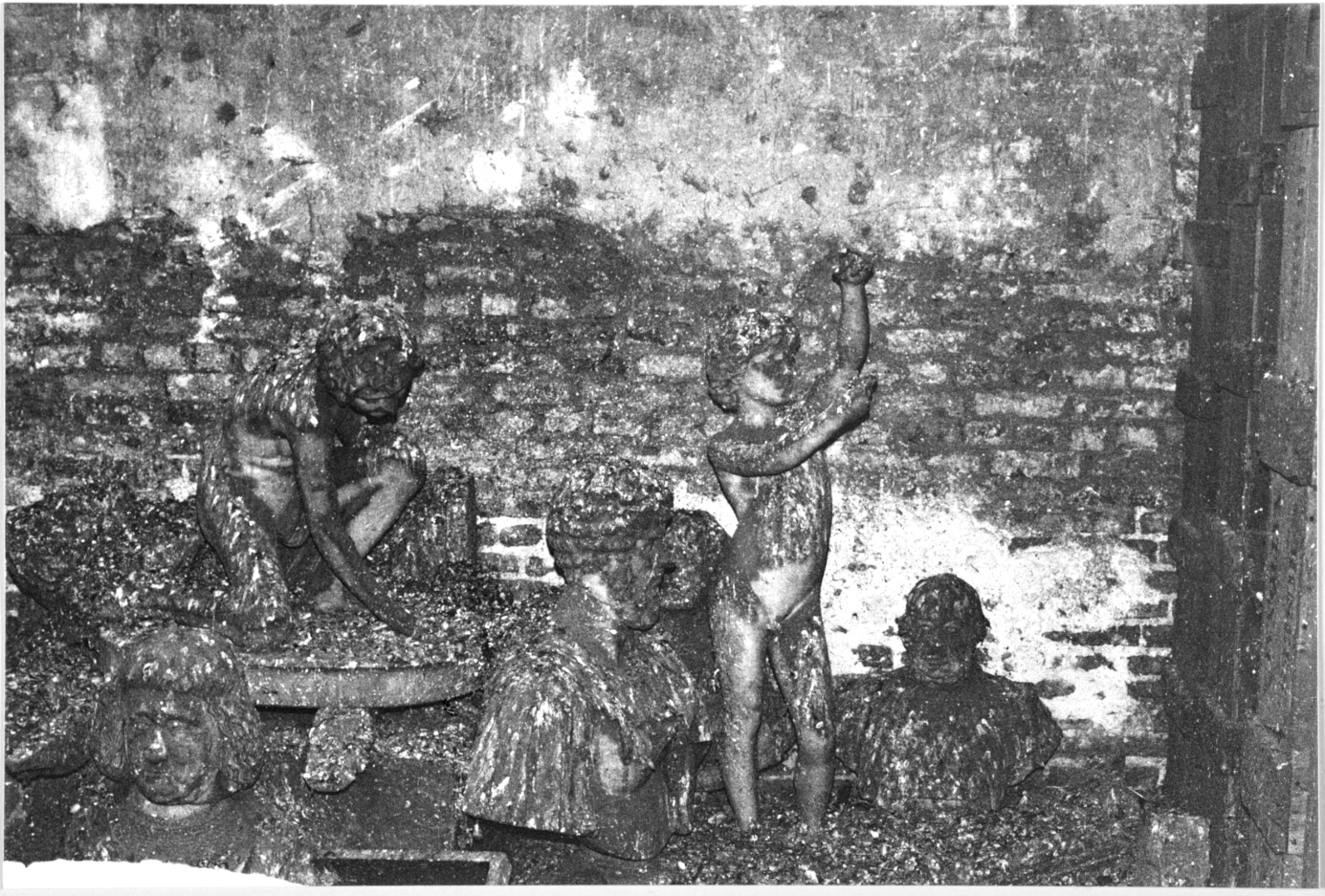
Sculpture storeroom in the Douai chapel, photograph by Anne Pingeot (1978), Paris, Musée d’Orsay Documentation, Topography collection.
Photo courtesy of the Musée d’Orsay Documentation
ALNR: Yes, everything we did went into the documentation section.
LdM: That photographic survey has proved very useful in terms of knowledge of the sculptures over the long term, especially when it comes to restorations. So many times, we were contacted by people who had a marble or a bronze, but the hand had been broken off in a public square, for example. And our photos were what allowed them to restore these pieces accurately.
AP: We needed to assemble the museum’s collection and establish the displays.
ALNR: Some thought went into the works that had previously belonged to the Musée du Luxembourg and were out on loan – which ones should be brought back? And how would we get them returned? I was in charge of all the museum’s loan returns, not just the sculptures. We started with the Musée du Luxembourg’s inventory – only the draft survives today – and catalogues that had been published. We worked in the archives down in the basement of the Palais de Tokyo, since that’s where the French state’s storage was. It was run by Marie-Claude Morette-Maillant, who scared everyone, but she eventually let us access the archives and we went through them all. This was very useful for tracking down works, some of which turned out to already be on site. For example, Geneviève Lacambre and the painting curators were searching everywhere for Fernand Cormon’s renowned Cain. It so happened that there were some large rolls of canvases in the Palais de Tokyo’s basement. One day, Geneviève said, ‘Cormon’s Cain has to be somewhere – why not in these rolls?’ I remember how excited we were when we started unrolling the canvases and the blue of the sky appeared! It was indeed Cain. Another of the Palais de Tokyo’s mysteries was the mural by René Piot, which was said to be walled in somewhere.
AP: Yes, a lot of walls had been put up.
ALNR: Constructing a partition was easier than moving things, and then afterwards, what was inside would be forgotten. In Grenoble, I was once searching for a few large sculptures for my dissertation and discovered they’d been enclosed inside four low walls. I had to climb a ladder and look at them from above.
Sculptures are cumbersome, heavy and bulky. Was this an obstacle or an advantage when it came to funding their restoration, transfer and exhibition?
ALNR: Those were lucky times; there was money for that back then.
LdM: And sculptures were probably easier to get back from regional museums than Monet’s paintings, which they often didn’t want to part with.
ALNR: Yes and no, because as soon as we showed interest in a work, it would immediately become that museum’s Mona Lisa. The curator would think, ‘If they’re interested, it must be valuable’ or ‘I might as well get something important in return.’ This was part of the work involved with loan returns – once a piece was selected for the Orsay, we had to offer something in exchange. So, we tended to ‘tap into’ the Impressionist works. The Musée des Beaux-Arts de Lyon never forgave us for bringing back Rodin’s Walking Man when it had been exchanged for a small Cezanne and one other work. To this day, the ‘pedestal of shame’ still stands in their courtyard, with the label ‘Walking Man by Rodin’.
AP: That’s right. At that time, they no longer had a director. Madeleine Rocher-Jauneau had left, and her successor hadn’t been appointed yet. In 1986, Philippe Durey played a crucial role in arranging for the return of sculptures from regional museums.
In 1985−1986, Durey had just collaborated with you on the large-scale exhibition of nineteenth-century sculpture, a crucial step in bringing these works back into view.7 Could you comment on the state of the research in the years before the Orsay?
AP: There’s a forty-year gap in the bibliography. Nineteenth-century sculpture was largely disdained. I came across a 1931 catalogue from the Musée du Luxembourg in which Louis Hautecœur had added annotations such as ‘weak’, ‘poor’, ‘dreadful’ and so on (fig. 2). Changes in taste probably caused more destruction than wars or central heating. Do you remember the Prix de Rome plasters stacked near the coal in the basement of the École des Beaux-Arts? That’s the cover photo of the journal Revue de l’art (fig. 3).8 For the Orsay, many works were rescued at the last moment from the public dump. Remember The Six Continents (fig. 4),9 for example!
Fig. 2
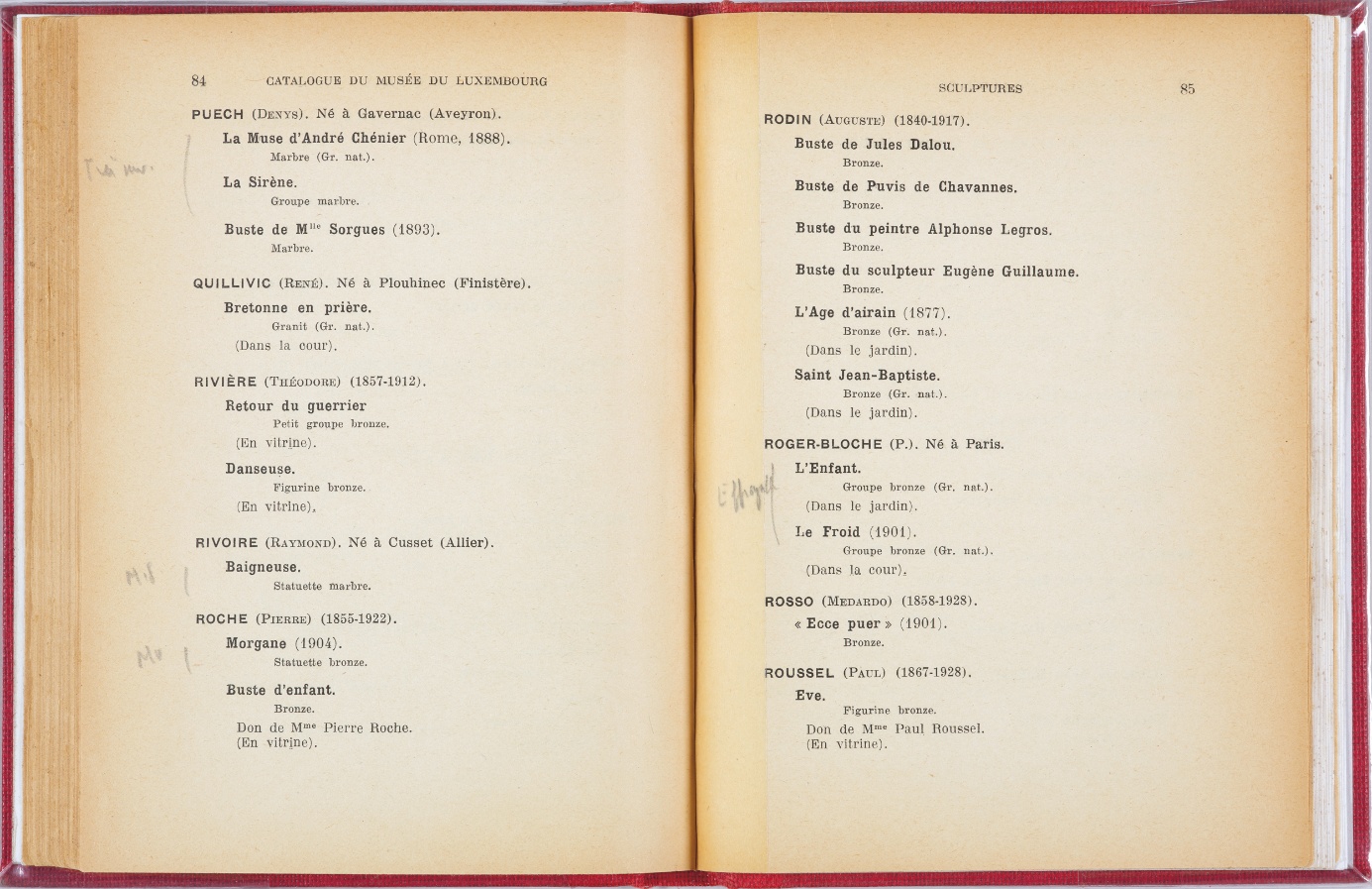
Louis Hautecœur and Pierre Ladoué, Musée national du Luxembourg. Catalogue des peintures et sculptures (Paris: Éditions des Musées Nationaux, 1931), 85, Copy annotated by Louis Hautecœur and held in the Musée d’Orsay’s library.
Fig. 3
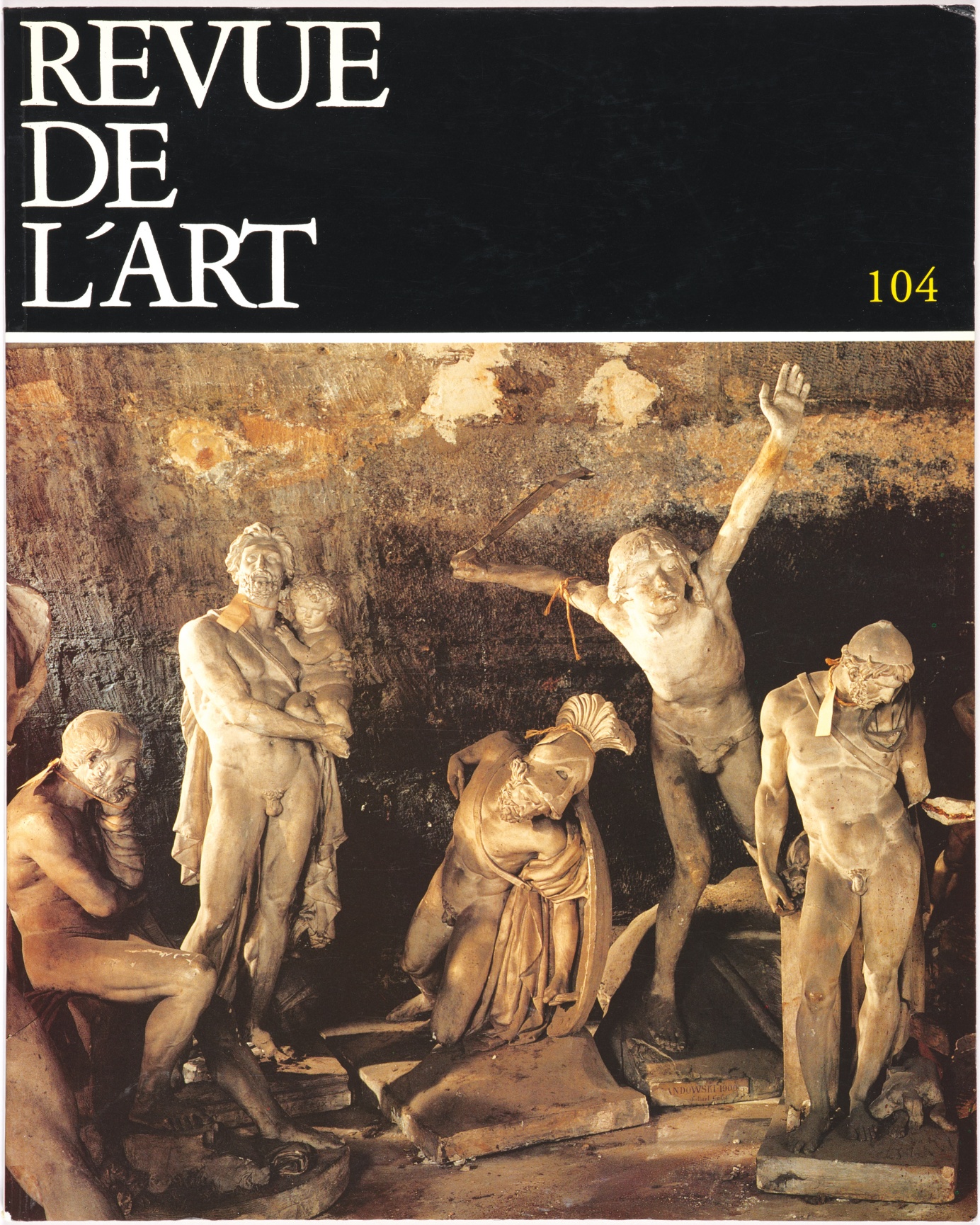
Revue de l’art, no. 104, 1994-2.
Fig. 4
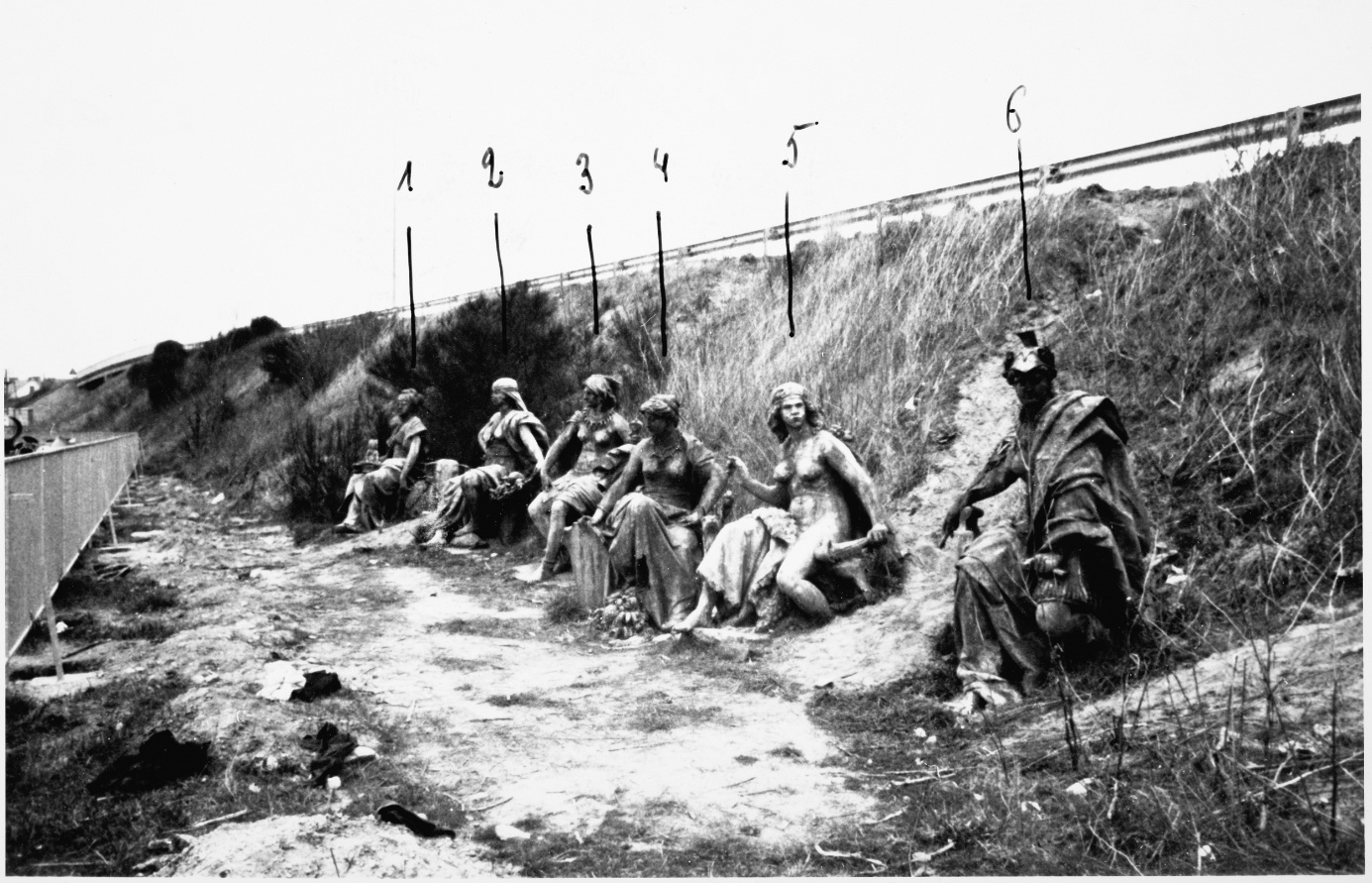
The Six Continents in a meadow beside a railway line in Nantes in 1977, Paris, Musée d’Orsay Documentation, ‘Delaplanche, Les Six Continents’ object file. The six sculptures were installed on the forecourt of the Musée d’Orsay in 1986.
Photo courtesy of the Musée d’Orsay Documentation
It was the Americans, particularly Horst W. Janson and Albert Elsen,10 who, in the 1960s, resumed work on nineteenth-century sculpture. I remember the pivotal moment being the 1979 International Congress of Art History in Bologna. All the leading American and European sculpture scholars were there: Ruth Butler, Peter Bloch, William Hauptmann, Fred Licht and Jacques de Caso, and the discussions were lively! Schmoll and Elsen both tried to convince the others of their respective views on Rodin.11 I gave a talk on state commissions for the niches in the Cour Carrée of the Louvre. Nicholas Penny focused on tomb sculptures in churches. I’d borrowed a car and − not being a very good driver − rear-ended someone. Nick was with me, and you do bond in a moment like that! Francis Haskell was also there and was very interested in what we were doing. He invited me to go to Oxford.
ALNR: It was definitely an extraordinary time, because we met a lot of the Americans who’d done pioneering work on sculpture. But it’s worth remembering that there was also a very active French network made up of a few regional curators who focused on nineteenth‑century sculpture. There weren’t all that many, but there was Dominique Viéville, who was in Calais at the time, and Armand-Henry Amann in Chambéry, before he moved on to Mont-de-Marsan at the Musée Despiau-Wlérick – a bit late for our period, but he was really interested in nineteenth‑century sculpture. And later on, Jean Aubert in Chambéry, who took over the sculpture catalogue.12 After that, Bruno Gaudichon in Poitiers and then Roubaix!
AP: Yes, that’s true! The museums in France’s Nord region, which are very good at joining forces, did some essential work early on. The catalogue for the 1977 exhibition on The Burghers of Calais is still a useful reference.13
Even so, didn’t everything still tend to circle round the same major figures – Rodin in particular?
ALNR: Indeed, most nineteenth-century sculptors were largely overlooked, apart from the ones who had their own museums, like Rodin and Bourdelle.
LdM: Carpeaux still got some attention, though; Anne worked on the big exhibition at the Grand Palais in 1975.
AP: Victor Beyer was the one who set it in motion.14 Soon after that, we organised the exhibition De Carpeaux à Matisse with our colleagues from the museums in the Nord region.15
ALNR: We mustn’t forget the team at the Petit Palais, for example François Pérot, and Thérèse Burollet also played a crucial role – she’s the one who really saved the nineteenth century! She prevented the demolition of the sculpture storeroom in Auteuil, where the plaster models for the bronzes in Paris’s public spaces were kept. She secured funding and organised a transfer to Ivry.
AP: She was the City of Paris’s equivalent of a national contemporary art fund. Without her, a whole chapter of history would have ended up on a rubbish heap, because a lot of those plaster casts are the only surviving traces of bronzes that were melted down by the Vichy regime.
LdM: The Dépôt d’Ivry, as it’s now called, is run by the City of Paris’s religious and civil artworks conservation department. Daniel Imbert and Guénola Groud wrote a book chronicling its history.16 Among their many projects on sculpture, they also put together an excellent exhibition, Quand Paris dansait avec Marianne, at the Petit Palais in 1989.17
ALNR: The key figure for Thérèse Burollet was Albert Bartholomé. André Chastel had urged her to write her dissertation on the sculptor. Her monumental study was finally published by Arthena in 2017!18
AP: She was connected to the Foucart family, and together with Jacques Thuillier that small circle really championed the cause of nineteenth-century sculpture and painting.19
ALNR: Yes, Bruno Foucart had Marie-José Salmon buying nineteenth-century works for the museum in Beauvais. I noticed that sculptor Eugène Antoine Aizelin has recently been highlighted there – on the opening page of the programme for the 2025 Year of Culture, you can see works acquired back in 1975. At that time, a lot of curators didn’t really know what to do with nineteenth-century collections. They were convinced no one was interested in them. At the Jeu de Paume there was hardly any sculpture at all. But in the regions, and in Paris, some people were making acquisitions and doing remarkable work. Since we were a small group, we stuck together and really enjoyed ourselves.
Fig. 5
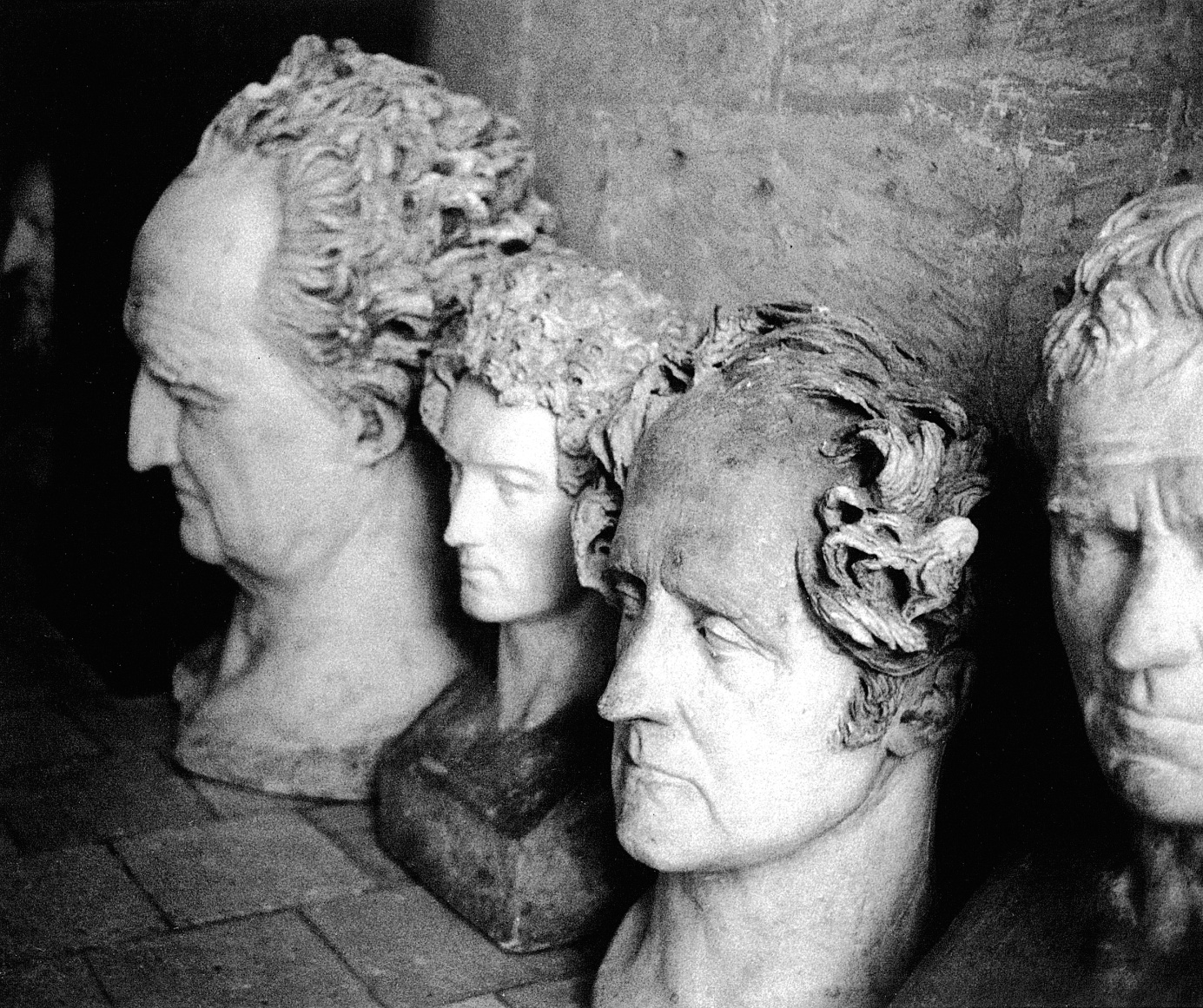
Busts by Pierre-Jean David d’Angers, stored at the Château de Saumur, photograph taken in 1984 by Isabelle Leroy-Jay Lemaistre, curator at the Musée du Louvre’s Sculpture department.
Photo © Isabelle Leroy-Jay Lemaistre (courtesy of the Musée d’Orsay Documentation)
What was the process for planning the sculpture displays at the Musée d’Orsay, particularly when it came to working with the architects and Gae Aulenti, as well as the museum staff? Did the idea for the triumphal aisle in the large nave come from you?
AP: Since air-conditioning the nave was impossible, nothing but sculpture could be displayed there (fig. 6). The triumphal aisle was therefore added almost by default. The French architects had come up with a long sloping layout that was tricky to organise. Gae designed some platforms, and for each platform we picked a theme.
Fig. 6
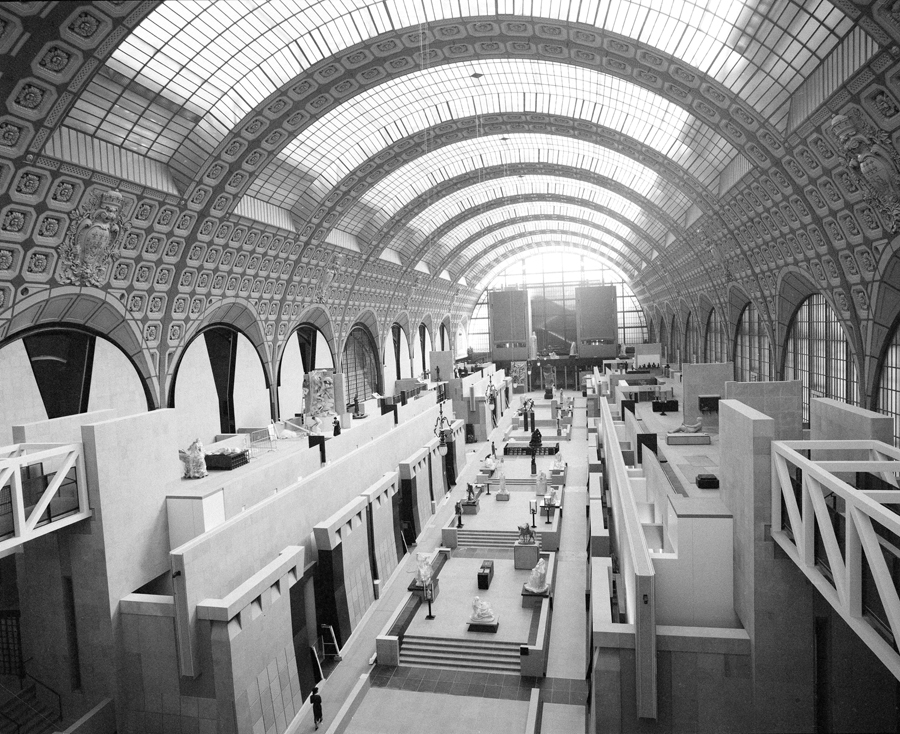
Jim Purcell, View of the Musée d’Orsay’s Nave in 1986, gelatine silver print, 21 × 27 cm, Paris, Musée d’Orsay Documentation, ODO 1996 22 1288 T.
Photo © Musée d’Orsay (dist. GrandPalaisRmn) / Jim Purcell
ALNR: Early on, it was decided there would be a large triumphal space at the back of the nave, with Carpeaux and Rodin above. They were the two highlights – it was a fairly obvious choice.
AP: Plus, it was the main thoroughfare, so there needed to be something impressive.
ALNR: For the galleries, though, it wasn’t an easy start. But in the end, having sculpture there made sense: in the domed rooms, official art worked well whenever paintings and sculptures were placed together. Degas had a room for himself when it came to Impressionism. And for Gauguin, that was obvious. In the large Second Empire room, paintings, sculptures and decorative arts were displayed together. The same approach was taken with spaces devoted to sketches for public monuments. There were still many sculptures at the nave’s lower end, heading towards the auditorium, in display cases that offered an introduction to the history, with busts, medals and models.
AP: Those display cases were Madeleine Rebérioux’s contribution. She was the one who insisted on including history, and she was right. I still remember the arguments! She used the word ‘products’ and Michel Laclotte would say: ‘But Madame, we have works of art here, not products.’ She wanted a locomotive in the nave. As for the historical context, we added it ourselves by starting the displays with François Rude’s Napoleon Awakens to Immortality (1842–1849) – after all, Napoleon cast a shadow over the entire century – and opposite it, his Genius of Liberty, also known as La Marseillaise, from 1836. That introduction, with those display cases designed by Chantal Georgel, are no longer there. All the Jules (Simon, Favre, Ferry, etc.) were sent back to Versailles. I remember the famous French figures on the dirt floor of the old menagerie at Versailles; Antoinette and I took photos of them (fig. 7). The busts were left abandoned until Simone Hoog published her 1993 catalogue organised by subject.
Fig. 7
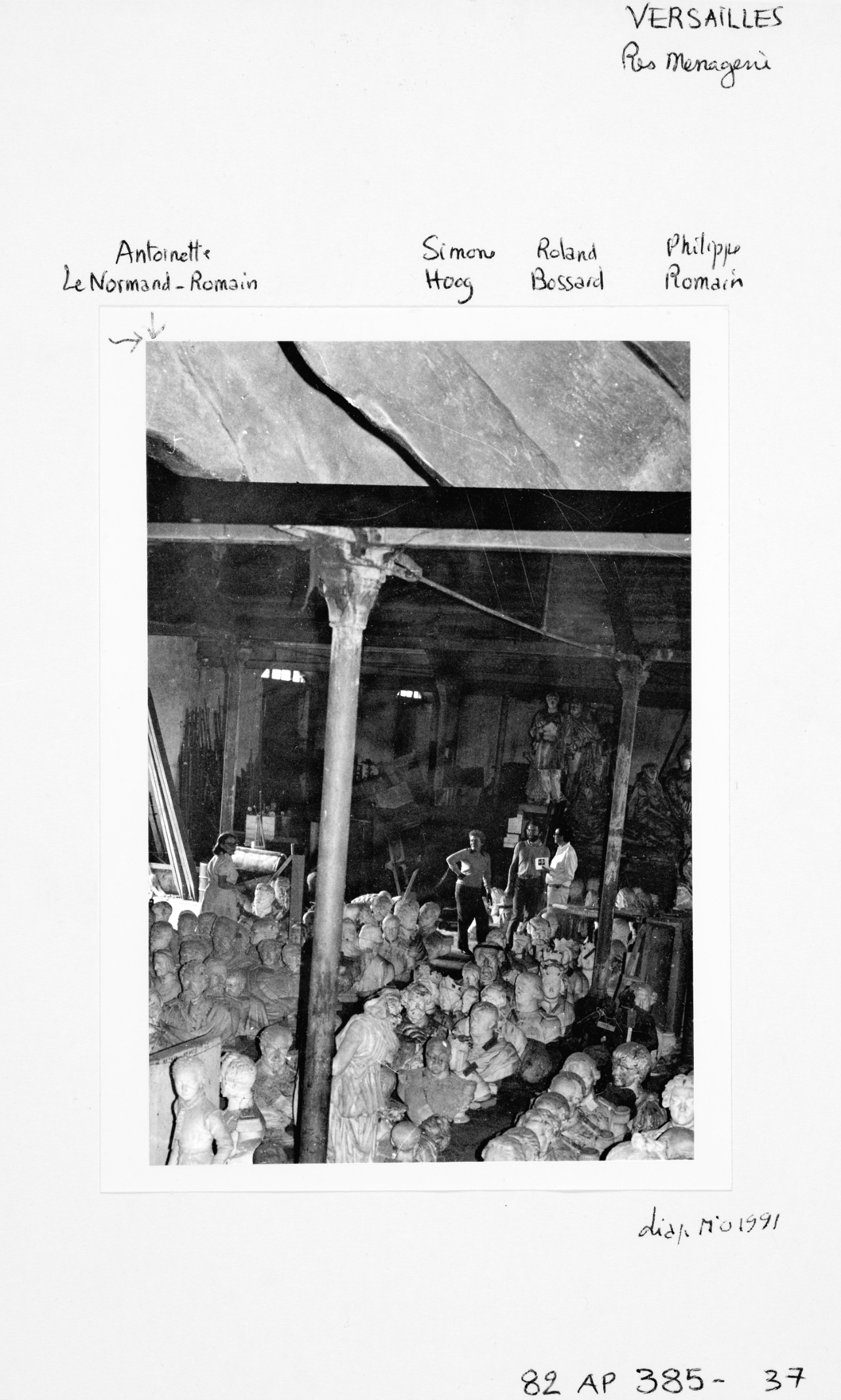
View of the Versailles Menagerie in 1982, photograph by Anne Pingeot, Paris, Musée d’Orsay Documentation, Topography collection.
Photo courtesy of the Musée d’Orsay Documentation
How exactly did you plan the installation of the sculptures?
AP: We had a scale model and used that to work out the arrangements and displays in the chilly space that’s now the museum’s restaurant – back then it wasn’t heated. We discussed everything with Gae Aulenti because sculpture is closely related to architecture. The towers at the back of the nave – one of Gae’s ideas – not only hide the outline of the neighbouring Caisse des Dépôts bank branch but also give some scale back to certain sculptures that looked too small under the vault. The three French architects weren’t meant to handle the interior, yet that was all they could think of. They were suggesting things that might not have worked so well – a little pool, which people would surely have fallen into, and elements lighter than the ‘mastabas’ (fig. 8).
Fig. 8
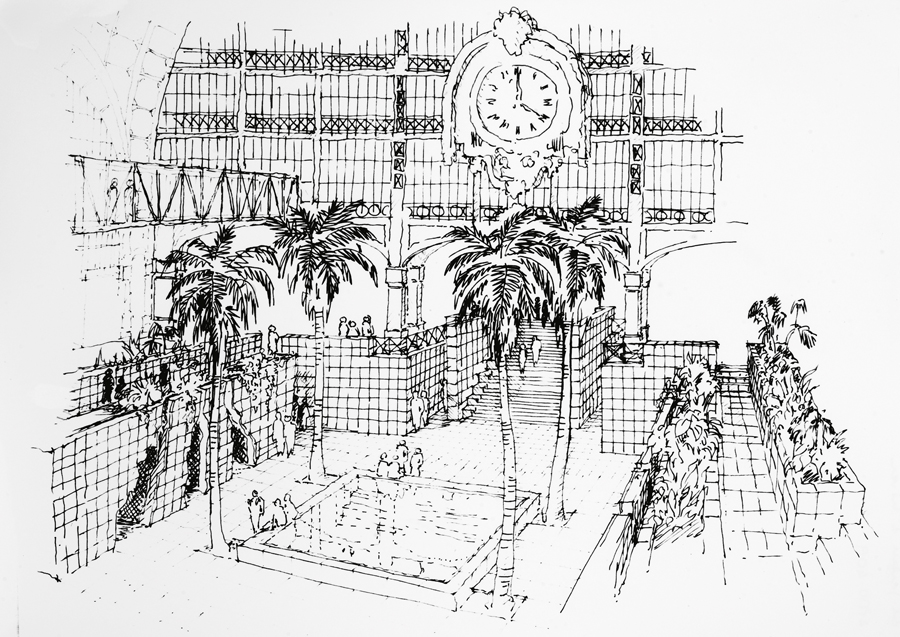
Sketch of the Winter Garden Looking Towards the Western Glass Roof, Project Proposed by ACT Architecture in 1981 (a follow-up study to the scheme presented in the 1979 competition), photograph by Jim Purcell (gelatine silver print, 21 × 27 cm), Paris, Musée d’Orsay Documentation, ODO 1996 22 409 T.
Photo © Musée d’Orsay (dist. GrandPalaisRmn) / Jim Purcell
LdM: The way the sculptures were arranged was the least criticised aspect, while the interior architecture came under heavy fire. I remember dinners in the city where we faced a lot of pushback over the museum’s decisions, for example the ‘pretentious’ artists being put on the same footing as the Impressionists. But the sculpture didn’t attract so many attacks. In the nave, the thing that drew criticism were the ‘mastabas’ – a term used in a derogatory way to refer to the enclosed spaces on either side of the nave.
AP: Another disappointment was seeing the Impressionists displayed against the white background of the gallery at the top of the building. The ‘white cube’ didn’t do them any favours.
LdM: On the ground floor, they were displayed against pale pink stone, and everyone compared that to the Orangerie or the Jeu de Paume. But going back to sculpture, what was more challenging than the nave were the display cases. You not only had to make a drastic selection among the sculptures, but you also needed to think carefully about their placement in these large, completely transparent cubes. It’s hard to fully appreciate the sculptures in this kind of arrangement, since you can’t really move around them. With Degas, the ‘easy’ part was that you could group the works into series, the dance movements broken down into stages, almost like in a Marey photograph. But at the same time, this reduced sculpture to a two-dimensional view.
AP: It wasn’t easy at all. Some of the display cases were refrigerated to house wax pieces. To access the Gauguin case, you actually had to crawl in on all fours – you had to do acrobatics to install the sculptures, change them or even just clean the glass!
ALNR: Yet it worked rather well. Remember the room devoted to Realism, with the Dalou sculptures and a few paintings on the walls?
AP: Sculpture clearly dominated in the Dalou room, which we nearly lost. In the Parisian Life room there was a fifty-fifty balance, as was the case in the Symbolists room too.
ALNR: The spaces closest to the Seine benefited from natural daylight. In contrast, the large domed rooms didn’t have that light but offered plenty of wall space and considerable height, which was ideal for accommodating large paintings. That’s where Cormon’s Cain was hung, above a mural by the same artist that had formed part of the railway station’s original decor.
LdM: There were also some cube-shaped display cases there; you used those for Saint-Marceaux and the Symbolists.
ALNR: There was the large scale model, and Falguière’s quadriga, which has since gone back to Grenoble. The real question, though, when sculptures are placed in rooms devoted to paintings, is whether visitors actually look at them, or whether they’re simply there to fill the space. Do people really see the sculptures?
LdM: There’s also the issue of lighting: unlike American museums, which tend to dramatise their lighting, French museums reject directional lighting in favour of a more diffuse approach. In some cases this worked well, because it felt less like museum lighting − in the Functions room, for example, where paintings and sculptures were brought together and interacted with the decor, mirrors and lighting.
ALNR: One particularly vivid memory I have is from the autumn of 1986, when the works were installed – I especially remember the transport of the largest pieces. I recall that for the Rodin sculptures coming from Meudon, the routes had to be carefully checked to make sure no overhead wires or tree branches would be in the way. There was an excellent team at the museum, including the very efficient Antoine Tasso. And then transport firms – Chenue and others – were called in to help.
AP: I personally always brought in the Louvre’s marble workers, because of the shared inventory system!
LdM: Yes, the large Carpeaux works that were taken out of the Pavillon de Flore to be carried across the Seine (fig. 9). For the Orsay, there was Germaine Pellegrin, an extraordinary woman who worked in the museum’s administration and eliminated countless obstacles for us. She made everything possible.
Fig. 9
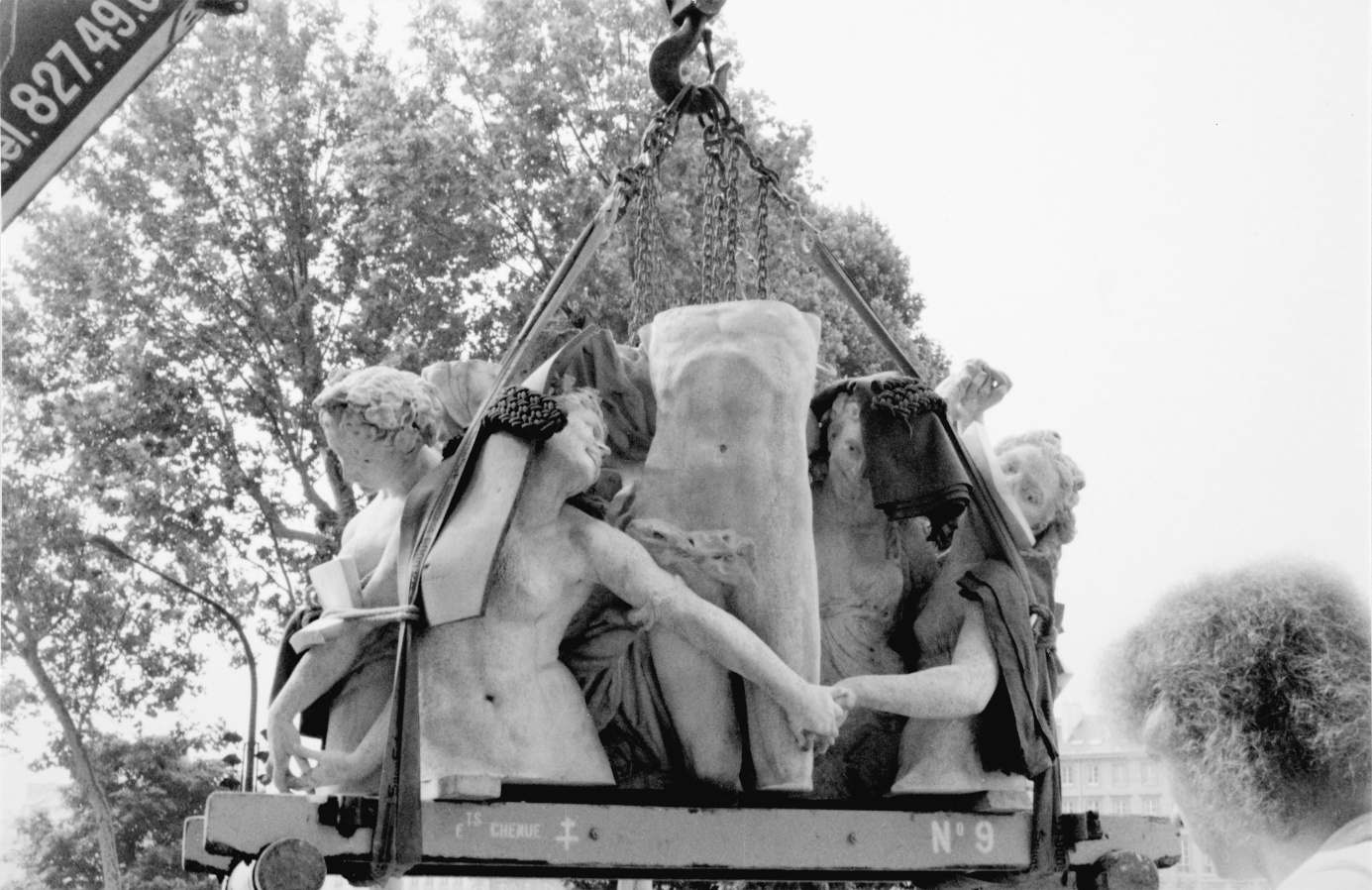
The Dance by Jean-Baptiste Carpeaux being transferred from the Musée du Louvre to the Musée d’Orsay in July 1986, Paris, Musée d’Orsay Documentation, ‘Carpeaux, La Danse’ object file.
Photo courtesy of the Musée d’Orsay Documentation
ALNR: Ève Alonso, the head of collections management, also played a vital role. ‘On we go, with Alonso!’ as we all used to say. She made transporting and installing the sculptures so much easier.
What first drew each of you to sculpture, and what made you stay with it?
AP: I was attracted to sculpture simply because it’s beautiful. Louis XIV preferred sculpture above all else, so in a way we’re carrying on his legacy [laughs].
ALNR: For me, it was a continuation of the dissertation I’d begun at the Villa Medici.
LdM: And for me, what really drew me in was Anne, and the fact that it was virgin territory. It was fantastic. Just imagine – I was studying the history of sculpture, and there were between five and twelve of us in the class. Next door, meanwhile, was Michel Hoog’s course on painting, with a hundred and fifty students. So we had this sense that we were clearing the ground, perhaps building something. The three of us – Anne, Antoinette and myself – were there to set things in motion. Anne always used to say: ‘We’re laying the foundations of knowledge; others will make use of them.’ Today, as I work on the French Sculpture Census project,20 I do so in that same spirit, making the material available so others can use it as they like in the future. We really were there to lay the groundwork. It was exciting. We never felt we were simply repeating things, but rather doing pioneering work. Because the Orsay deals with such a tightly defined period, the museum allows for countless different interpretations. And I think that’s also what the planning of the Musée d’Orsay made possible, thanks to the intense work carried out on the collections and the spaces: a whole range of possibilities and perspectives.