In English, they are called not pompiers or “official” artists but “academic” artists. To be sure, these are vague, overlapping and generally unsatisfactory terms; for present purposes, let us keep them elastic. One thing they have in common is that they are pejorative, even mocking. To be an “academic” artist in the later nineteenth century, for example, means to be disconnected from the latest developments in art and culture – to be absorbed in pedantic, technical questions, as if captured and consumed by the machinery of a great system of painting and sculpture on the threshold of its definitive eclipse. The term “academic” does have one benefit, however: it underlines the importance of a shared system of artistic formation that, by the second half of the nineteenth century, operated as a veritably global edifice. A system that enlisted countless young, mostly male artists into studios explicitly to train for prizes for which the vast majority had little chance of attaining.
Across its galleries and exhibition program, the Musée d’Orsay has made a powerful case for the meaningfulness of this art. Not simply as part of the nineteenth-century patrimoine, but for its renewed ability to command our interest and imagination. What follows in this essay will explore several aspects of this proposition. But first let us stay with the complaints historically made against “academic art,” a phrase that I favor thanks to its affiliation with a famous critique of the pompiers that once circulated widely in Modernist art criticism.
In his seminal 1940 essay “Towards a Newer Laocoön,” American art critic Clement Greenberg charged academic artists with bringing painting to “an all-time low.” For the “academician” (Greenberg’s term), what mattered was not medium but “the anecdote or the message.” It seemed simply a matter of convenience that a painting took the form of “a square of canvas and inside a frame.” Paintings by Jean-Léon Gérôme and his peers, Greenberg charged, might “just as well have been breathed” on air, or been formed “out of plasma.”1 To this charge, Greenberg added another: by embracing the mere “anecdote” and “message,” academic artists forged an unholy alliance with emerging mass culture. This was an art, in other words, that was popular, easy to digest, and ultimately devolved into kitsch, to cite Greenberg’s companion essay, “Avant Garde and Kitsch,” published a year earlier. There, Greenberg was explicit: “self-evidently, all that’s kitsch is academic, and conversely, all that’s academic is kitsch.”2
Perhaps Greenberg was more right more than he knew. The relationship between academic art and new technologies of mass culture has emerged as a central theme of modern scholarship and exhibitions, with the Orsay’s exhibition program front and center, in partnership with its robust documentary and scholarly apparatus. A 1998 retrospective of Jean-Paul Laurens examined his career as both painter and illustrator, the latter occupation underscoring his capacity for pictorial storytelling. The transition from painting and illustration to cinema was a notable theme of the Orsay’s 2014 exhibition Gustave Doré (1832-1883). L’imaginaire au pouvoir. Gérôme’s own intermedial legacy was a key theme of the 2016 retrospective organized with the Getty Center in Los Angeles, where a Hollywood-style reading of the artist naturally saw a warm welcome. And let us not omit similar concerns developed in Enfin le cinéma ! Arts, images et spectacles en France 1833-1907, from 2022. We also know how academic art penetrated bourgeois interiors across the globe under the auspices of the Maison Goupil and its affiliates – with Gérôme, who married Adolphe Goupil’s daughter, again serving as Exhibit A.3
There is much more to say about this historic intermedial hand-off. But this does not translate into redemption. Knowing that Hollywood found in Gérôme and his peers much to admire has not overturned the suspicion that such artists committed a gigantic aesthetic blunder. For the present author, missing from this approach is the artists’ own sense of enterprise, their all-embracing commitment to their artistic vocation, and what we may call their ambition. At the Orsay, such ambition is put abundantly on display. Yet ambition, we should add, is also a relational term, which is to say no artist failed to measure himself against another – living or dead – thanks to an intense, often disabling culture of fraternal emulation, enforced by the academic system and its parade of rewards. Which is to say that such ambition could also go awry.
Ambition
The unfortunate Gustave Doré died in 1883 at the age of fifty-one, wishing to be remembered most of all as a painter. But then (as now) his audiences preferred him as an illustrator. That is the bitter message of a drawing by Leiden artist Alexander Ver Huell (1822–1897) depicting Doré on his deathbed. The scene stages an anecdote published in L’Illustration in 1885, and which Ver Huell took care to transcribe (fig. 1):
Gustave Doré lay dying. A letter was brought to him, marked ‘Personal and extremely urgent’ on the envelope. He motioned to one of his near and dear to open it.
The letter contained a carefully cut-out newspaper clipping from an article listing predictions for the year 1883. One of them read: ‘Monsieur Gustave Doré will continue to make execrable paintings and impossible sculptures.’
The dying man said nothing, but the newspaper clipping slipped from his fingers and two large tears rolled down his cheeks. It was the last printed matter upon which Doré’s eyes – eyes filled with grandiose visions – ever rested..4
Fig. 1
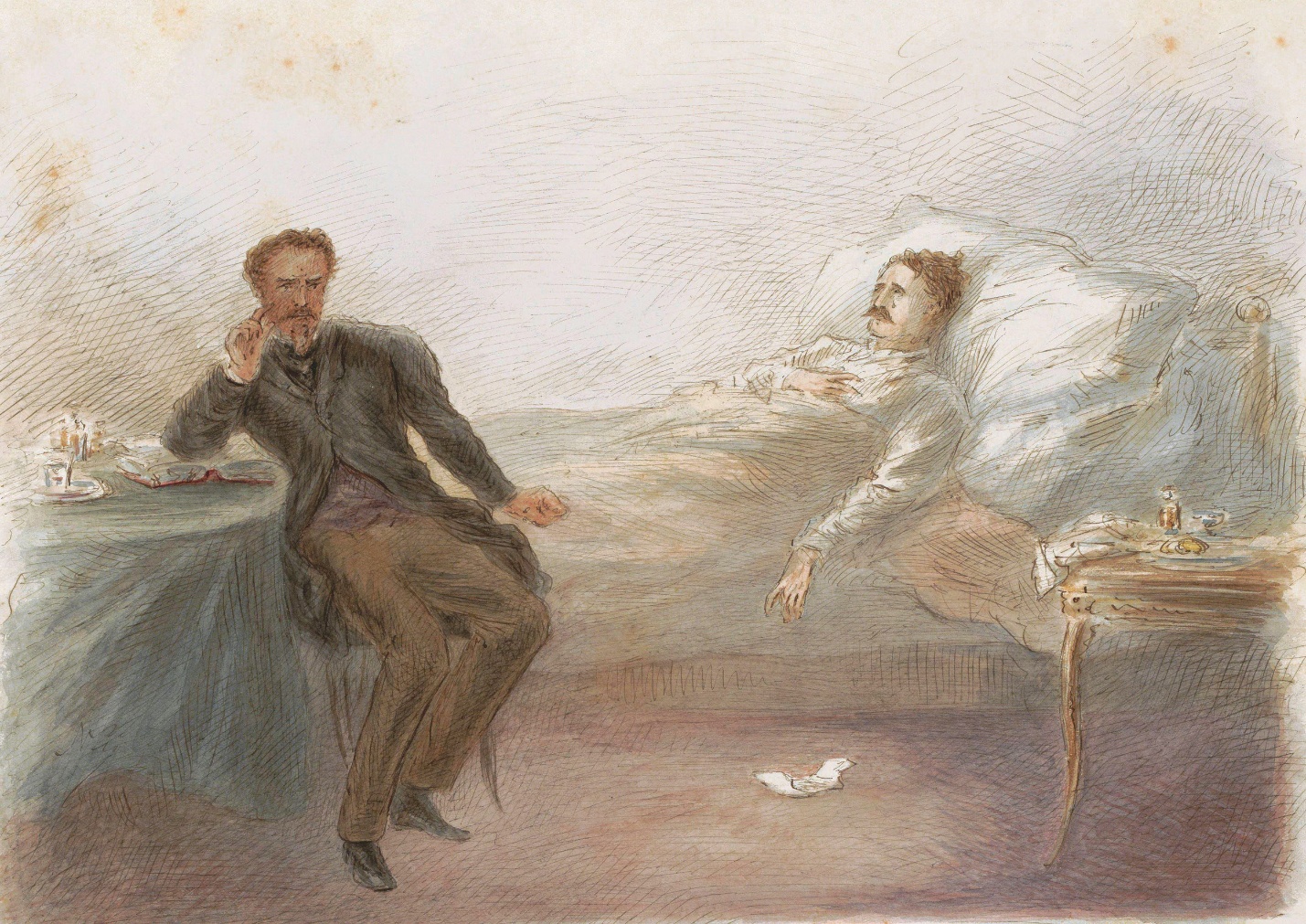
Alexander Ver Huell, Gustave Doré on his Deathbed, in or after 1885, pen and brown ink, 25 × 34 cm, Rijksmuseum, Amsterdam, BI-1924-384-10.
Photo CC0 Rijksmuseum, Amsterdam
In 1982, the Orsay acquired Doré’s captivating Enigma from a London collection, and later, in 2023, Fate and Love, his first effort at “impossible sculpture.” The state, to Doré’s frustration, had declined to acquire the piece, and it may seem like cold comfort that it took 150 years to remedy the offense. But the purchases make an important point. The Orsay is not simply the home for works previously acquired for the Musée du Luxembourg or other French institutions at the time. Rather, such acquisitions form part of a twenty-first-century project – a project that helps make the case for academic art as more than a body of imagery catering to bourgeois tastes, as more than a by-product of the need to adorn public edifices, and as more than part of the state’s collecting apparatus, to cite three familiar rubrics. Rather, this art was produced by artists most of all – by agents of a system, to take the case of Doré, whose vast canvases sometimes seemed, even in their own day, to descend into the “impossible” or the “execrable.” It is art, in short, that we must understand as necessary and urgent, and demanding to be interrogated as such.
Size matters. This was a metric that the Impressionists and Gérôme alike can be said to have demolished. Works of art destined to circulate in the marketplace rely on a different affective calculus than the labor of producing a gigantic painting destined for a (seemingly) permanent home in a public edifice. Size was also a vocational and even psychological metric, born of a commitment to history painting that for young artists operated as a veritable categorical imperative. The brilliantly restored paintings in Gallery 24 of the Orsay offer an exceptional demonstration of this proposition. Paul Chenavard’s Divina tragedia (400 × 550 cm) saw a miserable reception in 1869, although it was still purchased by the state before disappearing for a century. Pierre Lehoux’s Saint Laurent, martyr (429 × 311 cm), painted by the artist at the age of thirty, offers a bravura, even balletic exercise in anatomical figuration whose sheer artifice seems to exceed the most theatricalizing conventions of a historical tableau (fig. 2). No less extravagant are the supine nudes in Tony Robert-Fleury’s immense Last Day of Corinth (401 × 602 cm), while Henri Lévy’s Sarpedon of 1874 (306 × 235 cm) remains one of the museum’s great discoveries.5 Except for Chenavard, each of these large canvases was undertaken by young men – as if youth, ambition and large dimensions operated axiomatically to define the most elite, gendered conception of an artist’s vocation. That is also true for Henri Regnault’s Juan Prim, 8 Octobre 1868 (315 × 258 cm), painted when the artist was twenty-five. Prim rejected the portrait as insufficiently ennobling. This allowed the state to purchase the work after Regnault was killed by a bullet to the head in the Battle of Buzenval in January 1871, by which time Prim himself had already been assassinated.
Fig. 2
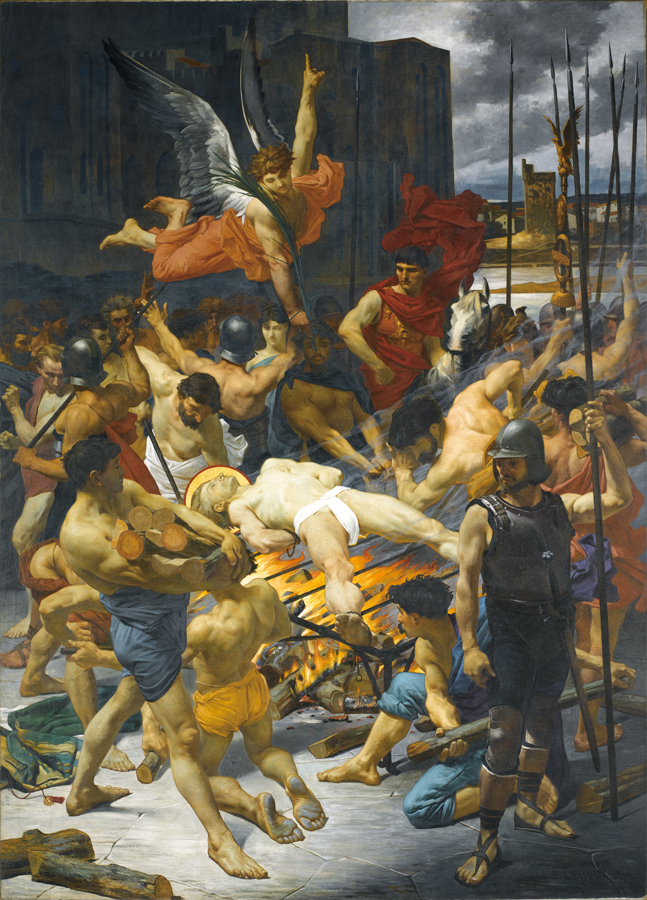
Pierre Lehoux, Saint Laurent, martyr, 1874, oil on canvas. 429 × 311 cm, Paris, Musée d’Orsay, purchase, 1874, RF 437.
Photo © Musée d’Orsay (dist. GrandPalaisRmn) / Patrice Schmidt
For the strange effects of artistic cohabitation, we can look no further than Thomas Couture’s Decadence of Romans (472 × 772 cm), Gustave Courbet’s Burial at Ornans (315 × 668 cm) or again the latter’s Painter’s Studio (361 × 598 cm). At the Orsay, these two artists undergo a remarkable defamiliarizing process, a consequence of the “1848” that launches the museum’s collections. No longer do we measure these ambitious exercises across the grands formats of their predecessors in the Louvre. Rather, the comparisons we are offered are the later, immense canvases in Gallery 24. Couture and Courbet, in other words, are turned into pompiers. This is perhaps confusing to a visitor seeking to track the emergence of Modernist art. But it is also a magic trick that allows us to experience this work with an unfamiliar eye.
And size matters in the other sense. Just ask Ernest Meissonier, whose tiny, brilliantly executed genre paintings, once prized by critics and collectors, today provoke less amused incomprehension (as with the vast canvases of his pompier brothers) than simple disinterest. Meissonier made two further errors as far as his posterity is concerned: he did not paint nude women and he never travelled to the Orient. Happily, a robust handful of paintings by the artist hang in Gallery 10. These include his iconic 1814, The Campaign of France, whose small dimensions invariably leaves visitors at little confused, as well as his superb Painting Connoisseurs of 1860. The panel (only 35.5 × 28.5 cm) exemplifies the artist’s vaunted commitment to authenticity of costume and locale. But even more, it speaks to Meissonier’s exploration of embodied attention, concentration and pose. Crowds no longer press close to marvel at the artist’s uncanny ability to capture how a figure leans back against a chair, or how a second figure bends forward, turning his head, or how a third instinctively presses his fingers together, or how a fourth, seated before his canvas and oblivious to the other three, leans forward, holding his brush. Late in life, Meissonier secured a commission to paint a mural on a large scale, explaining to surprised critics and colleagues that he had been secretly preparing for such a project for years. If the commission went nowhere, Meissonier’s aspiration to paint in large dimensions attest to the insecurities that plagued so many artists who internalized the values of the academic system. Nevertheless, this painter of attention still rewards our attention, and we might think of his tiny bonshommes as offering a discrete riposte to the grandes machines of his colleagues nearby.6
An Orsay Effect?
The great traffic in Salon paintings and sculpture from Paris to the United States proved crucial to the formation of American collections from the 1870s to around 1900. But within decades, this traffic would be obliterated by the massive pivot of American collectors in favor of Manet, the Impressionists and their successors. Works by academic artists descended into storage or made a silent exodus. Gérôme’s life-size Death of Caesar, which prompted such controversy at the Salon of 1859, was deaccessioned by the Corcoran Art Gallery, Washington, DC, in 1951 and has not been seen since. On the other hand, a steady migration from American public and private collections to the Orsay has given some academic artists new life. Jean-Alfred Marioton’s Ulysses and Nausicaa of 1888 arrived at the Orsay in 2016 thanks to a gift from the Société des Amis du Musée d’Orsay. After a second-place finish for the Prix de Rome, the artist saw success in the Salon, while his marriage in 1899 to the daughter of Eduardo Zamacoïs y Zabala led to new connections with the Maison Goupil. Four years later Marioton was dead, and it was probably following the dispersal of his estate that Ulysses and Nausicaa was acquired by American collector Jonathan Ackerman Coles. In 1920, Coles gave the painting to the Newark Public Library, which doubled as an art museum. Fast-forward one hundred years, and Ulysse and Nausicaa was deaccessioned so that Newark could buy more contemporary art.
Have American museums re-evaluated their collections of academic art in light of the Orsay’s example? Henri Regnault’s Automedon with the Horses of Achilles, purchased by the Museum of Fine Arts, Boston, in 1890, was conserved and reinstalled in 2002 after decades in storage. Nevertheless, the overall message is dispiriting. Many, mostly French examples remain in storage or are being sent to storage. In Boston, not only works by Gérôme, but such grand statements as Léon Lhermitte’s Friend of the Humble (The Supper at Emmaus)—exhibited in Paris in 1892 and promptly gifted to the museum by J. Randolph Coolidge—now bear the fatal inscription “not on view.” The Metropolitan Museum owns a still-larger version of this subject, painted by Lhermitte in 1905, also “not on view” (although we can see his spectacular Grape Harvest of 1884). At the Art Institute of Chicago, Henri Lévy’s macabre Death of Orpheus, which in years past gave this author much pleasure, is also “not on view,” despite its tiny dimensions. American museums have other priorities besides exploring the remnants of an academic system of art-making that had expanded across central and eastern Europe, North and South America, North Africa and beyond, sometimes on the heels of colonial expansion. But for the Orsay, compelled forever to reckon with this rupture, precisely the global character of late-nineteenth-century academic art offers a fertile terrain for future exhibitions and scholarship.
Bouguereau and America, organized by the museums in Milwaukee and Memphis in 2019, explored the exceptional enthusiasm for this artist in the Gilded Age. But where American collectors largely preferred chaste, sentimentalizing, and peaceable subjects, at the Orsay we discover a much different Bouguereau. His Birth of Venus was acquired for the Luxembourg in 1878. A group of recent acquisitions, on the other hand, show us Bouguereau exploring more unbridled terrain. These include a study for his prize-winning Zenobia Found by Shepherds on the Banks of the Araxes, acquired by pre-emption in 2015. More striking are two youthful works acquired in 2010 from the artist’s descendants, notably Equality, exhibited in 1849, and his Dante and Virgile of 1850. The latter’s Romantic subject offers a ferocious demonstration of the Diderotian desideratum that a tableau should deliver itself to the viewer in a coup-d’œil – as if, by virtue of such hyperbolic instantaneity, the young Bouguereau sought to erase from the viewer’s memory of all the Romantic Dantes-in-Hell that preceded him.
No less startling are three late paintings that also came to the Orsay in 2010: Compassion! of 1897, The Assault of 1898 and finally The Oreads of 1902. Modern scholarship typically speaks of Bouguereau’s mythological nudes as designed to satisfy bourgeois prurience. And his work’s polished finesse seemed designed to reassure cautious collectors that it stood for the highest standard of “art.” This argument remains relentlessly if casually rehearsed into the present. But to take the example of The Oreads, not even bourgeois prurience can explain the sheer number of nymphs (try counting them) who exuberantly soar into the sky without even attempting to fly (fig. 3). The Orsay’s presentation of Bouguereau invites us to reckon with a more complex and compellingly strange artist than is generally understood. This, in turn, can help dislodge the censorious culture of suspicion that today still colors discussions of the artist and his peers.
Fig. 3
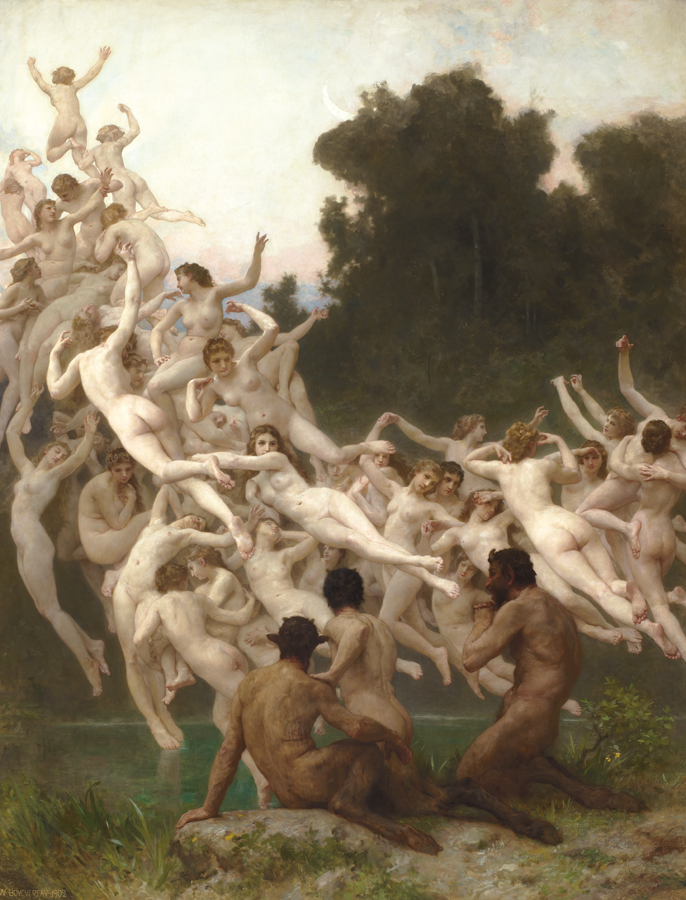
William Bouguereau, The Oreads, 1902, oil on canvas, 237.5 × 181.5 cm, Paris, Musée d’Orsay, gift, 2010, RF 2010 4.
Photo © Musée d’Orsay (dist. GrandPalaisRmn) / Patrice Schmidt
Enter Gérôme
The most famous pompier of his day was not especially well-represented at the Orsay when it opened. Gérôme’s Young Greeks Attending a Cock Fight, which vaulted the artist to fame in 1847, was purchased for the Luxembourg in 1873. In 1984, the Orsay acquired his allegorical figure of The Night, from around 1850. The Night was in fact the kind of traditional exercise that Gérôme would disavow following the tepid reception of his enormous Age of Augustus, exhibited in 1855; technically part of the Orsay today, the piece has resided in Amiens since 1864.7
In other words, in 1986, the Orsay did not possess a Gérôme signed “Gérôme,” to borrow a phrase from Théophile Gautier. Generally, this refers to the great cycle of popular easel paintings launched by the artist following the enormous success of his Duel After the Masquerade at the Salon of 1857. This cycle of “Gérômes” was only launched – to put it more dialectically – when Gérôme finally gave up trying to credentialize himself across the legitimizing terrain of grande peinture in favor of small-scale easel painting, the most brilliant examples of which (not the Duel) were sent to the United States.
Two acquisitions by the Orsay offer supreme examples of Gérôme’s experiments in pictorial scenography, both via American collections. “The Crucifixion!” recounted a journalist in December 1867, upon encountering Gérôme at work on his Jerusalem in his studio: “What a theme for a Frenchman!” Surely, the journalist went on to add, such a subject “might well seem to have been exhausted.”8 Point taken. And yet doubtless it was Gérôme’s very consciousness of the subject having been exhausted that impelled him to the most stupendously perverse drama in his corpus. Purchased by the Orsay in 1990, Jerusalem stands as his most daring exploration of the “moment after,” a quasi-cinematic pictorial device that has attracted much recent attention. It also stands as a major example of his Orientalism. After all, the painting’s title identifies neither an event nor a person but rather a place. (A subtitle was acquired when the painting was reproduced by Goupil.) In fact, it is less a place than a view, as if Jerusalem was the destination and the Crucifixion were something a traveler encountered by accident – and encountered too late. In 2004, the Orsay also acquired Gérôme’s Reception of the Grand Condé at Versailles. Originally owned by William Henry Vanderbilt, it forms part of a suite of subjects on the theme of ancien régime theatricality, in this case a sumptuously painted costume drama completed four years after his famous Éminence Grise from the Salon of 1874, and today in Boston.
Gérôme launched his career as sculptor with his Gladiators, adapted from his Pollice Verso of 1876, today at the Phoenix Art Museum. Following Gérôme’s death, his son-in-law Aimé Morot transposed the pair into a scene of Gérôme at work. Now located on the Orsay’s mezzanine, Gérôme Sculpting “The Gladiators” stands as an unusual exemplar of the now-faded culture of commemoration that spawned many brilliant monuments to artists, from Jules Dalou’s monument to Delacroix, still in the Jardin du Luxembourg, to Antonin Mercié’s monument to Meissonier, once installed (like Morot’s Gérôme) in the Jardin de l’Infante, but now sent off to Poissy.
This is not the place to itemize all of Gérôme’s sculptures at the Orsay, but one twenty-first-century purchase in particular has helped rewrite the history of academic art: the acquisition, by pre-emption, of Gérôme’s plaster and wax maquette of Corinth (fig. 4). On the eve of Gérôme’s death in January 1904, a small group of friends had assembled at his house for lunch. Gérôme did not join the group until dessert, after which he brought them to his studio, where he showed them the maquette. Her jewels had been removed, but to the delight of his guests Gérôme placed the diadem on her head. That evening he dined at the restaurant Champeaux, where he is said to have entreated his Institut colleagues to take seriously recent developments in photography (although which developments we cannot say). The following morning, Gérôme was discovered by his valet who, failing, to rouse him, summoned his doctor. As Moreau-Vauthier reported in 1906, Gérôme’s eyes seemed locked on a painting he kept in his bedroom. Indeed, his arm, “frozen and immobile in death,” was outstretched in its direction “in a supreme gesture of respect and farewell.”9 The painting was none other than Truth Coming Out of Her Well, which exists in several versions. This scenario is of course magical thinking on Moreau-Vauthier’s part, but typical of a nineteenth-century poetics of mortality that staged numerous artist-deathbed scenes. In Moreau-Vauthier’s account, Gérôme’s final gesture operates as a veritable artistic theology. The story recalls Vasari’s famous account of Raphael dying as he put the finishing touches on his Transfiguration, now performed in a secular key as Gérôme bids farewell to his art.
Fig. 4
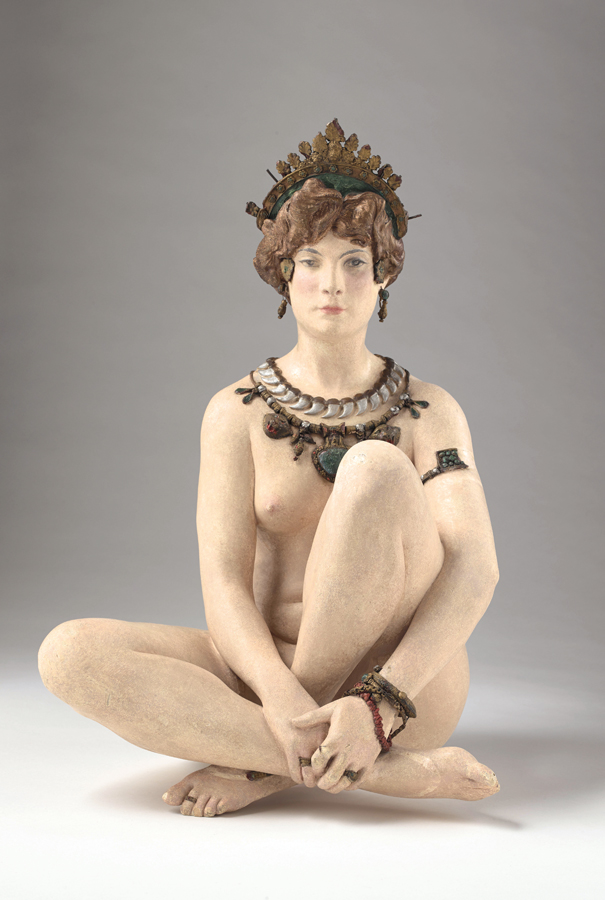
Jean-Léon Gérôme, Corinth, before 1903, statue in polychromed plaster, wax, metal wire, 47.5 × 33 × 30 cm, Paris, Musée d’Orsay, purchase, 2008, S RF 2008 2.
Photo © GrandPalaisRmn (Musée d’Orsay) / Adrien Didierjean
“Farewell Gérôme” was on the minds of visitors when a life-size version of his Corinth was exhibited at the Grand Palais for the Salon des Artistes Français in 1904. Decorated with gilt and precious stones and set on a Corinthian capital that brought the figure to eye level, it had been finished by Gérôme’s friend Louis-Émile Décorchemont. Gérôme had inscribed on the figure’s base, “Not everyone can go to Corinth” (non licet omnibus / adire Corinthum); the aphorism was attributed to one of the city’s “sacred” prostitutes, who resided in the temple of Aphrodite and whose favors were reserved for the affluent. The message was not only that Corinth was where rich men went to meet their ruin. Rather, it was a reminder that, for reasons of fortune or favor, not everything is permitted to us, or that our desires should not exceed our abilities.
A critic spoke of Gérôme’s naked courtesan as indifferent to the stream of visitors walking by, since, after all, “she was used to it.”10 A precious photograph of the vernissage gives us some sense of the attention that her indifference commanded (fig. 5). Exhibited, at first, without a glass vitrine, she sits precisely at eye level. While it might seem inevitable that she directs her volonté dominatrice to a man, in the photograph two women and a man gaze back at her, which is to say that her gaze is not simply emasculating but reciprocally empowering, in manner consistent with the fin-de-siècle cult of the femme fatale. Some critics feared the sculpture was less art than unmediated imitation: it belonged in the Musée Grévin or a shop window. A mere “double,” complained Camille Mauclair in his obituary on the artist, one “without life” – in short, “an enormous error.”11 The poet Tristan Leclère (Tristan Klingsor), by contrast, insisted Corinth was a masterpiece. But he, too, worried that Gérôme’s prodigious powers of imitation had touched on the limits of his art: “cette Corinthe est un chef-d’œuvre, mais le chef-d’œuvre de la fin d’un art : elle n’ouvre pas la route à des essors nouveaux ; elle en marque un aboutissement.”12
Fig. 5
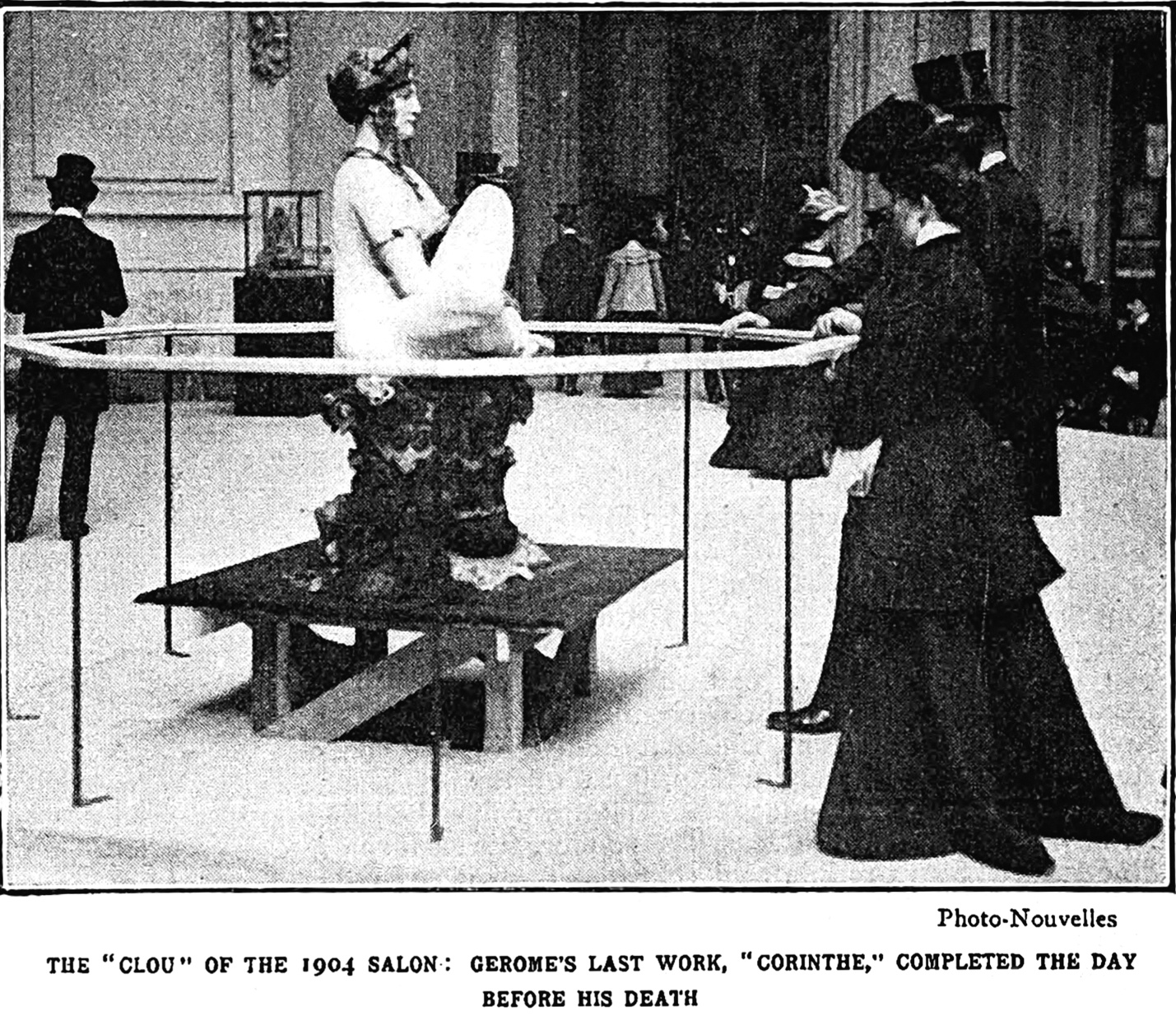
“The Clou of the 1904 Salon: Gérôme’s Corinth, Completed the Day Before His Death”, Black and White, vol. 27, 7 May 1904, 687.
“Completed the day before he died,” the photograph’s caption tells us. This is not quite correct, but let the claim stand, for this understanding was crucial to the sculpture’s reception. Indeed, the idea that Corinth marked a cul-de-sac not only shaped accounts of Gérôme’s polychrome but touches on the problem of the pompiers as a whole, whom we understand to have unleashed an illusionistic imperative taken up in film and other new media, but an imperative that threatened to evacuate their own enterprise from the very idea of art. And the ontological terror provoked by Gérôme’s Corinth remains relevant. The fears it incited recall present-day debates around the so-called “uncanny valley,” the affective discomfort viewers feel when an animation begins to look indistinguishable from being human. That is a topic for another day, but to stay with the uncanny, do we need to underscore that the Orsay’s maquette, to recall the tale regarding the artist’s last night on earth, was the last work of art to touch Gérôme’s hands? As if its category-busting realism was not only the end of his art but the end of Gérôme? As if – mission accomplished – Corinth now called Gérôme to the tomb?
L’Orient et la mort
Greenberg was suspicious, but the intermedial character of academic art must stand as one of its signal accomplishments: the fruit of a shared artistic formation and culture that nourished a complex exchange of imagery and association between painters, sculptors, printmakers, medalists, architects, photographers and architects, not to mention the critics and collectors who promoted or sustained them.
The Orsay offers numerous examples of this cross-media traffic but, by way of bringing this circuit to a close, let us consider just one. Doubtless few visitors pause before the array of fin-de-siècle medailles and plaquettes discretely installed along the Orsay’s “Niveau médian, passerelle.” In 1899, two years before he took up a professorship at the École des Beaux-Arts, Victor Peter completed a biface medal on behalf of the Société des peintres orientalistes, founded in 1893 by Léonce Bénédite (fig. 6). Peter’s cross-legged female figure recalls, if perhaps not outright adapted from, Ernest Barrias’s Young Girl of Bou-Saada, editioned in multiple formats and which also saw wide circulation in fin-de-siècle photography.13 This figure, in turn, had been adapted from Barrias’s marble, Young Girl of Megara of 1870, acquired for the Luxembourg and now on the Orsay’s ground floor. Barrias went on to borrow his for the tomb of Gustave Guillaumet, a celebrated Orientalist who died before the Société was founded. The French press spoke hesitatingly about the scandal, but the New York Times did not hold back, explaining in April 1887 that Guillaumet shot himself in the chest following a quarrel with his mistress.14 His wife and son retrieved the mortally wounded artist and, at his request, brought him to his studio, so that he could be surrounded by his sketches of Algeria as the curtain fell.
Fig. 6
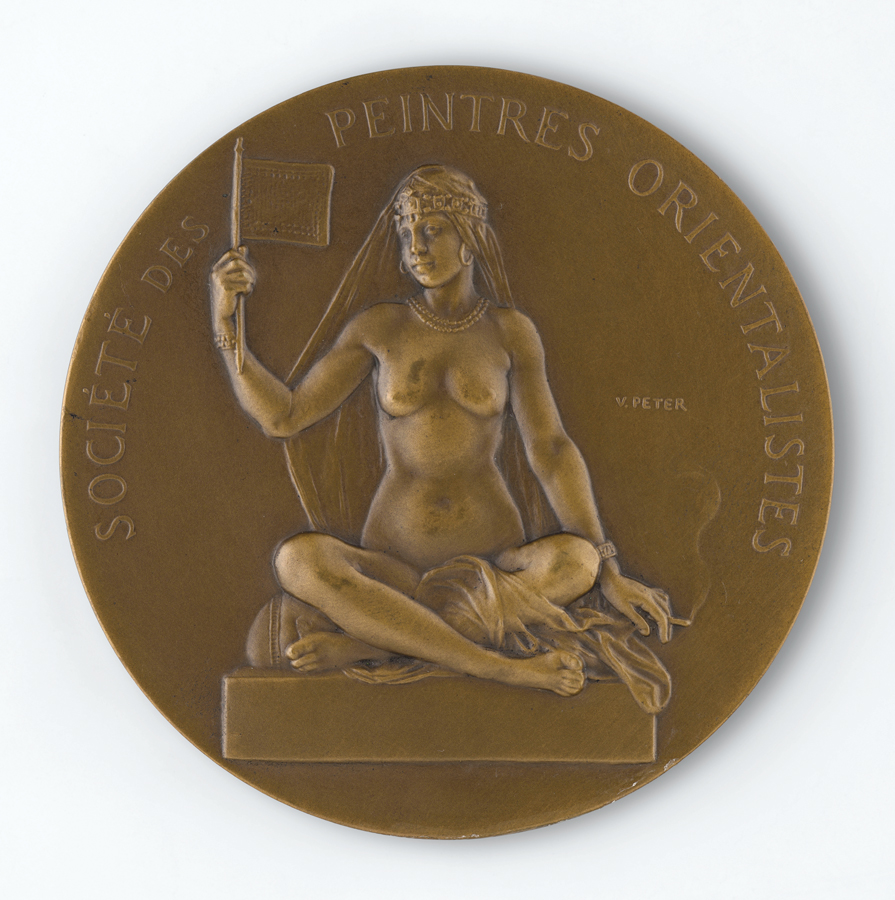
Victor Peter, Society of Orientalist Painters, 1899, biface medal in bronze, 6.5 × 0.6 cm, Paris, Musée d’Orsay, mode of acquisition uncertain, n.d., MEDOR 1105 2.
Photo © GrandPalaisRmn (Musée d’Orsay) / Sylvie Chan-Liat
Twenty years earlier, Barrias had pulled a death mask off the face of his friend Henri Regnault, after his body was delivered to Père Lachaise from Buzenval, where he was killed. If the circumstances differed, Barrias doubtless called to mind this prior Orientalist painter-hero when he undertook the monument to his friend Guillaumet, who had been a pupil of his brother, Félix-Joseph. Unveiled at Montparnasse in 1890, the monument features a version of Barrias’s Young Girl of Bou-Saada, together with a large portrait medallion of Guillaumet. Barrias’s flower girl itself recalled Guillaumet’s female figures, including the cross-legged young women in his Weavers of Bou-Saada, purchased by state after Guillaumet’s death and now at the Orsay. That the flower-girl on the tomb should evoke a figure from Guillaumet’s own painting was central to the conceit Barrias put in place. And this was also true for the nude on Peter’s medal – not a direct borrowing per se, but prompting an association impossible to suppress, as if every time the medal was given out as récompense, it called up the memory of an artist who could never number among the Société’s members. Smoking tobacco, Peter’s lethargic nude offers a vision of the Orient across the mythology of its intoxicating promise. A vision, in other words, not only of artistic renewal, but of sensorial overload and even death – a prospect, needless to add, figured as feminine.
Perhaps only at the Orsay can we bring to the surface such artistic networks uniting remembrance and association across media. Indeed, perhaps only here can we elicit their artistic and material trace, an intimate by-product of the vast, impersonal machinery, both institutional and pedagogical, of academic culture at a moment of its historical twilight. That is also to say, more generally, that there is no account of this art that can avoid wrestling with its melancholy terminus. History is written by the victors, and it is inevitable that a museum organized around a unique historical rupture will tell the story of that rupture from the victor’s point of view. But my Orsay, if I may be permitted the phrase, also shines a light onto the lived experience of artists as they navigated a shifting landscape and even its ruin. Such poignant journeys may not be the only, the most important, or the most popular narratives the Orsay puts in place for us. Still, they remain countless in number and we may hope that, forty years on, they continue to find new life.