‘If every cultural act is political, the Orsay project is certainly political,’1 wrote Jean Jenger, director of the Établissement Public du Musée d’Orsay (EPMO),2 at the end of his book on the architectural undertaking that had transformed the railway station into a museum. The creation of a service culturel (fig. 1) for the future museum can be viewed in the same light; indeed, this is how those who commented on the final stages of its planning saw it. Many attributed it to Madeleine Rebérioux’s appointment as vice-president of the EPMO in the summer of 1981. When this department was set up, in the autumn of 1985 − a little more than a year before the museum’s opening − it was easy to cast it as ‘left-wing’ in contrast to art conservation, presumed to be ‘right-wing’, as its very name, with its semantic ambiguity, seemed to suggest. Admittedly, its creation may have given rise to a certain wariness among the curators who had spent several years assembling and documenting the future museum’s collections. What is more, it was placed at the same level as the conservation department in the museum’s organisational structure − a choice that surprised many and even stirred up controversy. This dichotomous vision, recognised by all as echoing the shift in France’s governing majority, set the traditional idea of a fine arts museum against the imagined reduction of masterpieces to the status of ethnographic objects. Would the museum go so far, one journalist wondered, as to exhibit ‘a flatiron in front of a Degas painting’?3
Fig. 1
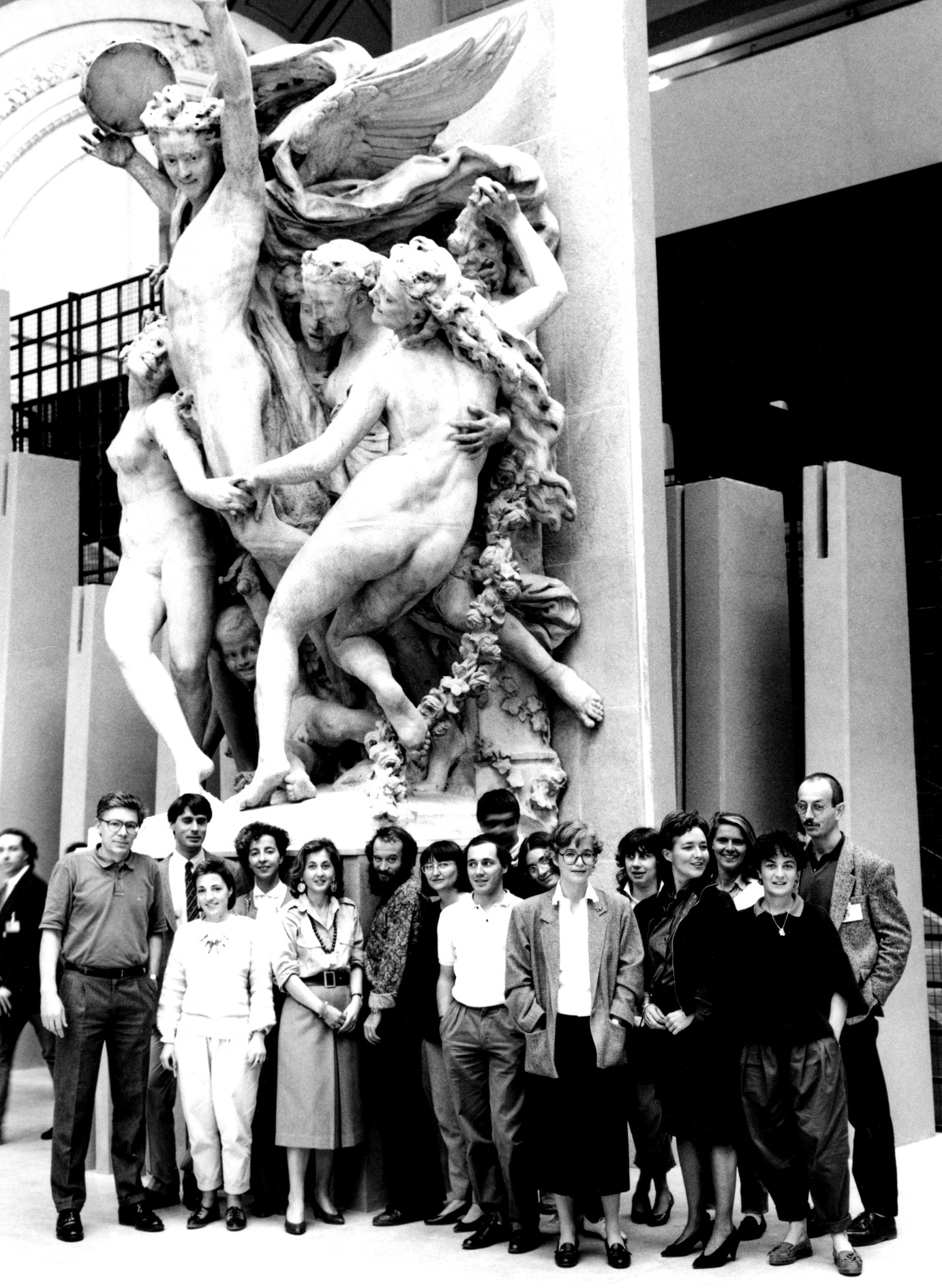
Jim Purcell, Staff of the Musée d’Orsay’s Service Culturel at the Museum’s Opening, ca. 1986, gelatine silver print, 21 × 27 cm, Paris, Musée d’Orsay Documentation.
From left to right: Roland Schaer, David Guillet, Nicole Hodcent, Aïcha Kherroubi, Marie-Thérèse Caille, Jean-François Minois, Pascale Buttaud, Didier Frémond, Claire Barbillon, Nicole Savy, Laurence Janin, Évelyne Lehalle, Virginie Herbin, Béatrice Brouard and Pierre Sesmat.
Photo © Musée d’Orsay / Jim Purcell
Today, we can see that the political explanation was overly one-sided. An examination of the project’s stages and testimonies from those involved shows that the concept of a service culturel, together with its general purpose and initial missions, had already begun to take shape before 1981. Michel Laclotte, who had anticipated the railway station’s conversion into a museum in the early 1970s and joined the project a few years later, repeatedly stated that the idea of a multidisciplinary museum had quickly become self-evident; he connected this with ‘the notion of a service culturel, which [to him] seemed like a natural choice, since music, lectures and academic conferences [had been planned].’4
Innovation and Inspirations
The service culturel’s creation was undeniably a groundbreaking move for a French museum, ‘a major museum innovation marked by inventiveness and vitality,’ as one commentator put it.5 However significant and novel the ambitions for the Centre Pompidou may have been, the latter institution offered no model that could be replicated. Of course, Georges Pompidou himself had explicitly affirmed this cultural vocation when describing his vision for the centre that would bear his name (‘My heartfelt wish is for Paris to have a cultural centre […] in which the visual arts exist alongside music, cinema, books and audiovisual research’).6 The idea had also been expressed in the January 1975 legislation defining the status, missions and organisation of the future centre as a ‘national public institution of a cultural nature’. But for the Musée d’Orsay, the project clearly consisted of a single institution − a museum rather than, with the Pompidou, a unified assemblage of different cultural entities (public information library, national museum of modern art, institute for acoustics/music research and coordination, and industrial design centre [BPI, MNAM, IRCAM, CCI]).
Institutionally closer to the museum curators working to set up the Musée d’Orsay, though less visible to the public and outside observers, an entity devoted to cultural initiatives serving all French museums already existed; it was further developed during Jack Lang’s first term as minister of culture. Its scope of activity, initially focused on coordinating lecture-based guided tours given by staff members of the French national museum agency to knowledgeable visitors, later innovated by introducing alternative tour formats for school groups. It notably developed educational resources for teachers at all levels for exhibitions organised at the Grand Palais and for new museum openings.7 It likewise oversaw audiovisual production for museums and temporary exhibitions while laying the foundations for openness to emerging technologies.
Finally, Laclotte recognised the influence that a trip to the United States, undertaken at the end of the 1970s, may have had on the team responsible for planning the future museum: a ‘tour of the major museums [notably] to see how service culturel and visitor services were organised at those institutions which had long been accustomed to them […], as well as the role of auditoriums.’8 However, he himself had noted that these departments operated entirely independently of curators and researchers, an arrangement that did not suit the Musée d’Orsay project.
Indeed, the museum’s focus on a relatively narrow historical period, together with the defining decision to embrace all forms of artistic creation, would inevitably result in a departure from these models. The appointment of a historian as vice-president would further shape the new department’s mission.
A Multidisciplinary Approach: More Consensual Than the Inclusion of History
Certain statements and other indications suggest that most curators working under Michel Laclotte on the future museum’s programme had accepted his ‘choice of a multidisciplinary approach’, which meant featuring works from various visual art disciplines – including photography, cinematography in its early days, illustrated books, and so on – as well as recognising the importance of reflecting the period’s cultural life. In 1979, he wrote that by focusing on ‘certain figures, events and themes’, the museum would showcase ‘the vitality of the literary, musical and even scientific creativity of the period, particularly with its multifaceted links to social life.’9 Moreover, several years before the service culturel came into being, four researchers – curators and university scholars – had joined the conservation team to focus specifically on music,10 literature,11 illustration12 and cinematography.13 The format of the ‘dossier’ exhibitions that visitors would encounter while making their way through the museum was essential not only in highlighting the multiplicity of fields represented but also in implementing several instances of interdisciplinarity.
However, the inclusion of political or social history was not yet explicitly mentioned. Rebérioux was in fact appointed vice-president because of her experience as a historian of politics, a member of the Communist Party until 1969, a member of the central committee of the Ligue des Droits de l’Homme and editor of the journal Le mouvement social. Her appointment came a few months after the election of President François Mitterrand, when Jacques Sallois14 was chief of staff to Lang during his first term as minister of culture. Upon being appointed, she herself explained: ‘It is because of my research on the nineteenth century’s social and cultural history, but also because of my political choices and involvement in the voluntary sector, that I have been given […] the responsibility of defining the new historical orientation of the museum’s programmes.’15
The idea of including historical information gave rise to substantial debate even before the service culturel was created. The task of integrating it was entrusted to Chantal Martinet-Georgel, a young curator originally destined for the Musée National des Arts et Traditions Populaires, who had incidentally written her doctoral dissertation under the supervision of historian Maurice Agulhon. She designed a section called ‘Ouverture sur l’histoire’ (opening up history), with display cases containing objects chosen for their ability to conjure up the defining moments of the years 1848–1914. This display occupied an area that visitors could easily miss, however, since it was behind them when they began making their way through the large nave on the ground floor. Even so, it remained essential for school groups, for instance, and for any other visitors interested in the conceptual framework of the museum’s period of focus. This arrangement was rounded out, in one of the walkways behind the clock, by another feature known as the ‘Passage des dates’ (walkway of dates), which offered a veritable lesson in event-based and cultural history. It stretched above a second corridor, the ‘Passage de la presse’ (walkway of the press) (fig. 2), which charted this medium’s extraordinary expansion during the second half of the nineteenth century. In both instances, the displays featured documents accompanied by audiovisual and digital devices. Rebérioux lamented what she saw as a ‘relegation of historical discourse to the museum’s margins.’16 In her view, the ‘strict separation of genres’ illustrated what she believed to be the conviction of most museum professionals, namely that works of art speak for themselves. The service culturel she called for was meant to remedy this by showing that the satisfaction of understanding in no way detracted from aesthetic enjoyment.
Fig. 2
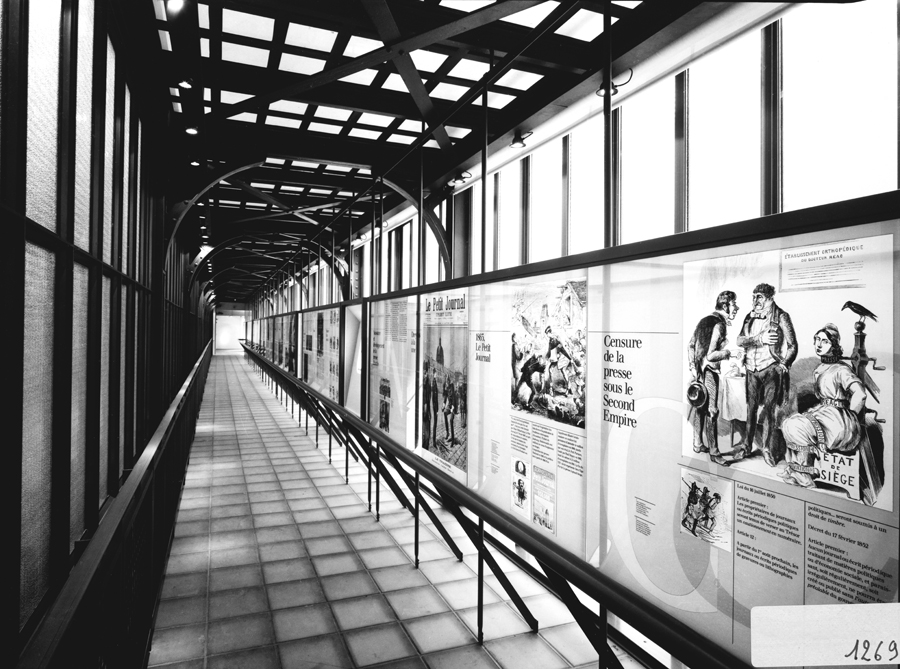
Jim Purcell, The Bellechasse Glazed Walkway, Known as the ‘Walkway of the Press’, 1986, gelatine silver print, 21 × 27 cm, Paris, Musée d’Orsay Documentation, ODO 1996 22 1269 T.
Photo © Musée d’Orsay (dist. GrandPalaisRmn) / Jim Purcell
The Service Culturel’s Gradual Development
If we summarise the stages that preceded the service culturel’s official ‘birth’, we will find that they already foreshadowed some of the missions it would later take on. Alongside the traditional ‘fine arts’ disciplines overseen by the four colleagues who had joined the curatorial team, an audiovisual production programme was also being developed.17 An ambitious and innovative image bank project linked to a database18 furthermore marked the dawn of digital initiatives, while a lecturer from the French national museum agency19 had been tasked with designing a number of workshop tours in the space above the auditorium provisionally called the ‘youth platform’.
It was not until September 1985, however, that the department was officially created. By that point it was no longer defined simply as a juxtaposition of functions but rather as a coherent entity, and a genuine policy had been established for it (fig. 1). All positions within it filled from that date onwards had been intended for teachers seconded from the French national education system − those with agrégé or certifié status, meaning that they had passed a highly competitive national exam, or who were primary school teachers − without any disciplinary specification. A university education in art history was plainly not a prerequisite. Although this choice may seem surprising today, it reveals the implicit emphasis placed first and foremost on pedagogical expertise, the aim being above all to make the museum a place of teaching and learning; the department’s dominant policy line would moreover be illustrated by the slogan ‘learning to see’ (apprendre à voir), an imperative conceptualised as a unifying mission. This focus on the department’s educational role was also evident in the ranking of duties listed in the job description for the department head, who was required to be agrégé: ‘This staff member […] will be responsible for relations with the educational sphere (teachers and young people), external cultural relations (cultural centres, film archives, universities, the French National Centre for Scientific Research, works councils, etc.) and the programming of cultural activities (performances, audiovisual media etc.).’20 In the event, the person appointed, Roland Schaer, was a graduate of the École Normale Supérieure and agrégé in philosophy. Like the three other colleagues who joined him at the start of the 1985 school year, he not only had an impressive academic profile but also arrived with a very different professional background, having directed the Institut Français in The Hague for nearly a decade. Nicole Savy, hired as the coordinator of cultural history lectures and courses for the museum, was agrégé in modern literature and had developed research expertise in nineteenth-century literature.21 One of the two new staff members with certifié status, Aïcha Kherroubi, was originally a modern literature teacher and Slavic studies specialist and had previously worked in the French cultural cooperation network in the Far East and Georgia; she was tasked with planning cultural events. I myself was the fourth person, and the only one with some limited experience in museum cultural outreach (I had worked in the government department responsible for museum oversight) or with a graduate degree in art history. We were soon joined by three primary school teachers, Didier Frémond, Nicole Hodcent and Jean-François Minois, appointed specifically to oversee the reception of primary school groups and design tours tailored to young children. Another teacher with certifié status, David Guillet,22 was recruited to take charge of external relations; it was he who created the Carte Blanche visitor membership programme. Not long afterwards, he was joined by Évelyne Lehalle,23 the first museum specialist hired by the department, who had previously been involved in outreach efforts aimed at new audiences, including potential visitors who were distant from or excluded from access to cultural offerings. By the end of 1986, a few months before the museum opened, the team dedicated to teacher training and educational resource development was further expanded with the addition of two instructors (Pierre Sesmat,24 agrégé in history, and Pascale Buttaud, certifié in the visual arts; together they devised a highly novel approach), as well as Hélène Madesclaire, a documentation specialist from the French national education system, replaced in 1989 by Joëlle Bolloch,25 both of whom developed visitor reception resources that made it easy for members of the public to plan their visits. Audiovisual production, begun during the museum’s planning phase, had been entrusted to Brigitte Legars (soon replaced by Virginie Herbin) and was later incorporated into the remit of the service culturel.
Multiplicity or Unity of Functions
The challenges that the service culturel’s initial team faced were varied. They had to foster a multidisciplinary approach and increase the contextualisation of the collections; help enhance visitors’ time at the museum by offering a broader intellectual experience; build loyalty among the most enthusiastic visitors; create strong links with the education sector by developing tours aimed at young audiences; and, finally, reach out to distant audiences – first-time visitors, social-sector audiences and those with limited access to culture, among others. The potential areas of action and arenas for experimentation were certainly multiple. The museum’s auditorium, for example, was an ideal venue for cultural events. The concerts and silent film festivals held there over the years were the outcome of rigorous research that went into developing a repertoire rooted in the historical period of the museum’s collections, and they functioned as events equivalent to temporary exhibitions. Lectures, debates and courses likewise supplemented the collections, focusing on themes open to the most current issues in nineteenth-century scholarship. They also provided opportunities to invite academics, whether French or international. The strategy of cultivating a loyal local audience was given an effective instrument, the Carte Blanche, which allowed cardholders access to the collections without the need to wait in line as well as the chance to take part in a wide range of cultural activities. This commercial attractiveness and social inclusiveness also set the programme apart from a conventional ‘friends of the museum’ type of association. The educational orientations spearheaded by the service culturel’s head thus not only disrupted the traditional lecture-based tour, whose strictly oral form was the most common practice, but also upended the earlier conception of workshop tours under consideration before the department’s creation. In fact, deploying all the facets of the overarching imperative forged in the first months and expressed in the slogan ‘learning to see’, the team specifically sought out alternative approaches to mimetic practices (such as having children paint to better grasp Impressionism or experiment with clay to learn how to make a statuette ‘hold together’). The aim was to educate the eye rather than the hand; while the learning process could also take place through actions, practice was never meant to take precedence over seeing.
Ultimately, then, everything converged towards the aim of enabling the widest possible range of visitors to acquire resources and tools allowing them to see the works in the museum’s collections more clearly – in other words, in a more informed way. Beyond the strictly pedagogical considerations, this amounted to a response to the well-known debate that, in rather rhetorical terms, posited two opposite conceptions of a museum: it was either a place of aesthetic enjoyment or of knowledge.
An Emblematic Cultural History Initiative: The ‘Key Points’ Information Sheets
At the museum’s opening, a discreet informational tool deployed throughout the exhibition spaces attracted little comment, yet proved so popular that it quickly led to a publication made available for purchase by the French national museum agency. It consisted of seventy-eight summary sheets providing further details on various cultural themes from the 1848–1914 period that were useful – in some cases even essential − for a fuller appreciation of the works displayed in the museum’s galleries. These texts were presented to museum-goers in the modest form of laminated double-sided A3 sheets kept in storage cases fitted with slots; eleven such units were installed at various points along the visitor’s path (fig. 3).26 They did not demand attention the way wall-mounted panels in the galleries might have done; visitors were instead free to pick them up and read them if they so desired.
Fig. 3
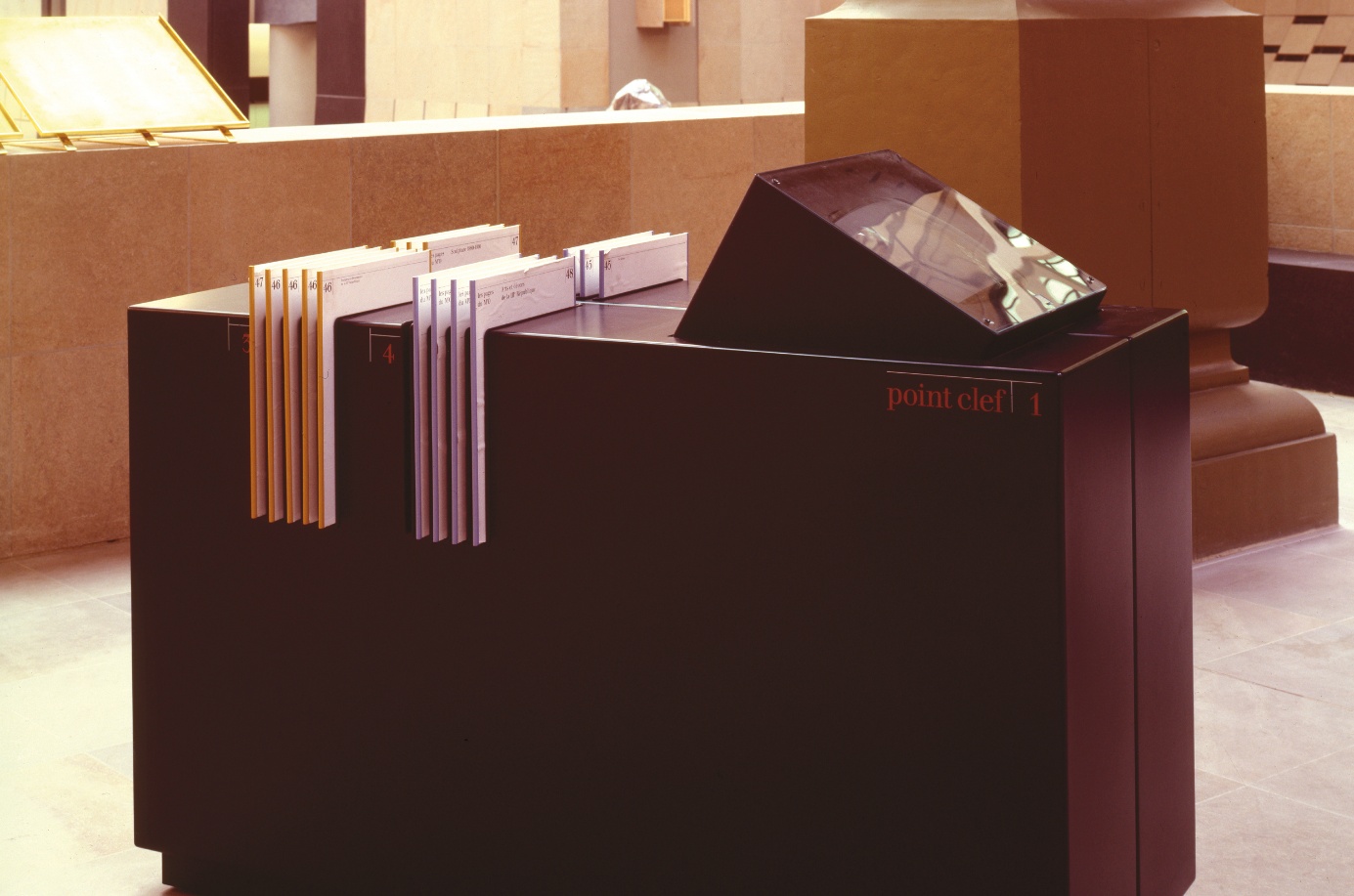
Jim Purcell, ‘Key-Points Case’ Designed by Gae Aulenti, with Video Screen, 1987, gelatine silver print, 21 × 27 cm, Paris, Musée d’Orsay Documentation, ODO 1996 22 1298 T.
Photo © Musée d’Orsay / Jim Purcell
The ‘editorial’ aspects of these sheets had been entrusted to the service culturel,27 whose instructions were clear – this information was to support, illuminate and complement a museum visit without competing with the artworks, and indeed without even commenting on them. The sheets were thus the opposite of what one might call ‘expanded wall labels’. Yet the goal for them was ambitious – taken together, the seventy-eight texts formed a ‘mini-encyclopaedia’ of the cultural context in which the highly diverse exhibited works were produced, and they were placed in various spots on all three of the museum’s levels. A subtle connection was moreover established between these sheets and the visitor’s progress through the different artistic techniques, which were exhibited separately. The coloured strips in which the sheets were inserted thus created correspondences between artistic fields and the themes addressed: blue for painting, light brown for sculpture, purple for the decorative arts and orange for architecture. This same colour-coding was also used on the museum maps distributed free of charge to visitors, and in the guidebook, the most commonly purchased publication. That said, this admittedly subtle coding system, which sometimes led to the production of bicoloured strips, was noticed only by the most attentive visitors.
Viewed with the benefit of forty years’ hindsight, the sheets are an example of how the creation of this all-new department − there being no precedent in any other French museums − was grounded in an intellectual affinity with the emergence and consolidation, in universities and intellectual circles of the time, of a novel discipline: cultural history. The latter owed much to the Annales school of historiography and also drew upon the German tradition of Kulturgeschichte. Historians Pascal Ory and Roger Chartier defined cultural history’s methods and objects by prioritising the social history of representations and depictions, which encompassed the production of art. As a sign of this permeability, immediately after the museum’s opening, the service culturel scheduled a series of ‘cultural history courses’ in the auditorium that were designed to bring together students (notably from the École du Louvre) and enthusiasts from all walks of life. The label ‘cultural history’ prompted some to question whether the museum was in fact the right place to provide, in an inherently multidisciplinary manner, courses that could cover works of art − even the most prestigious − in a perspective extending beyond canonical art history. The publication of some of these courses, and of lectures also held in the auditorium, gave rise to the first form of 48-14, with the subtitle Conférences du Musée d’Orsay (lectures of the Musée d’Orsay). After a few issues, it became a proper journal,28 supporting efforts to build loyalty among Carte Blanche cardholders.29 In this way, the service culturel affirmed its role in producing and disseminating cultural history offerings that were integral to the museum’s core missions. Despite subsequent reconfigurations that did not leave the structure of the service culturel untouched, this mission has endured. It has even opened up fruitful lines of research that still have much to offer four decades on.