The Musée d’Orsay came into being in a time of peak tension in art-historical debates. Clashes over protocols of interpretation in the 1980s had a profound impact on my journey as a scholar. Before returning to them, however, it is important to acknowledge that the field of nineteenth-century art history has clearly moved elsewhere. Interest in the “art of Édouard Manet and his followers,” to use Timothy J. Clark’s well-known designation, has weakened.1 French Impressionism and other Europe-based forms of modernism have been displaced by the study of conditions (exile, diaspora, colonialism, decolonization, racism, environmental devastation), diverse geographies (not European), other eras (post-1960s) and other media (photographic and popular).2 The tilt towards global approaches is a salutary acknowledgement of previously ignored determinative aspects of colonialism. Fifty years ago, no one introduced an account of Paris-based nineteenth-century modernist art by observing that the City of Light was the capital of the world’s second-largest empire.3
The global tilt has changed the prospects for social art history; as Robert Slifkin and Anthony Grudin have noted:
An understanding of art as an index of historical change, which provides a rudimentary but no doubt essential foundation for a great deal of social-historical analysis, has become increasingly tenuous as the traditional boundaries, both spatial and temporal, seem fractured and ill-equipped to comprehend the intersections and multiplicity of historical narratives that a globalized, postcolonial, and technologically mediated world has engendered.4
At the same time, a paradoxical museum-driven counterthrust needs acknowledgment. Paris 1874, the transatlantic celebration of the 150th anniversary of the so-called “First Impressionist Exhibition” in 1874 – mounted in 2024 at the Musée d’Orsay (Paris 1874. Inventer l’impressionisme) and the National Gallery of Art in Washington, DC (Paris 1874: The Impressionist Moment) – roused public attention and ignited the interests of university students, for whom Impressionism was both a new topic and more interesting (“more historical”) than they expected.5
This essay will back up and endeavor to describe and explain a seismic shift in the historiography of modern art: the turn to social history in the 1970s and 1980s, centered in anglophone histories of advanced French art, including my own work as a young, emergent art historian.6 But the investigation is made complex by those who believe that the methodological shift of the 1980s has remained in place – as, for example, when art historian Marnin Young asked not long ago, “Who would care to dispute that the social history of art now dominates our understanding of Impressionism?”7 His question problematically suggests that the “social history of art” is a fixed system of interpretation. It is, alas, an illusion to believe that social art history from the 1970s and 1980s parallels that which is practiced or at least avowed today (a matter touched on in what follows). It certainly does not accurately characterize the twists and turns in my own scholarship since earning my Ph.D. forty-two years ago.
Clark vs Cachin in 1985
We turn now to the ways and the conditions under which the historiography of Impressionism was shaped by particular accounts of Édouard Manet’s art, an irony appreciated by specialists well aware that Manet did not exhibit his work in any of the “Impressionist exhibitions.” The heated debates that arose over the interpretation of Manet’s oeuvre were spurred – indeed, in many ways, enabled – by the comprehensive display of his art mounted in 1983, the centenary of the artist’s death. The title of the enormous retrospective exhibition – it contained 221 artworks – was compact and to the point: Manet, 1832–1883.8 The primary curators were Françoise Cachin and Charles Moffett.
Fig. 1
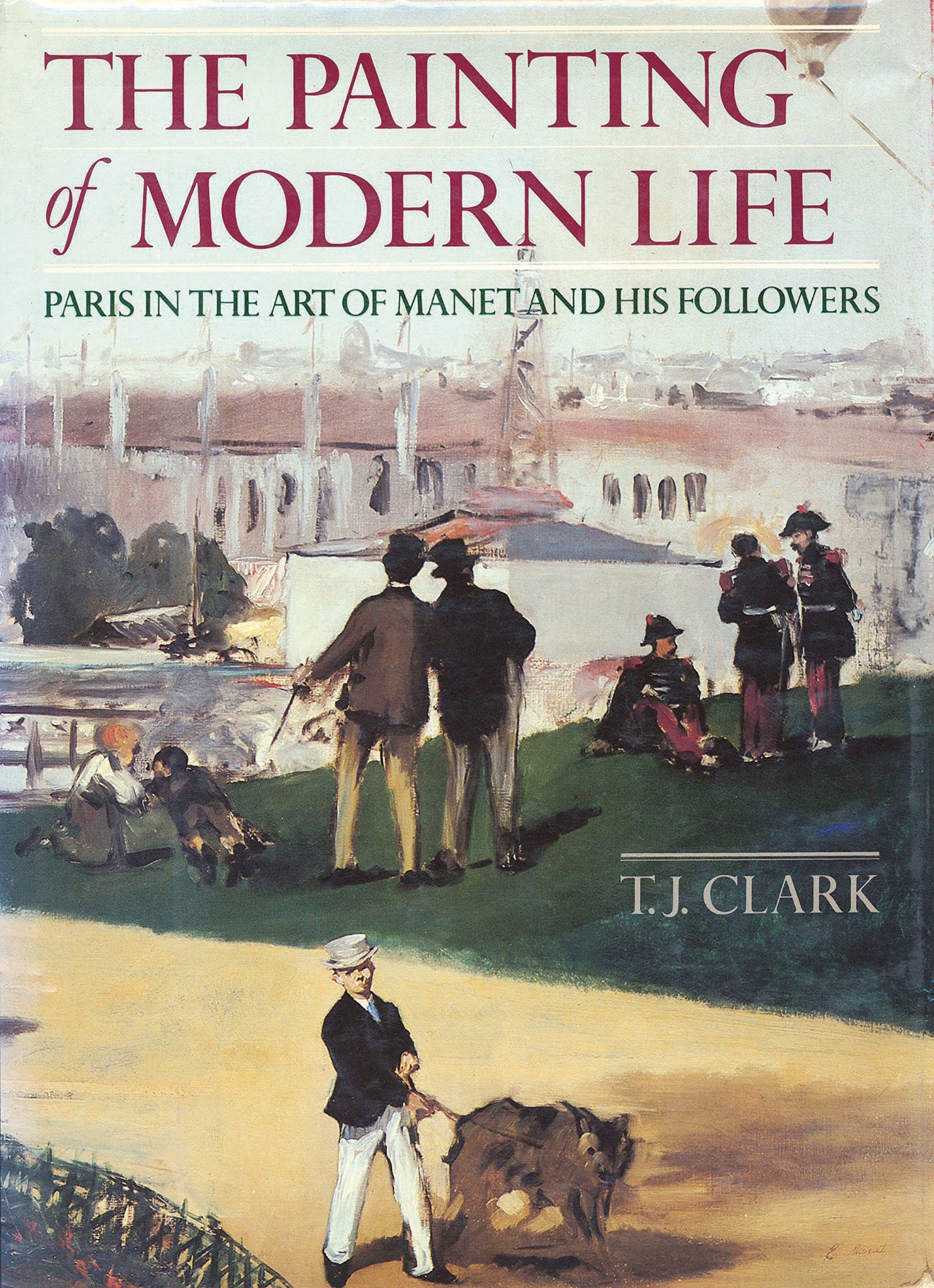
Timothy J. Clark, The Painting of Modern Life: Paris in the Art of Manet and His Followers, New York, Alfred A. Knopf, 1985.
Heated debate did not flare up in reviews of the Paris–New York show per se, but rather slightly later in response to the book published by Clark in 1985, The Painting of Modern Life: Paris in the Art of Manet and his Followers (fig. 1).9 Its opening sentence explained that Manet’s art was not, in fact, the exclusive subject: “This book is about Impressionist painting and Paris.”10 The vituperative exchange between a certain reviewer and Clark that took place in the pages of the New York Review of Books (NYRB) in May and August of 1985 set the stage for debates in art history for years to come. When Clark’s (offending) book was published, he was Professor of Art History at Harvard University, where he taught from 1980 to 1988. His most outspoken critic was none other than Cachin, whose importance in the French art establishment cannot be exaggerated. In 1978, she was named Chief Curator of the new museum of nineteenth-century art that would open in the converted Gare d’Orsay in 1986 as the Musée d’Orsay. Upon its opening, she was named the museum’s Director. For the record, she was also a granddaughter of Paul Signac (1863–1935), the eminent French artist (fig. 2).
Fig. 2
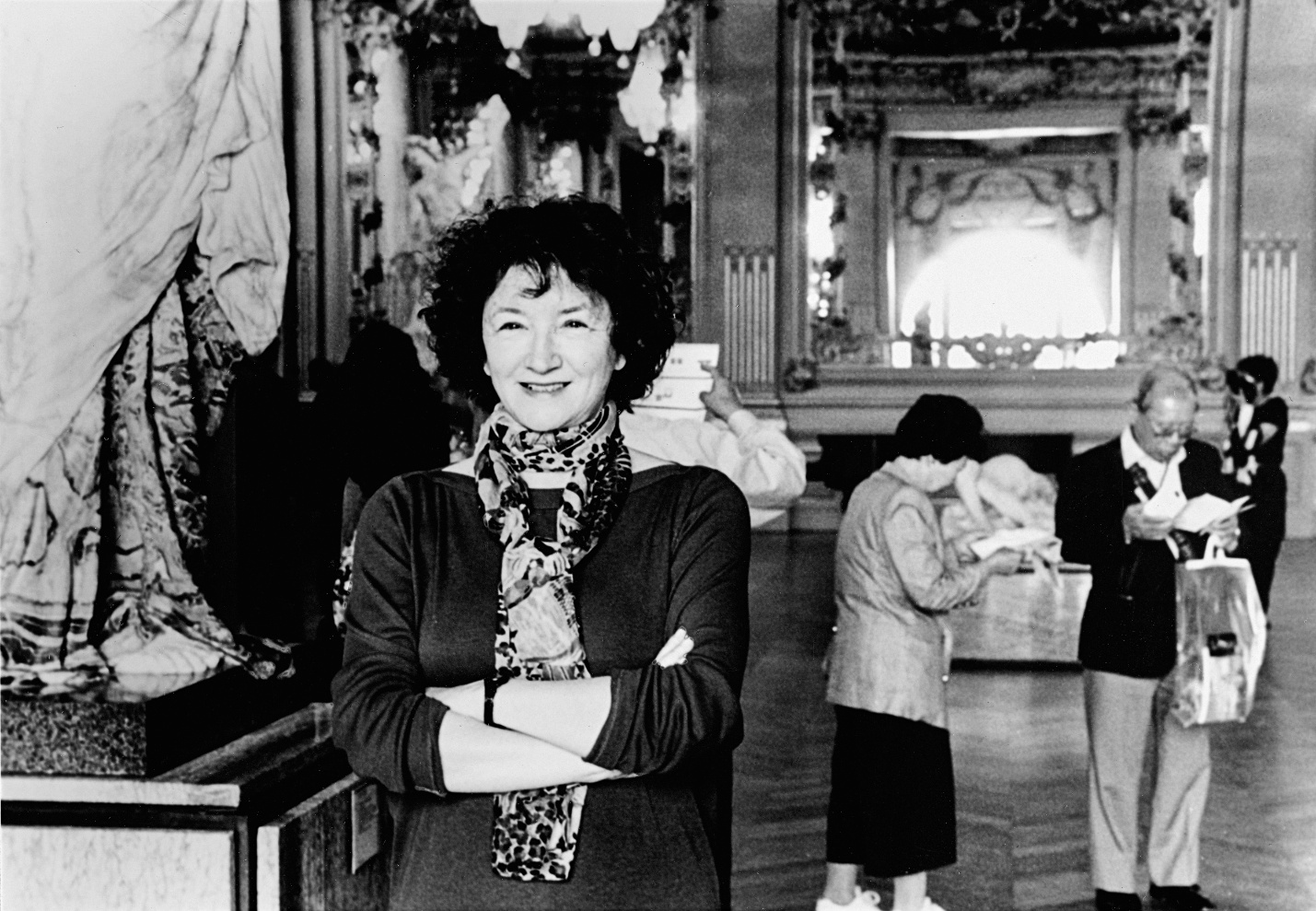
Françoise Cachin at the Musée d’Orsay, ca. 1986, Paris, Musée d’Orsay Documentation.
Photo courtesy of the Musée d’Orsay Documentation / All rights reserved
Before turning to Cachin’s key text, note that Maurice Berger’s own brief review in Artforum (May 1985) in some ways adumbrated the tenor of Cachin’s review and the issues broached therein. He wrote:
Clark ascribes a moral aspect to most advanced painting of the late 19th century: Manet and his followers, he argues, wished to expose a visual truth, to represent the debased polarization of classes that was a consequence of Baron Haussmann’s restructuring of Paris.… Overall, Clark’s thinking is provocative.… [He] insists on a fundamental distinction between the advanced and the retrograde.11
Fig. 3
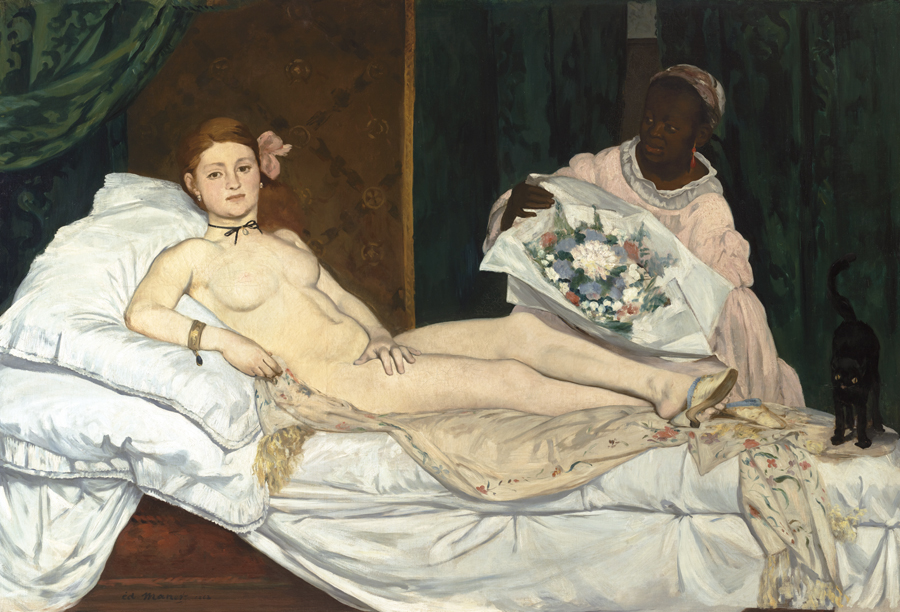
Édouard Manet, Olympia, 1863, oil on canvas, 130.5 × 191 cm, Paris, Musée d’Orsay, gift to the French State by public subscription on the initiative of Claude Monet, 1890, RF 644.
Photo © Musée d’Orsay (dist. GrandPalaisRmn) / Patrice Schmidt
Cachin’s brief against Clark’s interpretations, published in the NYRB, targeted his reading of Olympia (fig. 3) and was introduced with these words, which encapsulate her objections to the book overall:
Although Clark has found very interesting critical writings in the press of the time, and although he shows undeniable sensitivity when he allows himself actually to look at paintings, his convictions, inconsistencies, and intellectual quirks distort what might have been a useful approach. They reintroduce into art history a ghost one imagined had been banished a long time ago: the specter of censorious moral judgment.
Throughout the book there is a tension between Clark the connoisseur and Clark the ideologue and it is unfortunately the latter who wins out.12
The ensuing exchange between Clark and Cachin – which appeared in letters to the editors on 15 August, again in the NYRB, under the heading “Painting of Modern Life” – was a no-holds-barred slug fest, the likes of which, a mercilessly impolite debate, is very rarely encountered these days in the pages of high-minded periodicals. Clark’s response to Cachin’s review was, first and foremost, a pointed and cheeky assault on her “bourgeois status” and the function of prominent cultural institutions. He wrote:
The real issue underlying Françoise Cachin’s review of my Painting of Modern Life…is whether a certain present-day bourgeoisie shall continue not only to have the painting of Manet and the Impressionists – for assuredly they have it, and will do so for some time to come – but have it by right, because they understand it best, because their writers have described it adequately, because its values correspond to their own. A great deal of modern art history is concerned to offer reassurance on these questions. Cultural apparatchiks like Ms. Cachin work particularly hard at the job. They have a State machine set up for the purpose, which never stops vomiting retrospectives. The animus informing Ms. Cachin’s review of my book was provoked in great measure, I believe, by my wish not to do this kind of professional duty, and my lack of enthusiasm for most of its products.
There followed a blow-by-blow recounting of Clark’s disputes with Cachin – repudiated afresh by Cachin in her own enumeration of points made which were all, in her opinion, misunderstood by Clark.
During the same months, a measured and astute review of Clark’s book appeared in the journal October.13 It was written by the great art historian, Klaus Herding (1939–2018), in Germany the leading Marxist historian of French art, whose influence was felt across the Euro-American world. First and foremost, while the review was thoughtful and largely positive, the criticisms it posed were unassailably just. For example, he rightly objected to Clark’s categorization of Monet, Degas, Caillebotte, Pissarro and Seurat as mere “followers” of Manet.14 He was also concerned about a key historical underpinning of Clark’s account, namely that a number of the art analyses (specifically enumerated by Herding) “make one doubt the interpretation that the identity crises of the nouvelles couches sociales resulted solely from ‘Haussmannization.’ Wasn’t the crisis – with all the consequences of an epochal transition – already full blown by 1857?”15 He also expressed a fundamental concern about interpretive procedure; about the “analyses of images [that] are often preceded by extensive passages of sociological discussion.” He went on:
It would seem more reasonable to postpone the inquiry into historical links until the actual visual facts of a painting prove impervious to direct analyses or pose a dilemma that only background information can solve.16
Among Herding’s most valuable contributions was his answer to the question, “Why did Clark’s book cause such a violent response? Probably because most art historians still expect the very things from art history which Clark denies to Manet’s painting: entertainment and edifications.”17 Why the fact-twisting vicious attacks? “The only explanation for these,” he says, “certainly, is the fact that Clark employs both social criticism and structural analysis, gives as much weight to semiotics as to iconography, takes questions of color semantics as seriously as the shock produced among Manet’s contemporaries by his disruption of accepted canons of content.”18
Precursors and Forebears
While the fireworks generated by Clark’s 1985 book exploded most dramatically in anglophone exchanges, a foundation in progressive accounts of the art of Manet and his contemporaries had been laid by several European predecessors. Michel Foucault, for example, gave a lecture about Manet’s work in Tunisia in 1971, albeit published much later, in an anthology in 2004.19 Despite the delay, Foucault’s approach was influential, as astutely glossed by Molly Nesbit in 2013.20 Nesbit emphasized how Foucault presented Manet’s painting as an example of “philosophy-in-action,” a pragmatic approach to understanding the world that diverged from earlier metaphysical thought. She situated Foucault’s account within the specific context of WWII’s approach, suggesting that Manet’s modernism resonated with a new pragmatic philosophical landscape of the moment. Thus she saw Foucault having understood Manet’s works as philosophical acts, a far cry from a formalist perspective.21
A foundational text in the realm of primary-document publication, by the Swedish scholar Nils Gösta Sandblad, appeared in English translation in 1954.22 It was a painstaking study of three of Manet’s 1860s canvases: Music in the Tuileries Gardens, Olympia and The Execution of Maximilian, which aimed to undermine a formalist take on Manet that was gaining ground at the time. The book’s signal contribution was its inclusion of hitherto unpublished documentary material. Werner Hofmann’s Nana: Mythos und Wirklichkeit, from 1973, covered an impressively broad range of topics and perspectives, among which figured a Marx-inflected account of prostitution, “Das Fleisch und das Gold,” and a Baudelaire-inflected account of Manet’s contribution to an iconography of the everyday, “Der Heroismus des modernen Lebens.”23 Hofmann’s book helped to shape my own 1984 doctoral dissertation, “Representations of Prostitution in Early Third Republic French Art.” That the cover of my first book, Painted Love (1991), bears the image of Manet’s Nana is a tribute to the impact of Hofmann’s book, which I first encountered as a graduate student in Paris in 1976.
Radical Marxist-inflected art history had touched down like a lightning bolt with the work of Nicos Hadjinicolaou and Michel Melot in the 1970s. Hadjinicolaou’s Histoire de l’art et lutte des classes appeared in 1973.24 The entrenched perspectives he sought to demolish were made clear by three of the chapter titles: “First Obstacle: Art History as a History of Artists”; “Second Obstacle: Art History as Part of the History of Civilizations”; “Third Obstacle: Art History as a History of Works of Art.” A key concept for him: visual ideology. Histoire et Critique des Arts, the journal jointly edited by Hadjinicolaou and Melot, was published from 1977 to 1980. As soon as the first issue appeared, the journal’s contents became the focus of intense discussions, debates, seminars and public meetings in Paris. I was among those fortunate art history graduate students in Paris as of 1976 who were much affected by the meetings and discussions convened by Hadjinicolaou and Melot.
Jumping here only briefly into the twenty-first century, the forceful impact of the journal, Histoire et Critique des Arts, was honored by a two-part project headquartered at the French National Institute for Art History (INHA) in Paris. It began with an in-person conference held to celebrate the programming implemented by Philippe Bordes during his directorship (2007–2010) of the INHA’s department of studies and research. It was called “Les histoires sociales de l’art” (31 October 2016). Even more substantially, two massive volumes in French, Histoires sociales de l’art. Une anthologie, collecting inventive social art histories, were published in 2016.25 It documents the long and varied history of socially oriented art history in France, England and the United States.
A final Paris-based contribution to the interpretation of Manet’s art in the 1980s deserves mention. The exhibition, Bonjour, Monsieur Manet, was held at Centre Pompidou in 1983.26 It was conceived as an explicit counterpoint to the Manet exhibition across town at the Grand Palais. Its remit, placing Manet’s work in dialogue with a vast array of other artists active between Manet’s era and 1983, could not have been more different. Playful and eye-opening, it was joyfully unconcerned with the finer points of interpretive methodology.
A consequential anglophone forebear, whose work and impact are not easily slotted into a particular decade or country, requires acknowledgement: the Lithuanian-born American art historian Meyer Schapiro (1904–1996). His importance cannot be underestimated. In the introduction to his 1985 book, for example, Clark averred:
It had its beginnings, as far as I can tell, in some paragraphs by Meyer Schapiro, published first in January 1937 in a short-lived journal called Marxist Quarterly. Early Impressionism, wrote Schapiro, depended for its force on something more than painterly hedonism or a simple appetite for sunshine and color. The art of Manet and his followers had a distinct “moral aspect,” visible above all in the way it dovetailed an account of visual truth with one of social freedom.27
The late Robert L. Herbert’s 1988 magnum opus, Impressionism: Art, Leisure, and Parisian Society, discussed below, was dedicated to Meyer Schapiro. A collection of Schapiro’s writings (dating from 1937 to 1976) was not published until 1978, while a volume assembling his work specifically on Impressionism did not appear until 1997.28 The impact of his interpretations of modernist art over the decades was nonetheless momentous. Joel Isaacson, historian of Impressionism, put it eloquently in 2001: “Meyer Schapiro’s contribution to our understanding of Impressionism has had an importance that goes well beyond his actual written contribution to its study.”29
Anglophone Iterations of the Social History of Modern Art in the 1970s and 1980s
The writing of the present essay began at a moment that coincided with the third international exhibition on Gustave Caillebotte mounted in the past thirty years.30 It is unusual to be able to pinpoint the origin of present-day interest in an artist who participated in the independent (“Impressionist”) exhibitions whose star did not shine in the art-historical literature until the later 1970s. But in the case of Caillebotte, the starting point is crystal clear: the scholarship of the late Kirk Varnedoe. The exhibition he organized – Gustave Caillebotte: A Retrospective Exhibition, held in Houston and Brooklyn in 1976–1977 – opened scholars’ eyes to the artist’s achievement. By placing Caillebotte on the roster of the key painters of Modern Life in Paris, Varnedoe changed the direction of Impressionist studies.31
The 1980s saw an uptick in studies of Impressionist painting and its geographies, several authored by students of two Yale University art historians, Anne Coffin Hanson and Robert L. Herbert, the latter himself a pathbreaking scholar of Impressionism. Paul Tucker, for example, published Monet at Argenteuil in 1982, a study of Monet’s negotiation between 1871 and 1878 of a rapidly changing riverine town.32 Richard Brettell mounted the stunning exhibition, A Day in the Country: Impressionism and the French Landscape, in Chicago in 1984.33 Both projects succeeded in concretely identifying the locations in which paintings were set – as well as what was shown or deleted – during years of substantial industrialization alongside an invasion by tourists in the banlieue (the surroundings of Paris to the northwest). These studies set in motion a geography-centric approach to the social history of Impressionism that would have substantial staying power. In many ways, such scholarship was based upon chapter three of Clark’s book (“The Environs of Paris”), but with less emphasis placed upon a motif’s significance and meaning once identified as being included or edited out.34
Charles Moffett’s 1986 exhibition and catalog, The New Painting: Impressionism 1874–1886, was an ambitious and game-changing restaging of the eight independent exhibitions. The catalog contained essays on each of the shows written mostly by younger scholars – Stephen Eisenman, Paul Tucker, Richard Brettell, Martha Ward and myself – whose work exemplified a key 1980s methodological shift in the history of Impressionism: digging into the ideological contents of the critics’ responses, an enterprise which had not previously been center stage.35
Herbert’s own major contribution to the expanding literature, Impressionism: Art, Leisure and Parisian Society, his richly illustrated 234-page book, appeared in 1988.36 He acknowledged the place of his work in relationship to recent historiographic touchstones. The preface calls Clark’s Painting of Modern Life the “one book [that] has almost single-handedly reoriented the field.” He quarreled, however, with Clark’s approach. The core of his objection: “Clark’s chief concern – though he might deny it – is style.”37 Herbert’s project was instead the restoration of paintings to their sociocultural context.
The 1980s also saw the rise of feminist approaches to the art of Manet and the Impressionists. The deservedly attention-grabbing and game-changing analysis within that literature was Griselda Pollock’s 1988 “Modernity and the Spaces of Femininity.”38 She acknowledged the foundational work of Clark and others who argued that the founding fact of modernity was class, but to the deleterious neglect of recognizing the “gender specific conditions” under which Manet’s celebrated paintings were made.39 Her key insight, and the basis of her analyses of artworks, was this: “Undoubtedly these exchanges [represented in the paintings] are structured by relations of class but these are thoroughly captured within gender and its power relations.”40
The Impact of Clark’s Scholarship on My Own Art History
Let me start with the chronology of my acquaintance with Clark, a cornerstone of my intellectual self-definition. He came to the US from the UK to teach art history at the University of California, Los Angeles (UCLA) from 1974 to 1976. His advisees there included myself, Thomas Crow, Leonard Folgarait and Serge Guilbaut. His 1973 books, Image of the People and The Absolute Bourgeois, were well known by the UCLA group, and have been widely understood in many circles to have inaugurated a methodological “revolution.” His teaching at UCLA is often described as the practice that ignited the social history of art in the United States.41 My art history should be placed within this Clark-centric framework insofar as I became a graduate student in art history at UCLA (more or less by accident) in 1972–1973, and belatedly earned my Ph.D. in 1984 under Clark’s direction, though, by that date, neither of us lived anywhere near Los Angeles.
A key component in the story of my conversion to a progressive form of art history, open to art forms and rituals beyond the classics of the European pantheon, nevertheless predates Clark’s appearance in my intellectual world. I took my undergraduate degree in art history at a prestigious but conventional institution, Wellesley College, in whose admired art history program (it offered the first major in the country), only European art was taught (and, very occasionally, Chinese art). Even the art of the US was absent from the curriculum because it was “untested.” By the time that I ended up as a graduate student at UCLA, I was burning to do something unconventional.
It was via the impact of the late and undersung Africanist, Arnold Rubin, that I found a nourishing and original path into art history.42 As I took his courses in sub-Saharan African art, I became more and more certain that I would specialize in African art, so far away and different from anything I had studied previously and enmeshed in complex networks of belief and social practice. Rubin’s angle of interpretation emphasized that the use of objects in ritual settings in traditional African cultures was a very far cry from the standpoint of African sculpture’s later European modernist fans, such as the Cubists, who only admired “form,” giving rise to the problematic concept of “primitivism.” Rubin also – very importantly, for me – insisted that ritual abounded in the contemporary United States, which could be studied from the standpoint he had developed in his fieldwork in northern Nigeria.43 In preparation for New Year’s Day of 1973 and 1974, I became part of a student team on the ground scrutinizing the Tournament of Roses Parade, held every first of January in Pasadena, California, what Rubin called an “ethnographic ritual in our own backyard.” I wrote my 1975 master’s thesis on an aspect of the history of the Parade, and it was the subject of my very first academic publication.44 An index of the intensity of my engagement with the parade is this: I was the first woman in history invited to drive a Rose Parade float. (I declined.)
When Clark arrived to teach at UCLA in the fall of 1974, I was quickly gobsmacked by his teaching on top of my pre-existing admiration for his 1973 books and the important essay, “On the Social History of Art,” contained in Image of the People. In a very short time, I transitioned to becoming a student of nineteenth-century French art. Indeed, let the record show, from the mid-1970s, it was apparent that just about every ambitious art history graduate student in the United States who focused on modern art chose to study nineteenth-century French art; that was where the intellectual action was. Indeed, when we went to Paris to begin our doctoral research in early 1976, the core American researchers in art history working in the French capital’s libraries were all either Clark students from UCLA or Herbert students from Yale.
What exactly was the impact of Clark’s teaching, advising and scholarship upon my work in art history? Where does one see the traces of the outlook of the Clark who wrote and debated The Painting of Modern Life, the event with which this essay began? His emphasis on class – married to a rising, parallel concern with gender – was the fuel that sparked my early work on the representation of prostitution in the “Capital of the Nineteenth Century,” to use Walter Benjamin’s well-known epithet. I followed one of his first declarations discussed above: the art of Manet and his followers had a distinct “moral aspect.” Among other effects, Clark’s multipartite definition of modernism, encouraged me to think carefully about the aesthetic and ideological differences alongside thematic links between academic (or pompier) and modernist painting. The Musée d’Orsay’s 1986 opening dramatically enhanced this awareness by encouraging scholars and all kinds of other art viewers to incorporate sculpture and academic painting, not to mention furniture and the decorative arts, in their conception of what defined French art between 1848 and 1914. And the Orsay Effect has not lessened its impact over the forty years of its operation.
The impact of the Orsay’s opening, with its display of a hitherto unimagined assortment of period artworks, was brilliantly described by Patricia Mainardi in 1987:
What is new at the Orsay is the inclusion in the sequence of almost forgotten artists. This co-habitation of avant-garde and pompier art, with all the gradations in between, constitutes, in fact, a major revision of nineteenth-century art history, and Orsay is the first museum to carry it out on this scale.45
This diverse display (as well as advance news that it was coming) had an immediate impact on the priorities that shaped my scholarship. In my published writing, I first drew a subtle but consequential distinction between various types of thematically shared representations as a defining issue as early as 1985, in an essay of mine whose subtitle explained my goal: “On Some Differences between the Art of Degas and Duez.”46 I bore down on the challenge of Impressionist illegibility in the instance of the thematics of prostitution repeatedly. Was illegibility gendered and classed, or not? Did narrative illegibility guarantee ideological neutrality in an artwork? This question was clearly at the center of my 1991 book. My overall answer was no. And it further helped to nuance the thrust of my targeted analyses of more fully depictive artworks, those that clearly displayed female sexuality as a threat; this included my discussion of an artwork that was at the center of my consciousness between 1976 and 1992, Rolla, the controversial 1878 canvas by Henri Gervex that became a kind of signature of mine in my early years (fig. 4).47
Fig. 4
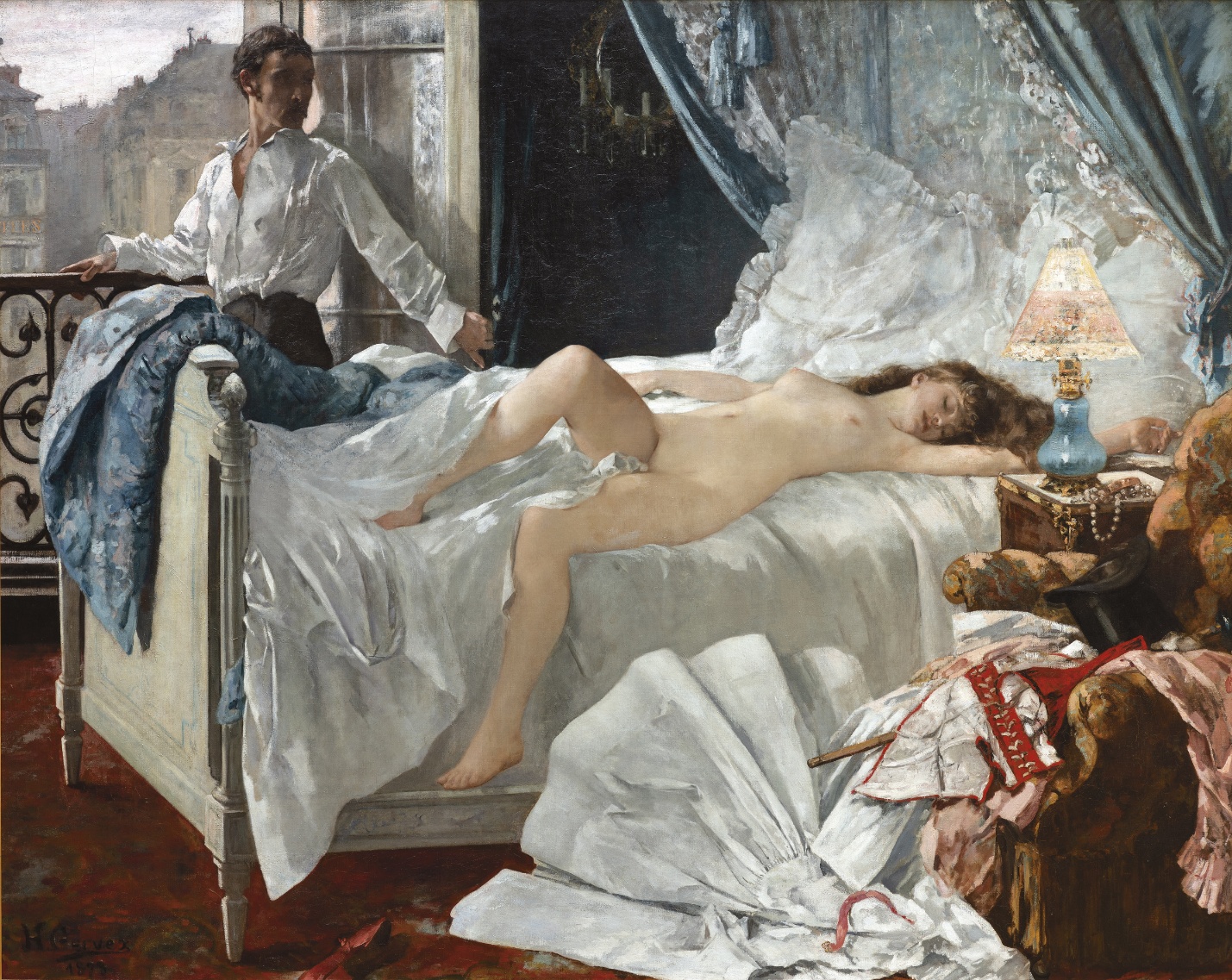
Henri Gervex, Rolla, 1878, oil on canvas, 175.5 × 222 cm, Bordeaux, Musée des Beaux-Arts (devolved to the Musée d’Orsay, on long-term loan to Bordeaux since 1933), legs Bérardi, 1926, Bx E 1455.
Photo © City of Bordeaux – Bordeaux Museum of Fine Arts – Photo: F. Deval
In my subsequent books, Paris in Despair (2002) and Illuminated Paris (2019), the traces of Clark’s approach might seem less evident, but my awareness of the broad range of artworks produced within a given time frame became a permanent organizing principle. But here is another, indeed the key foundational thing: I work on visual representations and the circumstances that begat them with a painstaking attention to mediations. I focus on works that cause me to be puzzled and to ask questions about them. I also do not structure my work by “isms” nor do I undertake monographic studies. My 2017 essay, “Impressionism as Procrustean Bed?,” addressed that problem directly. For me, an “ism” focus would have artificially cordoned off circumstances as well as cognate artworks – or rather, to put it bluntly, to ignore the range of artworks shown unapologetically at the Musée d’Orsay, irrespective of an ostensible hierarchy of spaces and galleries. And I have moreover become increasingly involved in the study of intaglio prints as well as and alongside caricatures and oil painting.
This account of my choices does not distinguish my work with 100 % clarity from that of Clark circa 1985. But without my early grounding in the complexities of modernism (learned from Clark) and the awareness of diverse coexisting modes and styles of art (credit goes to the Orsay), I simply could not have proceeded as I have. Perhaps this only partially facetious declaration will help to pinpoint the distinctions I have tried to make. Thinking occasionally about what might be engraved on my tombstone, I am confident that if the inscription reads “Historian of Impressionism,” I will not rest in peace.