Reading certain comments about the Musée d’Orsay and its collections, one could easily imagine that visitors in 2026 are seeing essentially the same works, in the same arrangement, as in 1986. This perception is not completely unfounded, as the broad framework of the displays conceived in the 1970s and early 1980s and unveiled in December 1986 remains largely recognisable. The central nave continues to structure the visitor’s encounter with sculpture (fig. 1) and painting up to around 1870; the fifth-floor gallery is still associated with the masterpieces of Impressionism and Post-Impressionism; and exhibits devoted to the art of the Third Republic, Auguste Rodin, Art Nouveau or the Nabis are, as before, on the middle level. But behind this apparent stability lie displays that have been continually revised, enriched and reinterpreted. For example, over a third of the works on exhibit today were acquired after the museum opened. The permanent display, which as of 2026 comprises around 2,250 works,1 is thus a historical object in its own right, with its successive strata, legacies and revisions. It offers a prime vantage point for observing the transformations of art history itself. Its history since 1986 – distinct from the respective histories of the building, the collections as a whole and the temporary exhibitions – has yet to be written.
Fig. 1
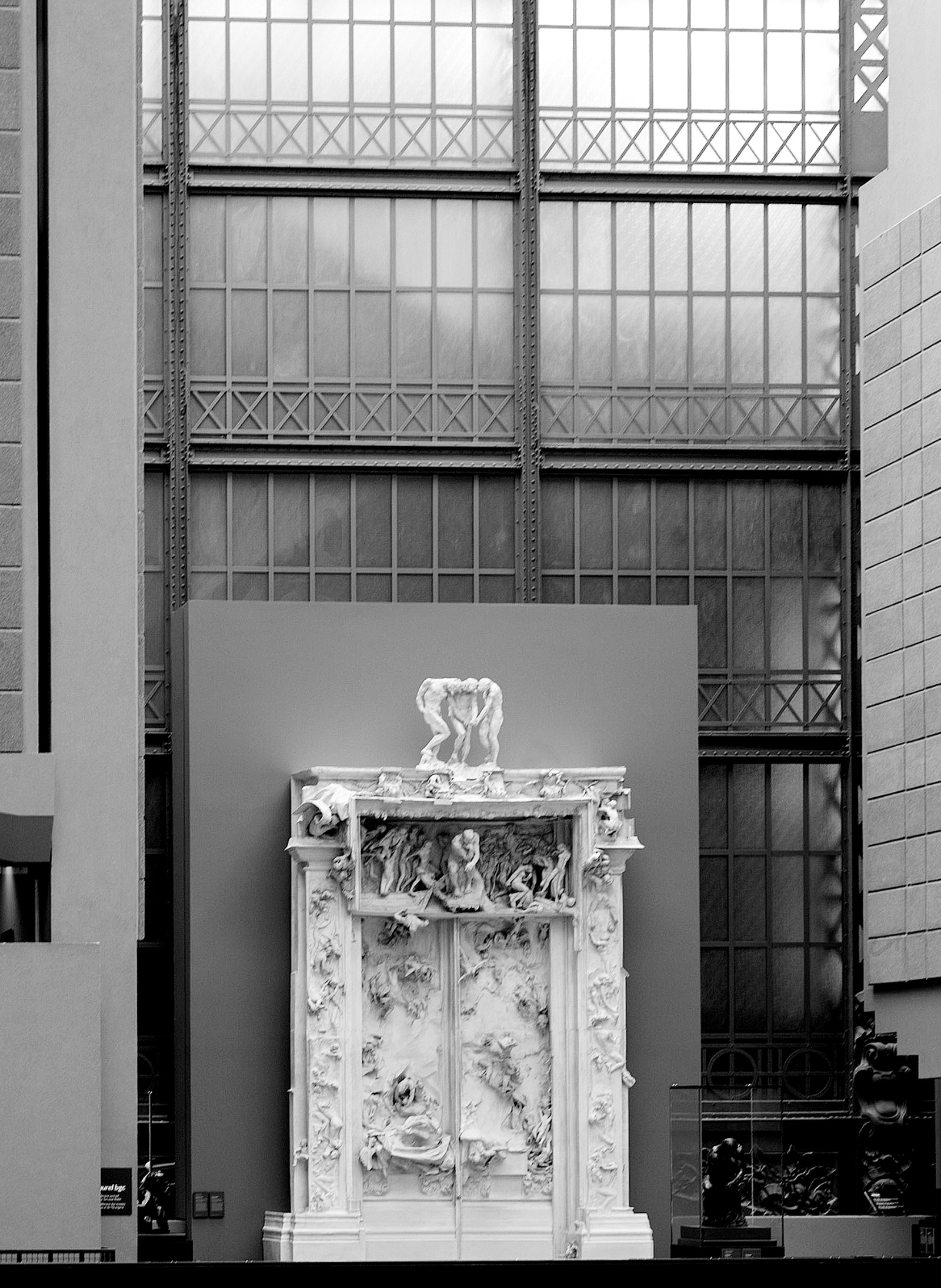
View of the 2021 redisplay of The Gates of Hell and the galleries devoted to Auguste Rodin (far end of the nave, middle level, photo taken in 2022).
Photo © Musée d’Orsay / Sophie Crépy
Here, we will focus primarily on developments occurring after the major rehangs undertaken during Guy Cogeval’s directorship (2008–2017) were completed. Although less spectacular than his vast ‘New Orsay’ project,2 which transformed the display arrangements of nearly four-fifths of the museum’s galleries and expanded the spaces devoted to the collections, the changes that the curatorial team subsequently carried out under directors Laurence des Cars (2017–2021), Christophe Leribault (2021–2024) and Sylvain Amic (2024–2025) were nonetheless significant. They affected the overall distribution of the collections, brought in new themes and artists, and thoroughly overhauled the narrative that surrounds the works by introducing a new system of interpretive texts.3 Yet these changes represent only the visible part of a broader and more far-reaching process of reflection that is still underway. Should the museum’s 1986 scholarly vision be extended, updated or transformed? How can the new perspectives opened up by research and the enrichment of the collections best be reflected? As the museum celebrates its fortieth anniversary and a new dawn begins, likely bringing further changes, the overall display – viewed by more than 3.7 million visitors in 2025 – appears as much a reflection of the current state of knowledge as a set of questions that remain open.
Readjustments and Enrichments
The main changes made to the display since 2017 stem from a decision that initially concerned temporary exhibitions rather than the permanent collections. The relocation of the second exhibition space from the fifth floor (Galeries 43–45) to a new area created at nave level set in motion a series of reorganisations and adjustments that gradually rebalanced the overall presentation.
Fig. 2
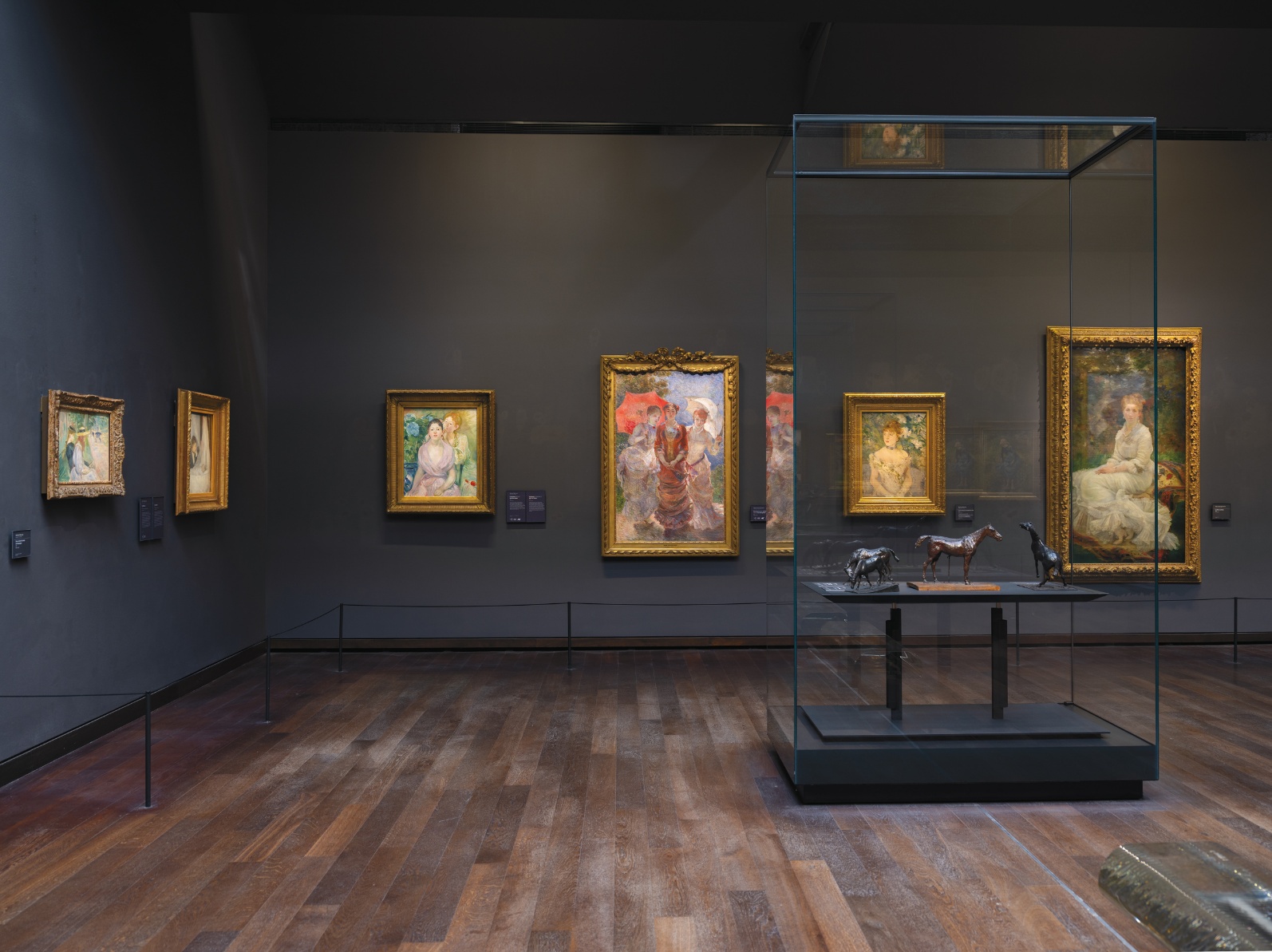
View of the Impressionist gallery with paintings by Berthe Morisot and Marie Bracquemond, in a later display (fifth floor, Impressionism, Galerie 32, photo taken in 2026).
Photo © Musée d’Orsay / Laëtitia Striffling-Marcu
The first of these was the complete transformation of the fifth floor in 2019, restoring Post-Impressionism to its logical continuation of Impressionism. The overall organisation of the galleries and their themes was renewed, combining displays devoted to major donations (Moreau-Nélaton, Mollard and Personnaz), thematic sections (‘Impression, Impressionism’, ‘Painting Modern Life’ and ‘Impressionism in the 1880s’) and more monographic approaches (reserved for the late work of Claude Monet, Auguste Renoir and Paul Cezanne). Gustave Caillebotte also now enjoys a more prominent place thanks to certain major acquisitions, as do women artists, notably Marie Bracquemond and Berthe Morisot (fig. 2), a subject to which we will return. As for Post-Impressionism, a new rehang was implemented in 2024 that made it possible, for the first time, to devote a suite of three galleries (38–40) to the development of Neo-Impressionism. In the Galerie Françoise Cachin, the Synthesism–Symbolism axis is now more clearly articulated, involving the Pont-Aven School, Paul Gauguin, Odilon Redon and the early Nabis. A particular effort was made here to highlight Gauguin’s sculptures and ceramics, while recent acquisitions have both enhanced the representation of Émile Bernard and introduced foreign artists who had previously been absent from or only sparsely represented in the collections, including George Morren, Anna Boch or Roderic O’Conor (fig. 3). On the middle level, along the museum’s rue de Lille side, one of the key developments was the 2017 integration of the Zeineb and Jean-Pierre Marcie-Rivière donation into a new suite of galleries devoted to the Nabis.4
Fig. 3
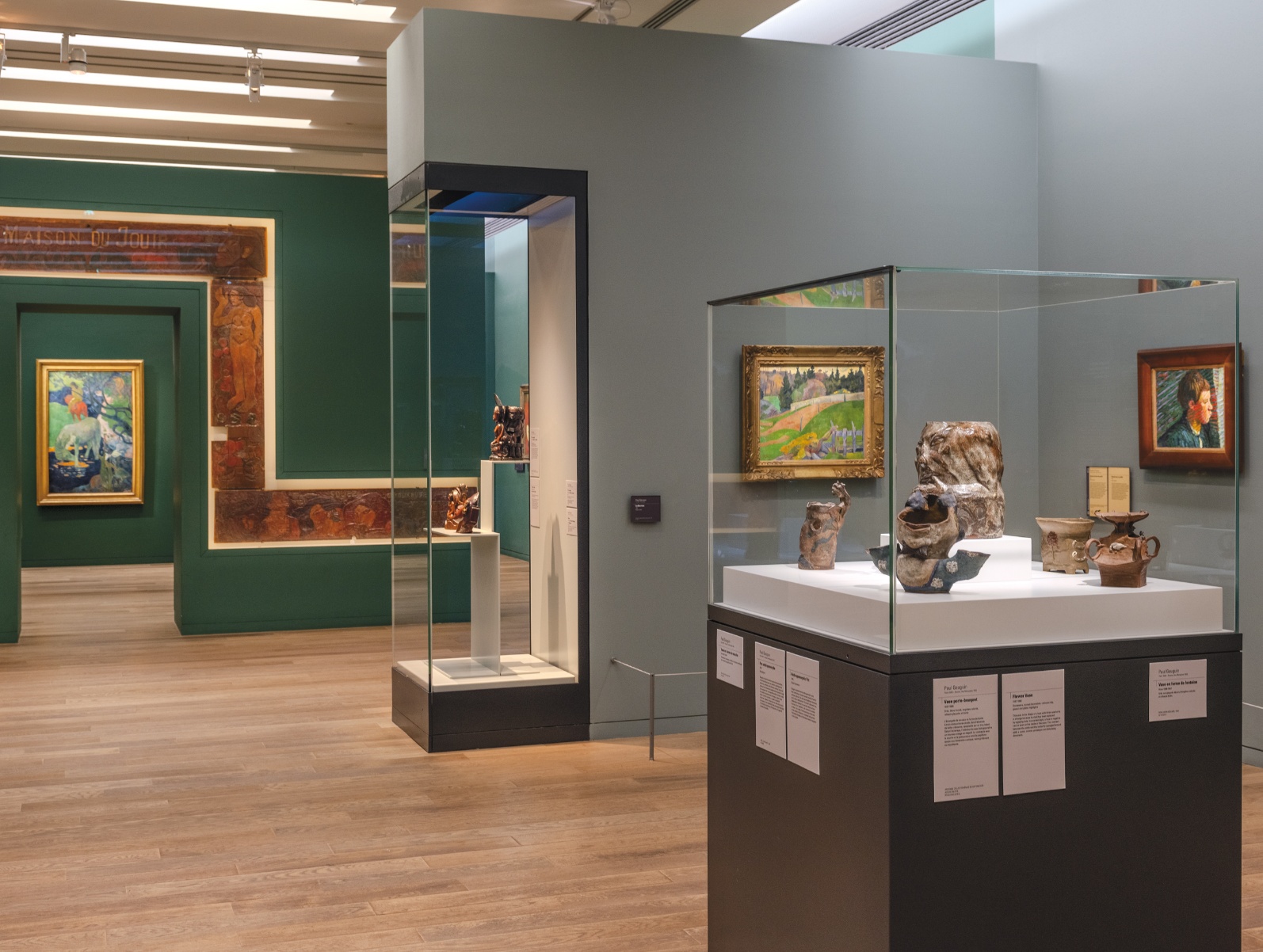
View of the galleries devoted to the Pont-Aven school and Paul Gaugin, rehung in 2019 and again in 2024 (fifth floor, Galeries 43–44, photo taken in 2026).
Photo © Musée d’Orsay / Laëtitia Striffling-Marcu
The conversion of Galeries 15–24 (ground floor, Seine side) into temporary exhibition spaces made it necessary to redistribute the collections previously displayed there, including Gustave Courbet and the Realism, Orientalism, photography and drawing collections, as well as decorative arts of the Second Empire. From December 2026 onwards, the collections among them dating from 1850 to 1890 will be brought together in Galeries 51–54 and presented in a display redesigned to more closely integrate into the historical spaces of the former railway station hotel on the first floor. The aim will be to highlight the distinctive character of these collections, which were established along with the museum and are largely composed of exceptional objects showcasing extraordinary technical virtuosity, while also examining the concepts of eclecticism and historicism. These two notions are essential for understanding the period far beyond the field of the decorative arts. The new display will also develop a narrative around the universal expositions, the relationship between art and industry, and the role of industrial designers. Alongside this project, the display of galleries devoted to French, Belgian, Catalan and Italian Art Nouveau on the middle level’s Seine side (Galeries 61–66) was redesigned in 2024. It had stood unchanged since the museum opened,5 leading to a particularly marked contrast with the new galleries that opened in the Pavillon Amont in 2012. Without fundamentally altering the overall display’s organisation, this change made it possible to modernise its appearance, enrich it with more contextual interpretive materials and incorporate many new acquisitions.
With regard to photography and graphic arts – which now represent the most abundant holdings in the museum’s collections but paradoxically remain the least visible to the public6 – the decision was made to give these disciplines (with the exception of pastels, which nevertheless featured prominently when the museum opened in 1986)7 more clearly permanent and defined spaces by creating an architecture gallery at the far end of the nave, a drawing gallery on the fifth floor and a photography gallery on the ground floor on the rue de Lille side. The many displays presented in these spaces have allowed curators to develop renewed approaches to these collections and highlight acquisitions.
When it comes to sculpture, the changes have been less extensive, consisting mainly of expanding the narrative with new acquisitions (Jules Cavelier, Charles Cordier, Gustave Doré, Léopold Chauveau, etc.). The most significant change, however, concerns the presentation of Rodin’s Gates of Hell, installed in autumn 2021 opposite the nave in a completely redesigned space featuring new deposits from the Musée Rodin. This rearrangement also provided an opportunity to revise the display of sculptures on the middle level, on the rue de Lille side,8 with a view to more logically following the progression leading from Rodin to the generation of Antoine Bourdelle, Aristide Maillol, Joseph Bernard and François Pompon.
Old Questions, New Answers
While many of the changes have consisted of readjusting the displays and incorporating new acquisitions, other, more thematic presentations have made it possible to revisit some of the ambitions that guided the museum’s creation, particularly with regard to so-called ‘academic’ painting, architecture, history and interdisciplinarity.
The return in 2018 of Courbet’s large-scale works to Galerie 7 (named the Salle Sylvain Amic in 2025) – meant to give back this artist a more central position in the museum – made it possible to free up Galerie 24, one of the largest and highest spaces in the building, for a new display of large-scale history paintings from the 1850s to the 1870s. One of the most significant developments concerns the prominence now given to works that were long grouped under the convenient but inadequate, and often disparaging, labels of ‘pompier’, ‘official’ or ‘academic’ art. This redistribution of the collections reflects research that has helped to foster a more nuanced and precise interpretation of these works, which were long regarded as the ‘foil’ or ‘counterpoint’ to the avant-gardes.9 Because many works were restored or pulled out of storage in the 2010s, Galerie 24 now features pieces by Paul Chenavard, Auguste Glaize, Achille Benouville and Louis Baader that had until then often remained unseen. Similarly, the Galerie Lille and its adjoining rooms were gradually reorganised in 2021 and 2022 to better highlight this aspect of the collections and to distinguish objectives and characteristics specific to the various Second Empire painting ‘genres’ (history and battle painting, portraiture and genre scenes). Significant groups of works by Ernest Hébert, Gustave Guillaumet, Jean-Baptiste Carpeaux and Ernest Meissonier, as well as some other, lesser-known artists, have been brought out of storage and given fresh attention. These new presentations have been accompanied by expanded and updated interpretations providing visitors − for the first time, in the case of ‘Orientalism’ − with the keys to understanding the context of colonial expansion in which these images were produced.
These reorganisations have given renewed importance to the question of what place history (especially political history) occupies at the museum. Solutions had been found when the museum opened, notably in the form of digital terminals installed in the fourth-floor footbridge known as the Passage des dates (the walkway of dates) and the many explanatory sheets (‘key-points sheets’) made available to visitors. Their gradual disappearance left the permanent displays almost entirely devoid of contextual material to help visitors understand the works. At the same time, the clarity of the museum’s chronological framework – 1848 to 1914 – had itself gradually faded. An initial response to these issues came with the creation, in 2021, of an interdisciplinary space devoted to depictions of the Franco-Prussian War, the Siege of Paris and the Paris Commune (1870–1871), a subject previously absent from the museum even as it continued to be one of the major chronological turning points in the presentation (fig. 4). The ‘opening’ date of 1848 has also been the subject of particular reflection, and the first painting gallery visitors encounter, located to the left of the nave entrance and devoted to Honoré Daumier and Jean-François Millet, was reconfigured in 2025–2026. Greater emphasis is now placed on art depicting the uprisings and the Second Republic as well as this regime’s democratic ideals and spirit of fraternity as expressed through its acquisitions and commissions from Realist artists.
Fig. 4
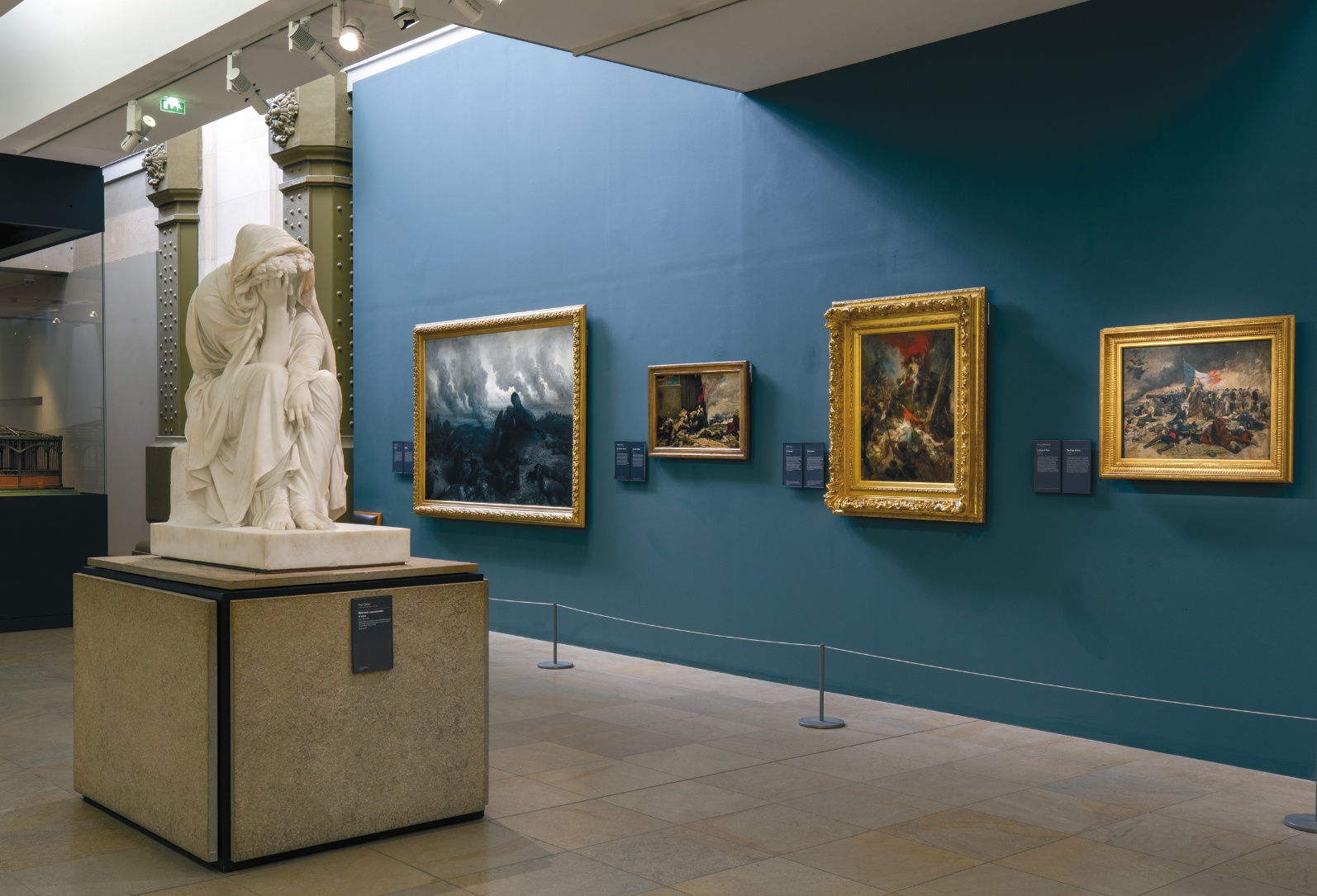
View of the space devoted to works depicting the Franco-Prussian war and the Paris Commune, opened in 2021 (ground floor, end of the Galerie Lille, photo taken in 2023).
Photo © Musée d’Orsay / Sophie Crépy
Apart from political history, consideration has also been given to the place that other social, economic, scientific and environmental developments might occupy in the displays. Since 2026, the first section of the Galerie Seine, long devoted to the Barbizon landscape painters, has offered a renewed interpretation of landscape and animal painting in the 1848–1870 period. It combines an account of these genres’ ascension to prominence in the mid-nineteenth century with the development of painting en plein air before impressionism – another subject previously absent from the museum’s displays – and the role of the great collector and donor Alfred Chauchard. In keeping with the initiative ‘100 Works that Tell the Climate Story’,10 organised in 2025, the project is intended to incorporate issues related to environmental history more explicitly in the museum; these include human–animal relationships, the history of forests and the earliest ‘artistic’ efforts to protect natural landscapes. A number of themes explored in major exhibitions since the early 2010s – from prostitution to Black models, and from justice to Darwinism – and now central to current research in art history, remain insufficiently visible in the displays. The same is true of topics relating to religion and spirituality, the construction of national and regional identities, private life and intimacy, race, gender and sexuality, as well as social issues and the world of work.11
One of the guiding principles behind the creation of the Musée d’Orsay was interdisciplinarity, understood first and foremost as the bringing together of several media in a single museum. Even so, the Orsay cannot be regarded either as a straightforward fine arts museum or as a comprehensive museum of artistic production in the nineteenth and early twentieth centuries, since printmaking and print culture remain largely absent, as do the so-called popular arts, while music, literature and the performing arts are represented only indirectly, through the museum’s cultural programme. In the Orsay’s early years, however, ‘dossier’ exhibitions made it possible to incorporate these fields into the permanent displays themselves. These spaces gradually disappeared as the collections expanded, while temporary exhibitions increasingly took on this interdisciplinary role. Conversely, the presence of photography and architecture contributed from the outset to opening the museum up to fields beyond the traditional fine arts. More recently, the museum has restored the former prominence of other forms of visual culture, such as the shadow puppets of the Chat Noir theatre and the cinematograph, which returned to the museum in 2019. Films from the earliest years of cinema are now presented in thematic selections that are regularly renewed (fig. 5).
Fig. 5
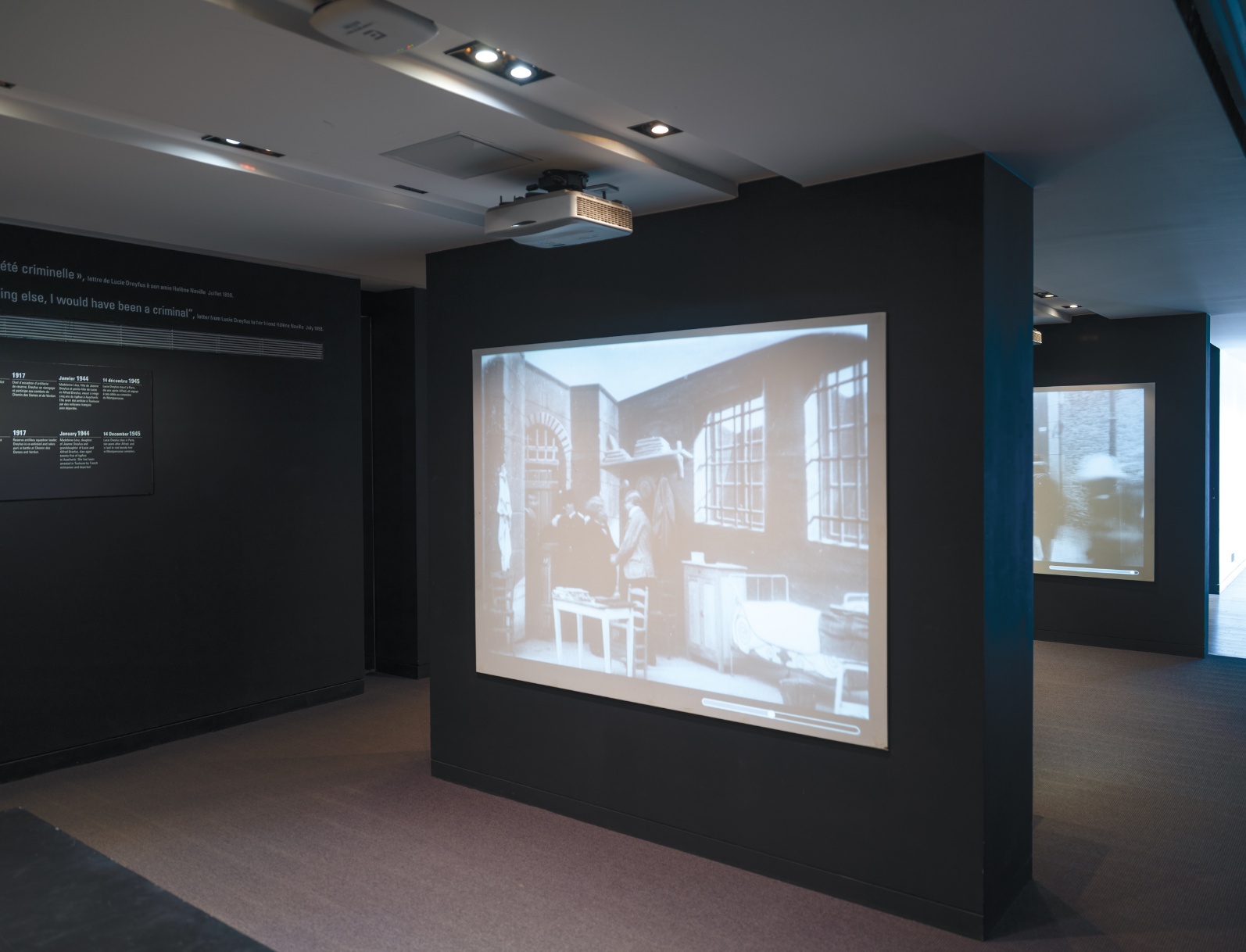
View of the Cabinet du Cinéma exhibiting works related to the birth of cinematography, opened in 2019 (fifth floor, Galerie 47, photo taken in 2025).
Photo © Musée d’Orsay / Laëtitia Striffling-Marcu
In spite of these developments, it is clear, forty years after the museum’s opening, that discipline-based approaches remain largely predominant, with each medium continuing to develop its own narrative in dedicated spaces. Points of convergence remain rare and still mainly concern artists whose practice spans several media (like Edgar Degas, Gauguin and the Nabis) or else new themes introduced into the permanent displays (portraiture, the Franco-Prussian War of 1870 and the Paris Commune). The major redevelopment, in 2022, of the area at the nave’s far end, formerly devoted to the Palais Garnier opera house12 and now focused on the modern city and the transformation of Paris, can be seen both as one of the most significant recent changes to the museum’s display strategy and as one of the most compelling areas for experimenting with multi-media displays.13 The project sought both to expand the presence of architecture in the displays, following the removal of the former presentation in the Pavillon Amont (with the dismantling of the architecture ‘tower’ in the late 2000s),14 and to introduce the issue of the urban phenomenon, understood as a total social fact (i.e., something that encompasses every dimension of social life), and one of the main expressions of the century’s technical, social, cultural and political transformations. Taking a single subject as a running theme, the displays bring together paintings, sculptures and maquettes, as well as works on paper, photographs and documentary material presented through the programme of the ‘cabinet d’architecture’ located in this space.
The Orsay’s ‘Canon’ – Expand or Transform?
Another issue that was central to the Orsay project from the start and remains just as pressing today is the artistic canon underpinning the presentation of the collections. Which artists and works does the museum choose to exhibit?
Of the approximately 4,500 artists represented in the Orsay’s collections, only around 580 are included in its permanent displays. Although this figure is relatively small in comparison with the collections as a whole, it remains considerable for a museum covering little more than sixty years of artistic production. Among them, the artists best represented in the galleries (with more than ten pieces each) are painters Bonnard, Cezanne, Courbet, Degas, Denis, Gauguin, Guillaumet, Manet, Meissonier, Monet, Pissarro, Puvis de Chavannes, Redon, Renoir, Seurat, Signac, Sisley, Toulouse-Lautrec, Van Gogh and Vuillard; sculptors Barye, Bourdelle, Bugatti, Carpeaux, Dalou, Daumier, Frémiet, Maillol, Pompon and Rodin; and architects and decorative arts creators Charpentier, Delaherche, Gallé, Guimard, Hoffmann, Horta, Lachenal, Lalique, Moser and Van de Velde. Only twelve of them have their own dedicated gallery (Carpeaux, Cezanne, Courbet, Degas, Gallé, Gauguin, Manet, Monet, Redon, Rodin, Toulouse-Lautrec and Van Gogh). This reflects the importance accorded to certain artists in the canon of art history, but also the desire to highlight the main strengths of the collections and to meet visitors’ expectations. As a result, a degree of imbalance persists between painting and the other media, as well as between Impressionism (and Post-Impressionism) and other artistic movements.
This imbalance is particularly pronounced in the case of the Naturalist and Symbolist movements which, in spite of the museum’s extensive holdings in these areas, occupied the same relatively small spaces in 2026 as they did when the museum first opened (essentially the galleries on the Seine side of the middle level).15 This is not without its difficulties, since, among international artists represented in the collections, a significant portion belong to these artistic movements. Although the museum’s exhibitions have done much to renew our understanding of the various European artistic scenes, and acquisitions have continued, these advances and enrichments remain difficult to discern in the displays. It must be acknowledged that a lack of space limits the museum’s ability to develop a genuine account of Western artistic production from national, comparative and transnational perspectives simultaneously. The exception is Art Nouveau, whose international dimension was planned from the beginning.16 This was a significant challenge for the museum, which needed to give greater visibility to the diversity of artistic production in France under the influence of these circulations and migrations. More broadly, it may also be necessary to consider how nineteenth-century artistic production beyond the Western world might be brought into the Musée d’Orsay’s narrative in order to situate its national collections within a genuinely global perspective.
A similar issue arises in the case of women artists, who are absent from the lists mentioned above and are likewise disadvantaged by the lack of space devoted to certain artistic movements, particularly Naturalism, in which they were especially active. Today, of approximately 2,150 works on view in the permanent display, around fifty are by women (2.3 %) and thirty women artists are represented (5 %).17 Figures already familiar to visitors – Marie Bashkirtseff, Cecilia Beaux, Sarah Bernhardt, Rosa Bonheur, Louise Breslau, Mary Cassatt, Camille Claudel, Eva Gonzalès, Marcello (Adèle d’Affry) and Berthe Morisot – have been joined, either with the acquisition of a work or its removal from storage, by names such as Alix d’Anethan, Charlotte Besnard, Anna Boberg, Anna Boch, Olga Boznańska, Fanny Brate, Eleanor Fortescue Brickdale, Elsa Engeström, Beatrice How, Margaret MacDonald, Jeanne Selmersheim-Desgranges, Edyth Starkie Rackham, Helene Schjerfbeck, Marianne Stokes and Annie Swynnerton. This inclusion is also noticeable in the temporary displays of works on paper and photography.18 These changes more faithfully reflect the compositions of the collections, but significant imbalances remain, especially in Impressionism and sculpture. These limitations stem from the history of the collections; the existence of long-standing outbound loans of major works by women artists; frequent requests for certain pieces that are now in high demand for exhibitions around the world; and the inevitably slow pace at which major works can be acquired, given the constraints of the art market.19
Behind this question, however, lies another, more fundamental one: is the aim simply to broaden the canon by adding new names? Or should the museum instead transform the very categories that structure the narrative? As the example of the so-called ‘academic’ painters has shown, the real challenge is not merely to increase the diversity of artists represented, but also to renew the interpretative frameworks through progress achieved in research. The reassessment of women artists therefore points towards a twofold development of the permanent displays in future: making their presence more visible in fields long regarded as the preserve of men (history, travel and public life, among others), while also giving greater prominence, through their works, to subjects sometimes considered of secondary importance, such as still life, domestic life, the family and childhood, which are nevertheless major fields of study.
A final question relates to the year 1914, the chronological ending date of the period the museum covers. By contrast, the presence in the Kaganovitch donation of two Fauvist masterpieces by Derain and Vlaminck only underscores the absence of the new avant-gardes of the 1900s and early 1910s from the permanent displays. This difficulty, identified as early as 1986, stems from decisions governing the allocation of the national collections between the Musée d’Orsay and the Musée National d’Art Moderne, and has been further exacerbated by the end of the long-term loan of Matisse’s Richness, Calm and Pleasure (the artist was born in 1869), which, since the museum’s opening, had embodied this openness to modern art. Of course, the early twentieth century remains present through later works by Monet, Bonnard, Hodler, Bourdelle or Pompon, a major group of paintings by Henri Rousseau, and early pieces by artists such as Kupka, Mondrian and Schjerfbeck. However, these scattered examples are not enough to fully convey the extensiveness and complexity of the interactions between the generations of artists coexisting in Europe at the time, particularly in Paris, or to demonstrate the emergence of the new avant-gardes, who appear to have been severed from their foundations.
The Site and its Collections as Historical Objects
A final development appears to be emerging in the museum’s displays: a growing determination to make the building itself and the history of how the national collections were formed into a focus of historical study in their own right.20
In 2023, two large screens were installed at the entrance to the nave for projections of a short film tracing the history of the railway station and hotel, from their construction for the 1900 Paris Exposition to their gradual abandonment and subsequent transformation into a museum. This initial form of interpretation is modest, however, considering the potential the building itself offers. With the site’s history, architecture and decorative features, a wide range of themes could in fact be explored, including the transport revolution, developments in construction techniques, the standardisation of time, the rise of electrical power, the growth of modern tourism and hotel culture, and the transformation of Paris in the era of universal expositions.
Another indication of this shift came in 2013, when, as part of a major redesign of the displays in the nave’s first few painting galleries – which notably introduced multi-tiered hanging reminiscent of nineteenth-century museums – these spaces were renamed the Salles Luxembourg.21 This name was meant as a tribute to the major role the Musée du Luxembourg played in that era; many of these works, acquired by the French state during the artists’ lifetimes, had originally been displayed there. Since then, major donations, foundational bequests and the histories of key collectors have occupied a more visible place in the displays through new groupings of works and the addition of explanatory texts. They serve as a reminder that the national collection is not a ‘natural’ assemblage of works, but rather a historical construct resulting to a large extent from the generosity of private individuals.
The year 2026 marks a further stage in this process, with, on the one hand, the opening of the ‘To whom do these works belong?’ space (Galerie 10), devoted to art known as ‘MNR works’, which introduces the issues of antisemitic art looting and provenance research into the permanent displays (fig. 6), and, on the other, the discreet appearance of a text devoted not to a collector-donor but to a curator-donor, Françoise Cachin, the Musée d’Orsay’s first director (1986–1994), to whom Guy Cogeval had already chosen to dedicate a gallery in 2011. Envisioned above all as a tribute to a major figure in the institution’s history, this move also suggests that the Orsay is beginning to embrace the idea of highlighting the people involved in its own construction.
Fig. 6
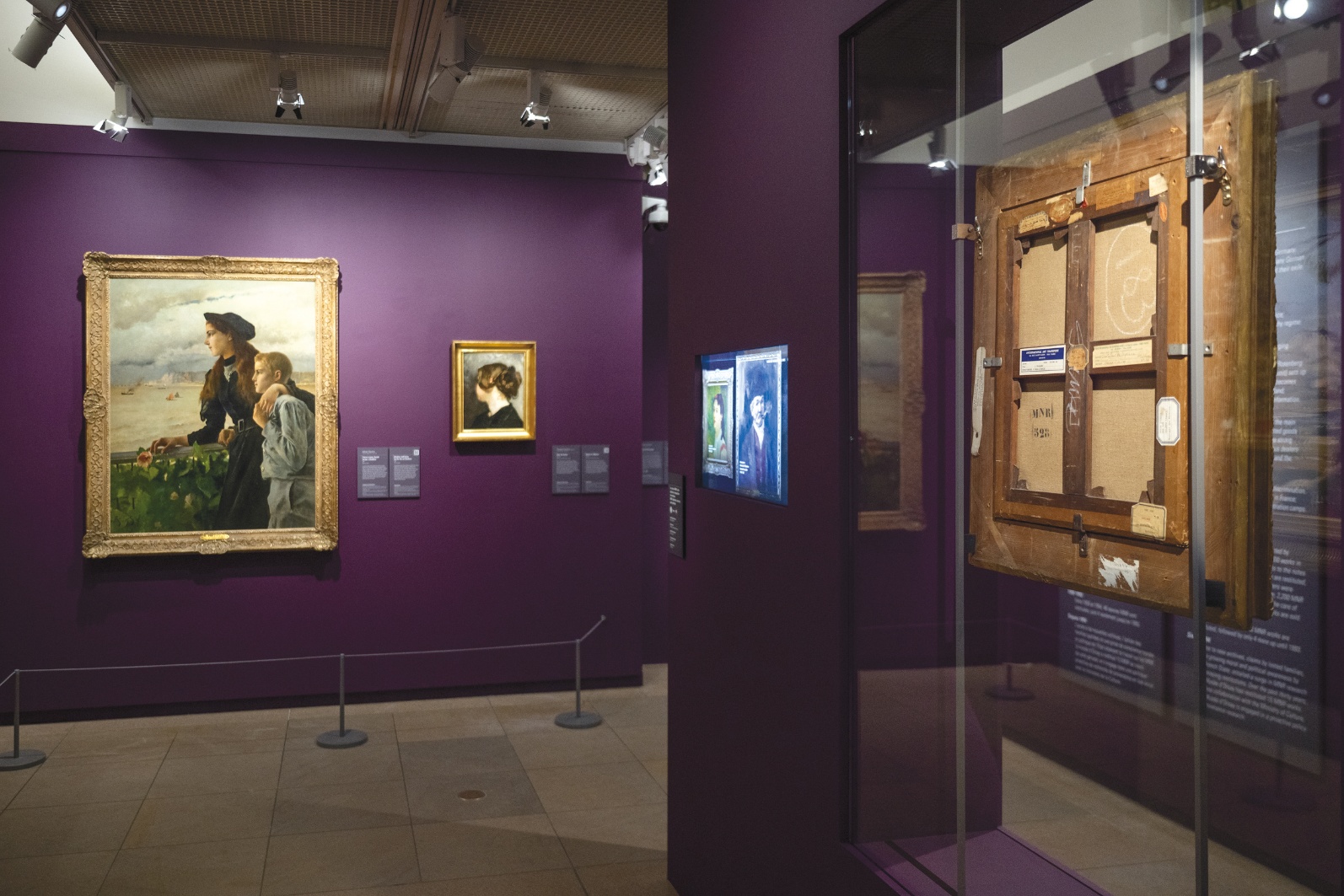
View of the ‘To whom do these works belong?’ room, opened in May 2026 (ground floor, Galerie Lille, Room 10b, photo taken in 2026).
Photo © Musée d’Orsay / Laëtitia Striffling-Marcu
Like the railway station that became a museum, and the successive interventions that have transformed the building over the past forty years, the Orsay’s displays are composed of layers, additions, shifts, continuities and revisions. This instability also reflects a strong capacity for self-examination and a certain agility and creativity, and is undoubtedly the greatest asset of a museum that remains intellectually vibrant. Indeed, what emerges at the end of this decade, on the eve of the opening of the Centre de Ressources et de Recherche Daniel Marchesseau and of significant new additions to the collections (for instance with the forthcoming arrival of the major Marlene and Spencer Hays donation),22 is less a narrative that has reached a definitive form than an overall presentation that has embraced a fruitful state of ongoing questioning. Open to research, debate, historiographical renewal and future acquisitions, it accommodates different levels of interpretation, temporalities and, at times, even competing conceptions of modernity or art history. In spite of all these upheavals, as the Musée d’Orsay celebrates its fortieth anniversary, its displays seem paradoxically faithful to what had already made them distinctive at the time of the museum’s opening: they are the product of a project that is both heritage-based and intellectual, a useful tool for reflecting on the arts of the nineteenth and early twentieth centuries and how their history is written.