‘No, we can rest assured: Manet and Cézanne no longer have to fight Bonnat and Gérôme’,1 writes Michel Laclotte in his Souvenirs, recalling the debates surrounding the 1986 opening of the Musée d’Orsay, whose early development he oversaw. With this remark, he underscores the endeavour’s symbolic significance and alludes to criticism from those who viewed the juxtaposition of so-called academic art with the avant-gardes as a challenge to the latter’s superiority. These categories are loaded, conveying moral and ideological values. The term ‘academicism’ emerged in 1840 as a critique of the systems and ideals of the Académie des Beaux-Arts, which at the time opposed Romanticism and sought to curb departures from tradition.2 Its pejorative meaning became more pronounced during the Second Empire, particularly in the writings of art critics.3 Official art, meanwhile, denotes works that received state approval.4 Often conflated, these concepts soon came to encompass a wide range of artists and were grouped under the disparaging term ‘art pompier’,5 at least from the 1880s onwards,6 in contrast to developments considered avant-garde. Originating in military and then political vocabulary, this latter expression entered the artistic register through art criticism in the 1880s.7 ‘Avant-garde’ implies a position of defiance vis-à-vis official institutions and a rejection of artistic norms inherited from the past. At the beginning of the twentieth century, this began to occupy a higher position in the value hierarchies of historical narratives.8
The dichotomy between academicism and the avant-garde remains structural in histories of nineteenth-century art in France, as it does in the Musée d’Orsay’s programme. Artists regarded as academic and official are represented there, but are distinct from the avant-garde, which ‘remain a unit’.9 Although their coexistence prompted debate when the museum opened,10 this ‘reconstruction’11 of the nineteenth century had in fact been under way, less conspicuously, since the 1950s. This article seeks to qualify the widely accepted narrative that entire areas of nineteenth-century painting attracted little interest before the Orsay opened by identifying historiographical and museological moments in which a fuller and more complex picture of the period began to emerge.
Examining the discourse in France around painting from the period 1848 to 1914, among art historians and curators during the fifty years preceding the Musée d’Orsay’s opening, this article considers the intellectual antecedents of the museum’s programme. While acknowledging that debates on the nineteenth century developed internationally,12 this study focuses on France, and primarily on its capital, while including noteworthy examples from museums elsewhere in the country that may qualify or contradict the dominant Parisian narrative. This choice attests to the central place occupied by collections exhibited in Paris as both reflections and vehicles of an artistic hierarchy, as well as the major role played by Parisian institutions in formalising a narrative structured around the avant-gardes and in training the first protagonists of the Musée d’Orsay. By focusing on the tension between academic art and the avant-garde, the study situates the Orsay project in a longer history of historiographical and museological visions and revisions of nineteenth-century painting, understood here as critical reassessments of the canon and artistic hierarchies.13
Before Orsay: Knowledge, Expectations and Visibility of the Late Nineteenth Century?
At the beginning of the twentieth century, accounts of painting from the second half of the nineteenth century were generally structured around major figures associated with what were interpreted as ruptures in the chronology: Gustave Courbet and Realism around 1855, Édouard Manet at the Salon des Refusés in 1863 or, in the 1870s, Claude Monet and Impressionism. In 1914, in his introduction to Du romantisme au réalisme, Léon Rosenthal explained his decision to discuss ‘mediocre canvases’ alongside famous works because of their ‘documentary function’, and to cite contemporary criticism of the works so as to avoid judging them according to ‘[his] own feelings or the esteem in which [they were then] held.’14 In other surveys, such as one by Louis Vauxcelles and André Fontainas, both defenders of the avant-gardes of their day in 1922, the nineteenth century’s academic side was mentioned in only a few lines, the authors ‘justly and deliberately passing over it in silence’.15 Other books nevertheless devoted more space to these artists, treating them with varying degrees of severity: in 1926, Louis Dimier described the characteristics of Ernest Meissonier and Jean-Léon Gérôme, whom he associated with the ‘minor genres’,16 without crediting them with much originality; two years later, Henri Focillon devoted substantial passages, though not without value judgements, to academic artists in a chapter on ‘eclecticism’;17 and in 1930 René Schneider gave over a chapter to ‘idealist art’,18 even expressing cautiously positive opinions of certain paintings by Gérôme and Paul Baudry.19 These early narratives either convey an overall negative judgement of academicism or omit it altogether.
Over the following decades, academic artists were increasingly relegated to the margins of publications and museum displays, while Impressionism began its emergence as a recognised part of France’s artistic heritage at the Orangerie des Tuileries in 1927. The Musée Claude Monet was created there to house the artist’s grandes décorations, which he donated to the state and which initially met with a mixed reception.20 In the 1930s, the museum also organised retrospectives devoted to representatives of the movement. Following the 1937 closure of the Musée du Luxembourg, which since 1818 had exhibited works acquired by the state from living artists, the museum’s collections were distributed among various institutions. Of those transferred to the Louvre, Impressionist and Post-Impressionist works were selected for display at the Galerie du Jeu de Paume, renamed the ‘Musée de l’Impressionnisme’ in 1947. Another portion of the collections was displayed at the Musée National d’Art Moderne starting that same year, while works considered less important were either placed in storage or dispersed among museums, churches, town halls and prefectures in cities across France. This was the case, for instance, with Henri Lévy’s Sarpédon,21 acquired by the state for the Musée du Luxembourg in 1874, deposited at the Musée de Chambéry in 1926 and then at the city’s courthouse between 1958 and 1974,22 before being assigned to the Musée d’Orsay in 1983. A significant proportion of academic works followed similar trajectories.23 Parisian museums therefore presented a truncated and fragmented nineteenth century, reduced to key figures illustrating the idea of rupture within a stylistic evolution.
Yet the isolation of the Impressionist collections on the other side of the Tuileries was not necessarily perceived as a mark of enhanced status at the time. As early as 1945, Rose Valland, an assistant at the Musée du Jeu de Paume, lamented this separation from the rest of the Louvre’s collections, fearing it might seem that the institution was ‘rejecting [Impressionism], or at least underestimating it.’24 Only gradually did this distance acquire a positive connotation in the writings of Louvre curators such as René Huyghe, Germain Bazin and Michel Florisoone, as Impressionism increasingly became an instrument of French cultural influence, associated with values of independence and freedom in the immediate post-war period.25 The presentation of this series of paintings in a separate building was then justified by its exceptional nature, positioning it both as a body of work that broke with the art preceding and contemporary with it and as a pivotal moment in the emergence of modern art.26 Successive changes to the museum display – greater spacing between works, pale walls and natural lighting (fig. 1) – reinforced this association with modernity.27 This arrangement contrasted sharply with that of the Musée du Second Empire, inaugurated at the Château de Compiègne in 1953, where works by Franz Xaver Winterhalter, Alexandre Cabanel and Alfred Stevens28 were instead incorporated into reconstructions of historical galleries (fig. 2).
Fig. 1
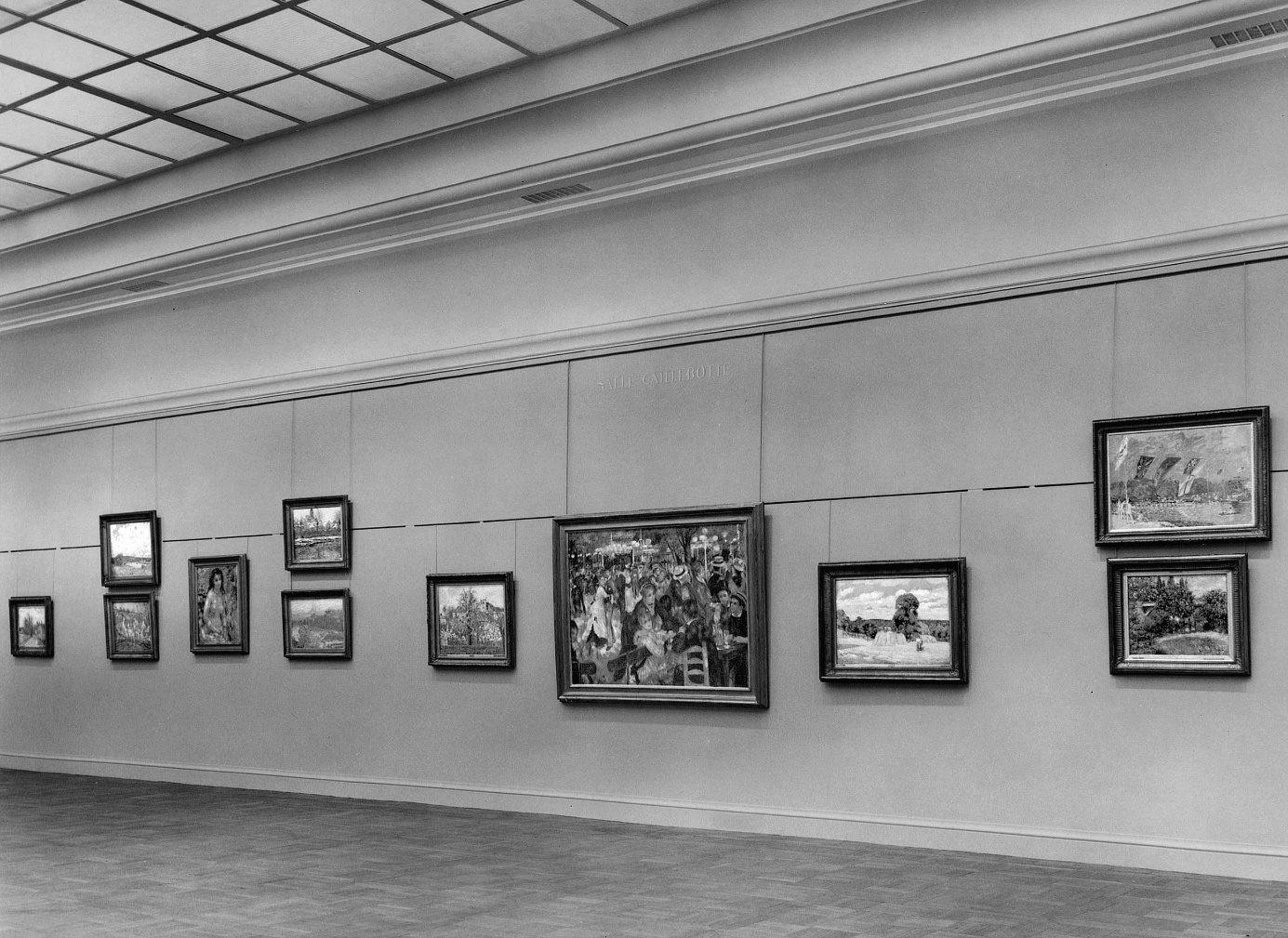
View of the Galerie Caillebotte on the first floor of the Musée de l’Impressionnisme, Galerie du Jeu de Paume, 1958, photographs from the Musée du Jeu de Paume et de l’Orangerie, gelatine silver print on paper [dimensions unknown], photograph by Agraci, Pierrefitte-sur-Seine, Archives Nationales, 20144659/160.
Photo All rights reserved
Fig. 2
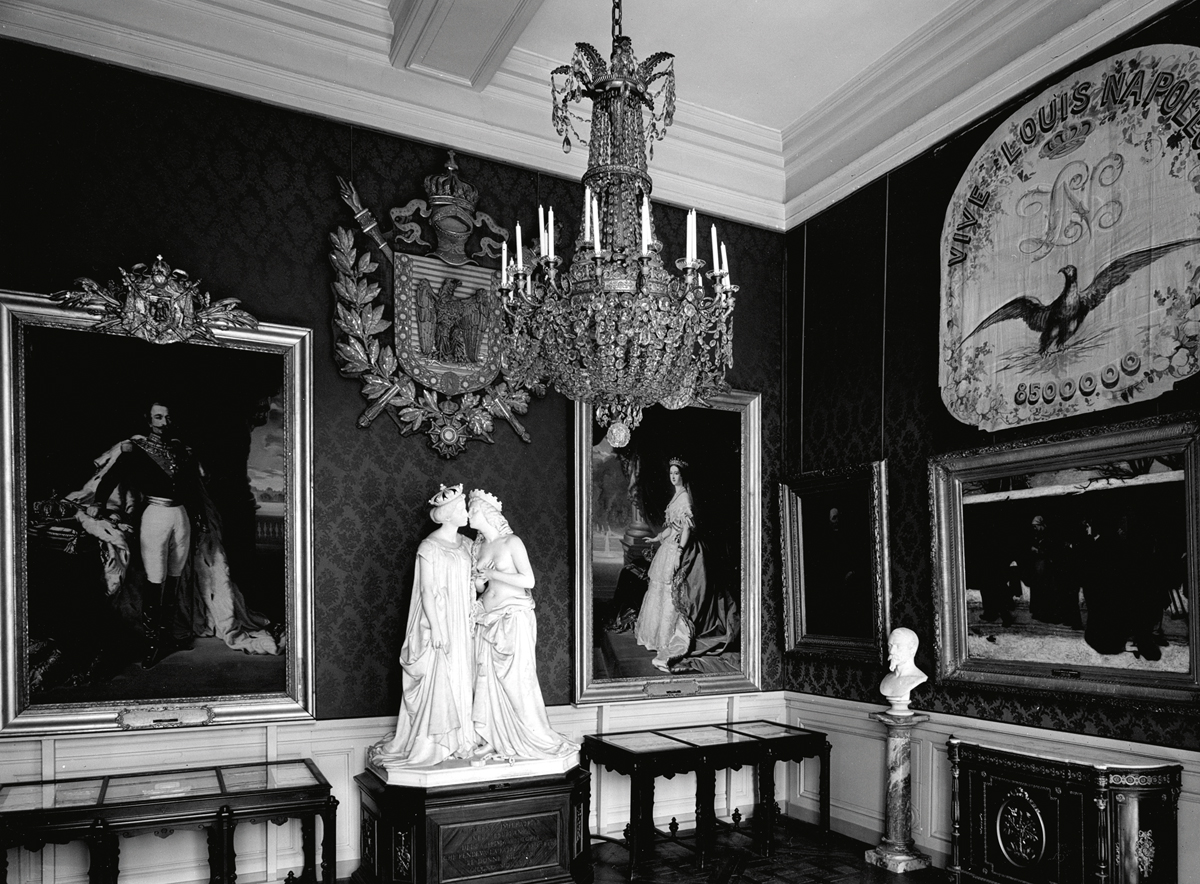
View of the Italy room at the Musée du Second Empire in Compiègne, between 1964 and 1969, photographic print, Compiègne, Château de Compiègne Archives.
Photo © GrandPalaisRmn (Domaine de Compiègne)
The polarisation between art regarded as academic and the avant-garde intensified in the 1950s. At the time, studies of art in the second half of the nineteenth century often followed a logic that set out a genealogy of modernity, influenced in particular by John Rewald’s accounts of Impressionism and Post-Impressionism.29 By the late 1960s, however, ‘the other nineteenth century’ was sometimes being reintegrated into the dominant narrative. In 1969, Bernard Dorival, a former director of the Musée National d’Art Moderne, wrote in Histoire de l’art. Du réalisme à nos jours (a volume of the Encyclopédie de la Pléiade) that, ‘unlike [what is done in] most other histories’,30 he intended to ‘recall [the] existence [of academic artists]’ and ‘briefly [define] the movement to which they belonged’, a task he considered ‘thankless’ but also ‘indispensable’. A year later, a generously illustrated chapter was devoted to ‘pictorial academic naturalism’31 in L’art et le monde moderne, edited by Huyghe and Jean Rudel. Academic art was thus gradually incorporated into the structure of a history whose writing remained to some extent the prerogative of curators at the leading Parisian institutions.
Re-visions of the Nineteenth Century: Parallel Counter‑Narratives
Alongside this discourse favouring a modernist reading, another history was developing, albeit less visibly, centred on the academic and official artists of the Second Empire and Third Republic. In 1922, Paul Alfassa organised the large-scale exhibition Le décor de la vie sous le Second Empire at the Musée des Arts Décoratifs in Paris, believing that historical distance made it possible to recognise the period’s significance.32 Alfassa laid the foundations for an initial retrospective reassessment of this body of work and began to develop a more inclusive vision33 of the period by displaying official and avant-garde artists together, reconstructing interiors and creating an atmospheric setting using colourful period damasks.34 A similar approach did not re-emerge until 1953, with the exhibition Le temps des crinolines.35 Once again, different aesthetics were brought face to face: Courbet’s The Spring36 and Cabanel’s The Birth of Venus37 were shown together in the introductory room devoted to the feminine ideal, with the aim of ‘understanding the evolution of society and morals’.38 That same year, Un siècle d’art français used the Petit Palais collections to present a section on official art during the Third Republic, bringing together Baudry, Léon Bonnat and Carolus-Duran. The catalogue explained that these artists could be of value to us ‘by bearing witness […] to their era’.39 Before being appreciated for their artistic qualities, these paintings appear to have been considered for their documentary value.
Similar initiatives multiplied between the 1950s and 1970s. In 1957, Le Second Empire. De Winterhalter à Renoir at the Musée Jacquemart-André brought together ‘painters who all lived at the same time, but belonged to two different classes’,40 this time to reconsider the notion of rupture. Intended to attract more visitors and ‘provide [this museum] with the resources essential for restoring the premises and collections’,41 the exhibition conveyed a nostalgic and positive view of the period.42 Following a similar typological approach, exhibitions were organised in Nice and Vichy in 1960 and 196143 to commemorate historical events. At the same time, some towns chose to pay tribute to ‘forgotten’ artists born locally, such as Léon Belly in Saint-Omer, on three occasions,44 and Amaury-Duval in Montrouge.45 This perspective on the nineteenth century can be described as circumstantial: it enabled municipal institutions to promote local history and collections, and even to restore certain works,46 while requesting loans of works outside the modernist canon.47 Legitimated by their connection to place and often associated with the political history of the Second Empire, these narratives differed from the reassessments developing simultaneously in the United States, which proposed an aesthetic reconsideration of a more diverse and expansive nineteenth century.48 Some approaches remained more ambiguous, moreover, and the term équivoque in the titles of two presentations at the Musée des Arts Décoratifs in Paris and then the Musée des Beaux-Arts de Bordeaux, in 1973 and 1975, may reflect uncertainty surrounding this new appreciation.49
During the 1960s, a more incisive reassessment developed in France. Some art historians and curators, including Thérèse Burollet, then working at the Musée d’Art Moderne de Paris and later the Musée Cognacq-Jay, openly questioned Impressionism’s supremacy. In the 1965 edition of the Musée de l’Impressionnisme’s collection guide, she argued that the institution ‘could more justifiably be called the “Museum of the Late Nineteenth Century” [Musée de la Fin du xixe siècle] if it did not completely neglect the representatives of official art’50 and asserted that ‘Monet’s Women in the Garden [fig. 3] is scarcely more modern than Winterhalter’s The Empress Eugénie Surrounded by Her Ladies-in-Waiting [fig. 4].’51 Her article ‘Antidisestablishmentarianism’, published two years later, defended these artists’ stylistic diversity and technical skill while condemning the neglect with which their works were conserved.52 At the same time, Bruno Foucart repeatedly spoke out against the destruction of a disparaged nineteenth-century legacy; the 1971 dismantling of Victor Baltard’s pavilions in Paris fed this rhetoric of a heritage under threat.53
Fig. 3
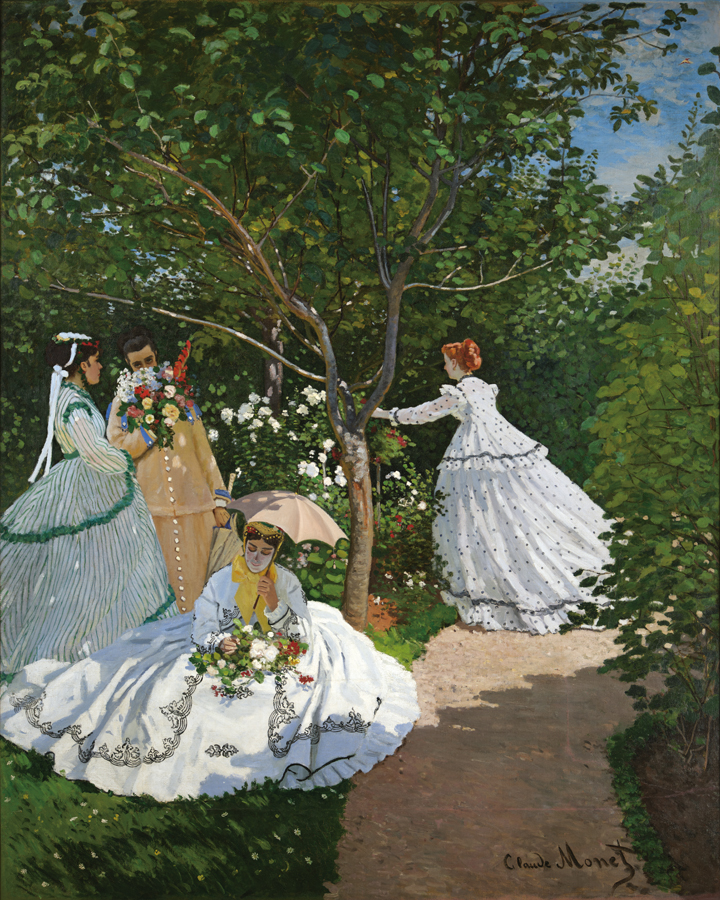
Claude Monet, Women in the Garden, ca. 1866 (1867?), oil on canvas, 255 × 205 cm, Paris, Musée d’Orsay, state purchase from Monet for the Musée du Luxembourg in 1921, RF 2773.
Photo © Musée d’Orsay (dist. GrandPalaisRmn) / Laëtitia Striffling-Marcu
Fig. 4
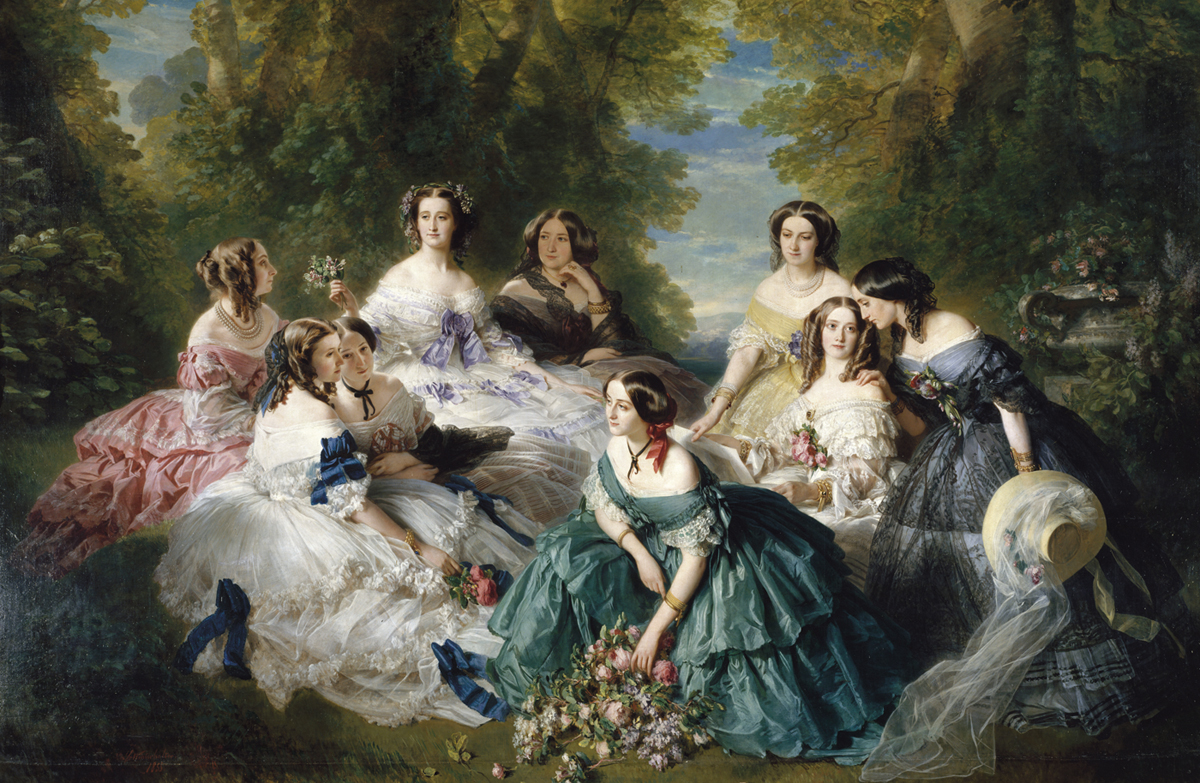
Franz Xaver Winterhalter, The Empress Eugénie Surrounded by Her Ladies-in-Waiting, 1855, oil on canvas, 295 × 420 cm, Compiègne, Musée National du Château de Compiègne, gift of Baroness d’Alexandry d’Orengiani to the Musée de Malmaison and deposited in Compiègne in 1952, MMPO 941.
Photo © GrandPalaisRmn (Domaine de Compiègne) / Daniel Arnaudet
It was in this context, in 1974, that Centenaire de l’impressionnisme shared the Grand Palais with the exhibition Le musée du Luxembourg en 1874. Peintures, installed in the other wing.54 The latter was directed by Geneviève Lacambre, curator of paintings at the Louvre, who hoped that the two exhibitions’ simultaneity would make it possible to ‘revise the image we have of nineteenth-century art’.55 This presentation of the period’s official art was underpinned by meticulous research: each of the catalogue’s 240 entries included an artist biography and an account of the work’s history, and this was the first time that many of the paintings in it had appeared in print. Five years later, Lacambre co-organised L’art en France sous le Second Empire, again at the Grand Palais, seeking an ‘entirely new and fairer appreciation’56 of a period that ‘exists, artistically speaking’.57 This revisionist undertaking also translated to monographic retrospectives in the 1980s.58
All these varied initiatives offered a broader vision than the dominant corpus founded on figures regarded as heralding twentieth-century art. In the 1970s, these positions were grouped under the term ‘revisionism’, encompassing highly diverse methodological approaches and ideological foundations.59 Yet hybrid forms of these revisionist approaches had appeared as early as the 1950s, complicating a categorization that describes an effort to deconstruct the canon and rehabilitate artists excluded from it.
The Orsay’s Position: Revision, Expansion or Reformulation of the Modernist Narrative?
The Musée d’Orsay’s decision to exhibit academic artists therefore did not emerge ex nihilo; rather, it crystallised these earlier reassessments and broadened the visible corpus of nineteenth-century art while retaining a modernist hierarchy. This compromise was apparent even in the development phase. The curatorial team in charge of planning the museum’s programme was assembled by Laclotte, who was responsible for its scholarly direction. From 1978 onwards, he brought several advocates of academic artists – Lacambre, Jacques Thuillier, Bruno Foucart and Jacques Foucart – onto the governing boards,60 alongside specialists in Impressionism and Post-Impressionism such as Hélène Adhémar, Sylvie Patin and Anne Distel, curators at the Musée de l’Impressionnisme and the Orangerie.
The decree of 20 March 1978 stipulated that the museum was to present ‘artistic production from the second half of the nineteenth century and the early years of the twentieth century’.61 Several chronological boundaries and display schemes were considered. One proposal discussed in 1983 was to devote the first rooms to the Salons of the 1860s, both the official Salon and the Salon des Refusés. Bruno Foucart argued that ‘popular expectations […] focus on art pompier’,62 which Thuillier likewise believed ‘foreign visitors’63 wanted to see. This comment alluded to approaches developed outside France, where Thuillier observed greater interest in academic art.64 Examples abounded: individual retrospectives of Gérôme and William Bouguereau developed earlier in the United States, where these artists found a place in museums without being positioned as a counterpoint to the avant-gardes.65 In the minds of those planning the Orsay, academic art was something the public expected to find at the new museum.
Fig. 5
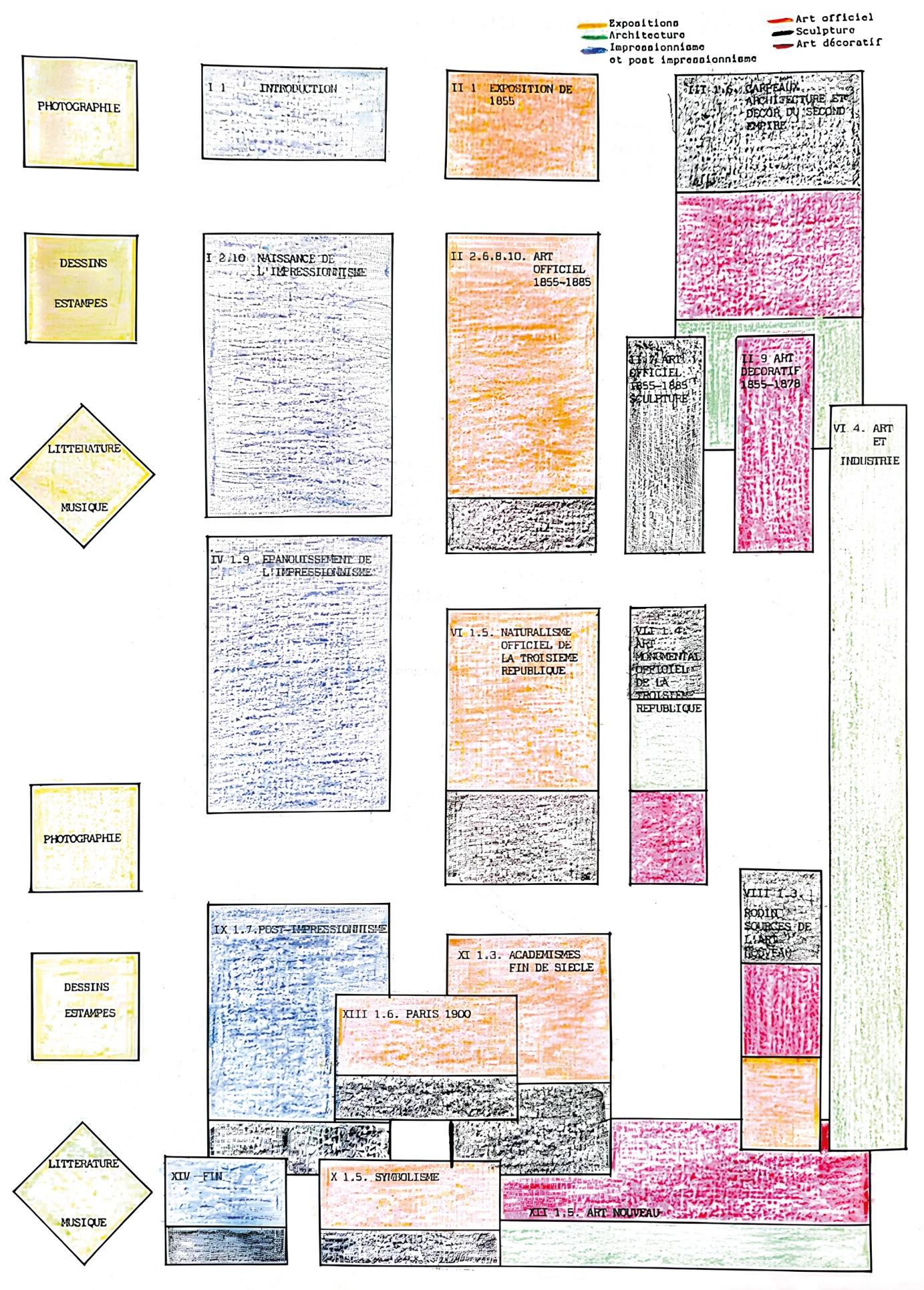
[Michel Laclotte?], Hand-drawn diagram showing the distribution of the exhibitions and the themes of architecture, Impressionism and Post-Impressionism, official art, sculpture and decorative arts in the Musée d’Orsay’s museographic programme, 1979, Pierrefitte-sur-Seine, Archives Nationales, 19950142/2.
According to a 1979 diagram (fig. 5), one of the earliest display proposals balanced Impressionism and Post-Impressionism (in blue) against ‘official art’ (in orange), which encompassed everything outside the former movements. It was already clear that these two groups would remain distinct, like parallel paths. In 1986, the display gave material expression to the superiority of the former movements, placed beneath the glass roof on the building’s top floor, while academic works were hung more densely in the artificially lit ground-floor rooms (fig. 6). Laclotte acknowledged this, explaining ‘The fact that we placed Cézanne, Gauguin and Monet in very good light and in much more spacious galleries unmistakably reflects our hierarchy.’66 This arrangement carried on museographic traditions that treated the two sides of the nineteenth century separately.
Fig. 6
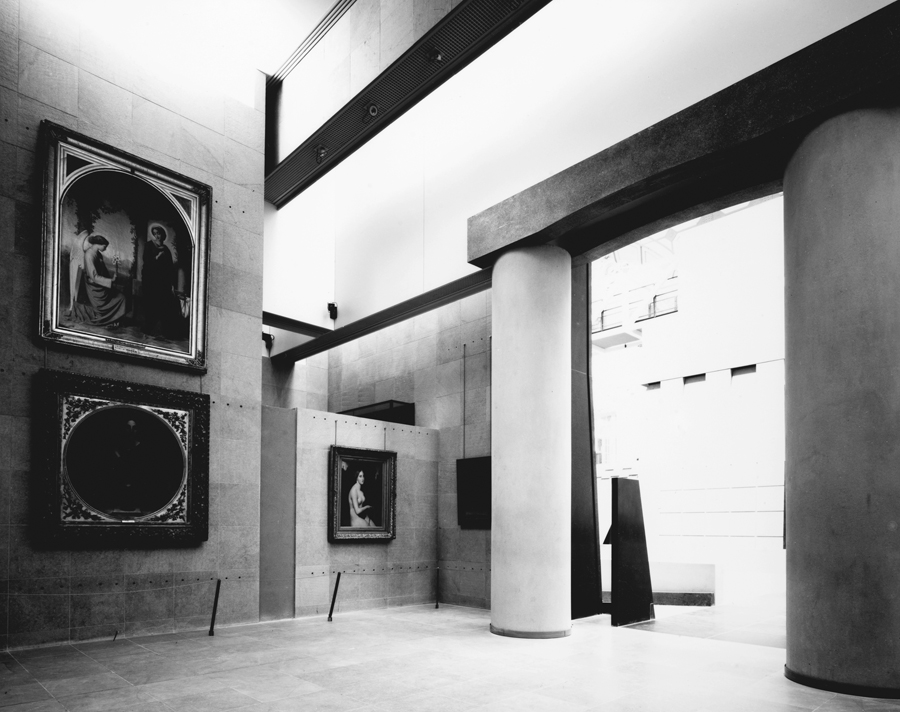
Jim Purcell, Gallery Devoted to Ingres and Ingresque Art, 1986, gelatine silver print, 21 × 27 cm, Paris, Musée d’Orsay Documentation, ODO 1996 22 1158 T. From left to right: The Annunciation (1860) by Amaury-Duval; The Virgin Adoring the Host (1854) and Venus at Paphos (1852) by Ingres.
Photo © Musée d’Orsay (dist. GrandPalaisRmn) / Jim Purcell
The modernist canon nevertheless opened up to other movements whose integration attracted less attention than that of academicism, with which they had initially sometimes been associated. Honoré Daumier, Jean-François Millet and the Barbizon School, Symbolism, Pierre Puvis de Chavannes and the Nabis all found a place at the Orsay following initial reassessments from the 1950s to the 1970s. The breakdown of the academicism-versus-avant-garde binary was also accompanied by an expansion beyond the national framework. Since the closure in 1946 of the Musée des Écoles Étrangères, housed at the Jeu de Paume, works by non-French artists that had entered the national collections at the beginning of the century had received only limited and fragmented visibility, divided between the Musée National d’Art Moderne, certain regional museums and storage. Although European painting was regularly the focus of temporary exhibitions in Paris,67 acquisition policies paid it only marginal attention until Laclotte arrived at the Louvre in the 1970s.68 In 1978, his list of gaps in the collections included the following note: ‘Munch/Klimt/Belgians Khnopff Ensor/Swiss Hodler/importance in themselves and in relation to French art’.69 This international approach to the period also had precedents, such as Les sources du xxe siècle,70 an exhibition presented by Jean Cassou and Albert Châtelet at the Musée National d’Art Moderne in 1960, which called for a renewed history of European art in the tradition of Focillon’s work.71
The clearest point of tension in discussions of the programme concerned the integration of historical context into the presentation of the works. The historical reference points and documentary displays devised by Madeleine Rebérioux and Chantal Georgel were not presented alongside the works but in dedicated spaces72 because the curatorial team feared that the intrusion of history would deprive the works of their autonomy.73 This disagreement had less to do with the museum’s content than its methodological approach: the dominant methodologies – those of the Parisian curators – remained attached either to a psychological reading, in the case of Huyghe and Dorival, or, for Adhémar and Patin for example, to biographical and contextual analyses that paid close attention to documents. The museum nevertheless opened at a historiographical turning point, characterised by the coexistence of recent studies that used divergent methodologies to address previously under-explored subjects: the role of prints for Michel Melot,74 artistic sociability for Jean-Paul Bouillon75 and, for Marie-Claude Genêt-Delacroix, analysis of the artistic field’s institutional, social and ideological structures.76 Among these studies, Pierre Vaisse’s 1980 doctoral dissertation examined relations between public authorities and painting during the Third Republic; in considering the conditions under which artworks were produced and their institutional contexts,77 he placed himself in the tradition of a foundational figure such as Rosenthal.78 In the United States, a critical overhaul of methods was undertaken earlier and along lines distinct from French historiography: while Timothy J. Clark foregrounded the historical and ideological structures at work in artistic production through a Marxist approach,79 Albert Boime documented the history of academic training and the careers and artistic ideals associated with it.80 These methodologies led many to reconsider academic painting and underscored the importance of context, in its multiple senses, for understanding works, while dismantling certain myths of the discipline. At the Musée d’Orsay, contextual issues were confined to ancillary display spaces separate from the works, suggesting a possible gap between the institution’s timeframe and the historiographical paradigms developing at universities and across the Atlantic.
The opening of the Musée d’Orsay provided a forum for debates concerning methods and hierarchies, historical relativism and the documentary or aesthetic value assigned to works. Previously confined to a community of art historians who shared broadly similar conceptions of their profession and discipline, these questions now encountered other epistemological approaches. As Françoise Cachin, the museum’s first director, observed, ‘it was not a new theoretical vision of the nineteenth century that gave rise to the museum but […] a fortuitous coincidence that made it possible to show in a single space what had formerly been scattered across different places.’81 The Orsay continued both circumstantial and conservation-driven reassessments, as well as approaches that included academic artists while maintaining the superiority of the avant-gardes. Although the canon was broadened at the Orsay, the museum did not constitute a rupture but instead extended a modernist paradigm demonstrating both the stability of the methods favoured by Parisian curators and their way of defining nineteenth-century art, its museum and its history.