December 2026 marks the fortieth anniversary of the Musée d’Orsay’s opening. This milestone surprises many, since the museum often seems as old as its walls, as though it has always belonged to the dense landscape of institutions along the banks of the Seine. For the vast majority of visitors who come each year in their millions, the Orsay is a timeless fixture. Their amazement upon learning its actual age speaks volumes, as it shows how a museum can make its own history seem self-evident, obscuring its reality as a recent construct defined by particular circumstances as well as decisions, debates and relocations. This enduring sense of wonder is a key theme in the inaugural issue of our new scholarly journal, 48-14. La revue des musées d’Orsay et de l’Orangerie, in which – as anniversary presents – various authors offer glimpses into a history that is both short and long. In this way, rather than merely commemorating a landmark date, the journal seeks to establish a lasting forum for discussion and knowledge‑sharing.
Histories Within Histories
To grasp the Musée d’Orsay’s true age, we must consider the respective timelines of the building, the collections, the institution and the perspectives that have continually transformed it. The Gare d’Orsay opened in 1900; a well-appointed railway station with its own luxury hotel in central Paris, it was popular with visitors to that year’s Paris Exposition Universelle. It occupied a prestigious location opposite the Louvre Palace, which since the seventeenth century had embodied both political power and the royal collections. The Musée d’Orsay’s walls are therefore 126 years old, and the architecture itself forms part of the artistic and cultural heritage that the museum’s planning team sought to introduce (or reintroduce) to visitors, as Guy Lambert explains in this issue. Chronologically situated between the respective collections of the Musée du Louvre and the Musée National d’Art Moderne, the works exhibited at the Musée d’Orsay span the relatively brief but intensely productive period between 1848 and 1914. The museum’s first journal, 48-14. La revue du musée d’Orsay, took its name from these key dates. We have retained the same title for this new incarnation despite the fact that the institution managing the Musée d’Orsay is now also responsible for the Musée de l’Orangerie and has therefore extended its scope a few steps further into the twentieth century.
In reviving this title, we furthermore pay tribute to our predecessors, whose work has had a profound impact on nineteenth-century scholarship. As a further anniversary gift, the new journal’s editorial team has digitised the entire run of the original 48-14, published between 1995 and 2011, and are making it freely accessible through the Persée platform (fig. 1).1 But using this title is also a way to remember that this time period is not dead and gone, for it continues to raise questions that engage actively with our present. It is worth noting that the choice of these start and end dates was far from obvious: it had sparked countless discussions during the planning phase of what was initially conceived as the ‘Museum of the 19th Century’ before the focus crystallised on the dates of a European revolution and a world war, the abolition of slavery and geopolitical realignments whose seismic repercussions have scarcely subsided.2 Today, extending beyond the major dates of history, this timeframe has become known to art historians as ‘the Orsay period’ – a span of just over half a century that was incredibly productive for the arts, boldly embracing many expressions, techniques and media.
Fig. 1
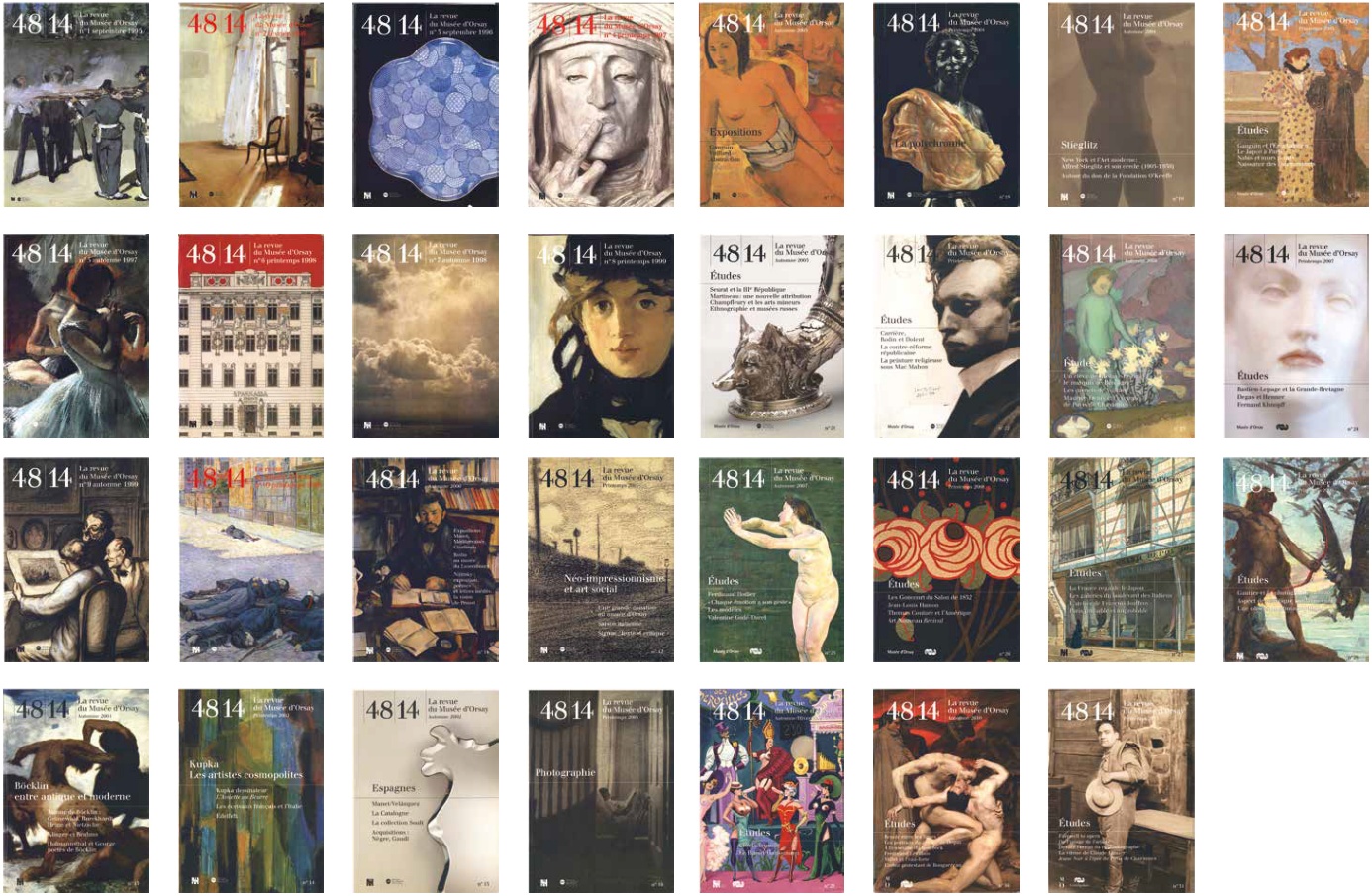
The thirty-one issues of 48-14. La revue du musée d’Orsay, published between 1995 and 2011 by the Musée d’Orsay and Éditions de la Réunion des Musées Nationaux.
Condensations
Is the Musée d’Orsay as old as its collections, then? Many histories and journeys have entered the former railway station along with the art, some of them equivalent to multiple trips around the globe. While visitors perceive them as naturally belonging in the museum’s galleries, these works in fact have had complex trajectories marked by successive relocations, reclassifications and reinterpretations. Some were acquired for the Musée du Luxembourg but were later transferred to the Louvre, then housed at the Jeu de Paume followed by the Palais de Tokyo and then ultimately moved to the Musée National d’Art Moderne–Centre Pompidou. Others were placed in regional museums or organisations of widely varying kinds before beginning their migration, from the mid-1970s onwards, to the new museum of the nineteenth century being established inside the Gare d’Orsay.
Alongside works acquired by the French state for national and regional collections, many of the pieces now in the museum’s holdings previously adorned opulent private residences, artists’ studios and country houses. They travelled the world before eventually entering this museum through gifts both modest and exceptional, but always generous. The museum also has custody of works recovered from Germany after the Second World War; some of these bear witness to the horrors of antisemitic expropriation while others reflect the opacity of transactions conducted during that period, whether lawful or unlawful, voluntary or coerced.
Finally, the Orsay embodies the memory of numerous museums, some longer-lived than others, from the Musée des Artistes Vivants, which opened in the Palais du Luxembourg in 1819,3 to more experimental ventures of their day, such as the Galerie de Dessins d’Architecture housed at the Louvre from 1891 to 1903.4 In 1994, the museum mounted La jeunesse des musées, an exhibition curated by Chantal Georgel. As the great-grandchild of all those pioneering, foundational institutions, and a catalyst for nineteenth-century museums, the Musée d’Orsay was the ideal place to reflect on what a museum can tell us about its own history.5
By shifting its perspective in this way, the Musée d’Orsay did indeed become the historian of its past and a living centre for reflection on art, society and culture between 1848 and 1914. This was far from a self-evident move as it deliberately introduced a distance between the museum and the period it presented; this distance remains at the heart of the Orsay experience today and undoubtedly contributes to the enduring uncertainty surrounding its ‘age’. Very much in keeping with a critical philosophy of history rooted in the nineteenth century, this self-reflexive aspect also established a distance from that century that the founding team chose to emphasise by entrusting the interior architecture’s design to Gae Aulenti.
Adjusting the Distance
Above all, the museum planners felt, the Gare d’Orsay could not be allowed to become a monument whose interiors merely pastiched the ornate exuberance of a nineteenth-century exhibition hall. The architectural competition bears this out: proposals that sought to recreate too faithfully the atmosphere of a winter garden at the heart of the station, or the exuberance of a world’s fair, were rejected in favour of Gae Aulenti’s more timeless, almost hieratic design. In fact, a quintessential nineteenth-century museum already existed: across the Seine, the Petit Palais, also designed for the 1900 Paris Exposition, showcased Charles Girault’s spectacular architecture, a masterpiece of that century’s age of attractions, its interiors decorated by an array of celebrated artists and studios from the early twentieth century, including Paul Baudoüin, Albert Besnard, Fernand Cormon, Maurice Denis, Giandomenico Facchina, Ferdinand Humbert, Georges Picard and Alfred Roll. Owned by the City of Paris, the Petit Palais housed a collection of nineteenth-century paintings and sculptures whose scope was similar to that of what would later form the Musée d’Orsay’s holdings.6 The new museum therefore could not simply reproduce on the opposite bank what the Petit Palais already embodied and was displaying with ever greater ambition under the guidance of Thérèse Burollet, one of the leading figures spurring the renewed interest in the nineteenth century in public art collections.
In this issue, Elise Wehr reminds us that the nineteenth century had never entirely faded from public consciousness; however, the Musée d’Orsay project, launched in the early 1970s, served to reshape perceptions of the period. This new mindset helped secure the preservation of Victor Laloux’s railway station and encouraged a determined revival of overlooked areas of artistic production, challenging conventional hierarchies and judgements of taste. At that time, the nineteenth century was not yet so distant; in 1967, the journal Historia referenced a still-vivid collective memory of Degas walking the streets of Paris just fifty years earlier.7 A century after his death, such tales have morphed into art history and archival testimony.
As the nineteenth century it explores continues to recede into the past, the Musée d’Orsay has acquired a new identity as a young museum with highly visible and mobile collections, a popular institution that has risen to become the second-most-visited museum in the French capital and, consequently, in France. It presents iconic works that draw crowds of visitors – Van Gogh’s self-portrait is its Mona Lisa – and is a popular shooting location for independent films and mass-market television series alike. It experiments with contemporary reinterpretations of its collections and explores the possibilities of immersive digital experiences that bring works of art and art history to life, reanimating the figures such as Degas and his contemporaries.8 Orsay is more than a museum: it is a time capsule in which past, present and future are condensed, making it difficult to assign the institution any single age. Is it young, or is it old?
The Secret of Eternal Youth: The Orsay as a Laboratory
If the Musée d’Orsay seems to oscillate between the different eras represented by its architecture, collections, institution and representations, this may be because it has never stopped being transformed by its own narratives. Yet these stories do not emerge of their own accord; they are continually produced, debated and tested, as Paul Perrin reminds us at the end of this issue. The Orsay is not a static repository, but a space in which hypotheses are explored, interpretations intersect and knowledge is developed and shared.
Forty years after opening to the public, the Musée d’Orsay still has the rare ability to inspire wonder and shift our perspectives, in part by reorganising the canon of the nineteenth century, but also by changing the very way in which we learn to see and, through seeing, how we think, to borrow the expression Benoît Peeters uses in his contribution to this issue. Reducing ‘the Orsay effect’ to a mere redistribution of masterpieces and hierarchies, or to a more generous reinterpretation of so-called ‘academic’ painting, would indeed mean forgetting one essential point: from the very start, the museum was designed to serve as a laboratory. It was to be a place where art history would never be the linear narrative of triumphant modernity but rather a field for experimentation and exploration – a space in which works of art, stories and disciplines could come into tension.
This laboratory function was conceived in a truly constructive spirit during the museum’s planning phase in the mid-1970s. While in concrete terms, the project would transform a railway station into a museum, it would also reconfigure the very conditions that allow an entire century to be seen. With its pre-opening exhibitions in France and the United States,9 and later with its ‘dossier’ exhibitions,10 the Orsay forged a method of its own: producing knowledge through the very process of creating exhibitions, acknowledging that certain works need to be explained before they find their way back into our world, while others, too familiar to be truly seen, require a degree of distance to be perceived afresh.11 The museum has sometimes had to take on an exploratory role, identifying, locating, documenting and recontextualising forgotten, neglected or little-known bodies of work, bringing them to light to expand and enrich the range of potential questions. In this sense, the Musée d’Orsay has been a site for scholarly research and experimentation since its preparatory stages.
It was clear to the museum’s planning team that the nineteenth century could not be understood if painting were isolated from all other art. From the outset, the museum provided unprecedented conditions for a cross-disciplinary and interdisciplinary approach, featuring sculpture, decorative arts, architecture, photography, graphic arts and cinema as well as literature, music, theatre, opera, philosophy and social and political history – not as ancillary disciplines, but as forces with the ability to recast interpretations of works of art. The creation of an ambitious cultural department, founded on this conviction and headed up by philosopher Roland Schaer, was one of the institution’s most decisive initiatives, as Claire Barbillon explains in these pages. Its aim was to make the museum a place of shared experience and a space for reflection, where interpretation would not be an optional addition but an essential component, and where research would inform and enhance the visitor’s encounter with works of art.
The project embodied an equally decisive objective by placing the nineteenth century in its international context. The planners had to confront the structural shortcomings of France’s public collections, which had long been constrained by a policy of providing only a minimal representation of foreign schools at the Musée du Luxembourg. France’s collections therefore contained relatively few foreign works in spite of donations from major collectors that brought in the occasional significant piece. The challenge for the Orsay, then, was twofold: to fill these gaps via targeted acquisitions starting in the planning stage, and to invest in exhibitions that would cast light on artists, movements, exchanges, markets and techniques that had long remained in the margins. This sustained effort helped establish the Orsay as a museum with a close eye on the nineteenth century across Europe and North America, rather than merely the stage for a narrative limited to France.12 Partnerships forged early on, through pre-opening exhibitions with museums across France and abroad, immediately situated the Orsay in an active network of national and international collaboration.
The Orsay also took shape amidst an intense debate that reflected the attention it attracted,13 with episodes that left a lasting impression on those who witnessed them, as Hollis Clayson recalls in her deeply personal account. The expectations were enormous. When the Orsay opened, certain visitors were disappointed, often for entirely contradictory reasons. Some felt as if the avant-garde had been relegated to the ‘attic’ while the ‘official’ artists were presented as the new victors; meanwhile, others considered that nineteenth-century history had been confined to the margins of a temple of fine art. For some, the separation and hierarchy between the arts appeared to have been definitively enshrined, while for others, they had not been made sufficiently explicit. But this debate was possible precisely because the Orsay offered an opportunity to view the nineteenth century with fresh eyes. As Marc Gotlieb and Neil McWilliam remind us, this new vision of the nineteenth century was indeed unprecedented: it had never before been seen with such breadth of vision. While history − as a discipline − was effectively confined to a display case at the entrance listing the major dates, the central nave itself discreetly introduced François Rude’s Napoleon Awakening to Immortality, alluding to the shadow that would hang over the entire century, and the bust of Johann Wolfgang von Goethe by David d’Angers, evoking a Europe of ideas whose dense intellectual networks sustained pacifist and progressive ideals. It concluded with Auguste Rodin’s Gates of Hell, a masterful synthesis of the history of forms, ideas and art after a century of intense reflection. The team responsible for defining the role of sculpture within the Musée d’Orsay—Anne Pingeot, Antoinette Le Normand-Romain, and Laure de Margerie—vividly recounts this process in these pages.
Indeed, the human side of this enterprise should not be underestimated. Looking through the archives, working photographs, notes and object files, as well as listening to those who helped bring the museum into being, one notices several things: the youthfulness of the planning team led by Michel Laclotte, their enthusiasm and creativity, and the sense of urgency behind their work. This energy became a roadmap for Françoise Cachin, the Musée d’Orsay’s first director, who was driven by solid confidence in the public’s intelligence and the shared determination to challenge established boundaries, overturn hierarchies and design a museum that would not be content simply to preserve, but would also seek to transform and to take action. This young team was closely attuned to what was happening in museums and universities across the French regions, Europe and beyond, determined to reshuffle the deck in an increasingly rich game. Éléonore Challine mentions this point in connection with Françoise Heilbrun and Philippe Néagu’s creation of the Orsay’s photography collection. This forward-looking momentum was also reflected in a pioneering approach to new technologies. The Orsay was among the first institutions to experiment with computer systems for recording and documenting its collections, while also making this information available in the museum itself, in a way accessible to visitors. This commitment to sharing knowledge, inseparable from the spirit of exploration, is integral to the Orsay’s identity.
It was also a place where different worlds intersected, to an extent greater than has sometimes been acknowledged. The museum had many links with universities, and these were embedded from the beginning in the hybrid career paths of those who crafted the ‘Orsay project’: curators, academic researchers, recent graduates of the École du Louvre, the École Normale Supérieure, other universities and the École Nationale du Patrimoine, as well as philosophers, musicologists, literary scholars and independent researchers. Such interactions allowed for multiple, and sometimes contrasting, reinterpretations of the nineteenth century: unexpected juxtapositions, exhibitions that went against the grain, and productive tensions between aesthetic readings and social narratives, between monumental architecture and playful inventiveness. The museum’s history demonstrates this, as the Orsay embraced the constraints imposed by its own monumental scale – accentuated by its architecture and exhibition design – only to challenge and continually recompose them.
During Henri Loyrette’s directorship, this energy also found expression in an editorial initiative. In September 1995, members of the cultural department (Claire Barbillon, Stéphane Guégan and Nicole Savy) and the curatorial department (Catherine Chevillot, Anne Distel and Chantal Georgel) joined forces to found the journal 48-14. It was then part of an editorial dynamic driven by the publications department of the Réunion des Musées Nationaux (the French national museum agency), which was strongly committed to research through ‘dossier’ exhibitions and lecture publications – in a series already entitled ‘Quarante-huit/Quatorze’, published from 1989 to 1995 – with designs by Philippe Apeloig that make these publications collectors’ items today as well as essential milestones in nineteenth-century studies. The publications featured contributions from eminent figures and a new generation of historians specialising not only in art history but in the history of literature, music and politics, bringing their voices into dialogue.14 The journal, for its part, would extend and transform these initiatives, supporting the museum’s intellectual activities – exhibitions, acquisitions, publications – by accompanying them with meticulously researched, pioneering texts, several of which have left a lasting mark on both the historiography and the memory of those who grew up with the museum. It was fuelled by a certain freedom of invention and the pleasure of bringing the arts into dialogue with literature, music, film and philosophy – a way of opening up the nineteenth century to readers, researchers and curious minds from every walk of life.
Although a museum is never a neutral space, as Linda Nochlin and Patricia Mainardi stressed from the beginning in position statements that received much attention, the history of the Orsay has proven one thing: its ability to bring together multiple readings. It offers windows onto the twentieth century by examining the continuities or cracks leading to ‘the origins of abstraction’15 or the perpetual reinvention of figurative art. It draws comparisons that redefine the scope of the canon by setting works regarded as unclassifiable alongside one another. And, more broadly, it continually challenges the very boundaries of the nineteenth century, in terms not only of the arbitrary chronological framework assigned to it (1848–1914), but also of the place this century occupies in our contemporary world. The weighty social questions that the nineteenth century has bequeathed to us – and that works at the Orsay bring so powerfully to the fore – are ones the museum has ultimately never shied away from, even if Madeleine Rebérioux felt she had lost the battle.16 In this issue, Charlotte Foucher Zarmanian explains how the museum has incorporated and taken these reflections into account over the years.
The Rebirth of a Journal and the Birth of a Research Centre
In 2011, 48-14, our publication’s predecessor, ceased to exist. Fifteen years on, it would be unwise to assume that the journal’s new incarnation could simply pick up where the earlier one had left off. The Musée d’Orsay has undergone profound changes in its organisational structures and working methods, its communication tools, its relationship with the public and the scope of its cultural programme – dance, concerts, live performances, lectures and talks. The main lines of development have continued, but they now take a different form. While, in a sense, 48-14 once handled a significant part of the museum’s storytelling and communications efforts, the journal now forms part of a broader whole: one voice among others in a polyphonic chorus.
If the journal is being revived today, it is not merely for the sake of continuity or to commemorate an anniversary. Rather, this new version meets a more important need: to show the conditions under which knowledge is produced at the museum, and thus to clarify its choices, document its methods and situate its activities within a broader space for scholarly discussion. It is also meant to serve as a forum for dialogue with research being carried out in France and internationally, at the intersection of the histories of art, museums, collections, circulations and audiences.
The journal will be published once annually, taking the time necessary to explain the reasons behind an acquisition, a museum display, a publication or a restoration. The goal will be to make choices, methods and occasional uncertainties comprehensible, and to foster dialogue – in its thematic sections – with the bodies of knowledge that underpin them, both at the museum and in the academic world. It is this same collegial spirit that has allowed the journal to reawaken from its slumber, assisted by many fairy godmothers: the members of the academic advisory board and the editorial board, active both in France and abroad, whose lively, frank and enriching discussions have already informed this collective endeavour. I will take this opportunity to express our heartfelt gratitude to them.
This editorial initiative is informed by, and inseparable from, a major institutional development: the creation, within the public body responsible for the Musée d’Orsay and the Musée de l’Orangerie, of the Centre de Ressources et de Recherche Daniel Marchesseau. This research centre bears the name of the institutions’ foremost patron, a leading figure in the museum world who has always emphasised research as a powerful unifying force.
Rather than bringing research to the museum, this centre gives it a concrete place, greater visibility and new tools, extending a long-standing commitment made by an institution for which museography, acquisitions, exhibitions, restorations and publications have, from its inception, found inspiration in the abundance of sources, investigations and inventiveness in its own field. Scholarly programmes will undertake long-term fundamental research into key questions relating to the period, drawing closely on the collections of works and documents held by the Musée d’Orsay and the Musée de l’Orangerie. In-depth research will inform plans for exhibitions, displays, the permanent collection, interpretation and publications. The journal finds its foundation here, serving as one of the tools making this work accessible, shareable and open to discussion.
As a crucible for research, the centre will be a space open to all forms of scholarly practice; a place where expertise can engage in dialogue, where areas of uncertainty are documented; and, ultimately, a welcoming environment, receptive to every approach, method and line of enquiry. Through this centre and the journal that accompanies it, the aim is to open up a space in which questions posed about the nineteenth century can be reformulated from new perspectives – not to establish its contours once and for all, but to explore its shifts, tensions and contemporary uses.
Setting Things in Motion
This first issue marks the rebirth of 48-14 with a focus on ‘the Orsay effect’. It offers essays looking back at the making of the museum itself: the formation of its collections – some of them in fields that, at the time, had no obvious place in French museums – and the devising of working methods and new conditions of visibility, as well as the interpretive conflicts to which the museum quickly gave rise, both in France and internationally. Several contributions revisit how the Orsay reframed the nineteenth century and examine the Orsay effect – in other words, the way the museum was perceived from the start as both an ideological construct and a site of critical debate, admired by some, contested by others, but always scrutinised. An underlying question running through all the pieces is how the Orsay has influenced the way we write art history – and how, in turn, this history has impacted the museum.
The interviews offer a unique perspective on the planning phase, bringing it to life through personal memories and accounts of actions taken and decisions made, and of the inspirations and constraints that moulded the project. Alongside a selection of photographs taken by Jim Purcell to document the undertaking, they remind us that the Orsay is not only an institution and a building, but also a physical, architectural and human undertaking, an intellectual and sensory experience, a workshop for poetic creation and new forms of storytelling.
After all, a museum is never an abstraction. It must contend with limited floor space, flood-prone areas that must be monitored, constant building work, teams that are continually changing, a memory that endures but also fades, and a legacy that is passed on and perpetually reinvented. It is a space defined by architectural, logistical and budgetary constraints, yet constantly extends beyond them – through its deposits and loans and, as a grand département, its nationwide responsibility for nineteenth-century collections outside its own walls – because it thrives on tensions and trade-offs, and must continue questioning itself to remain coherent and dynamic, as Paul Perrin reminds us so movingly in this issue. The Orsay’s constraints have changed over time, or perhaps simply tilted – towards greater economic and commercial pressures, for example – without diminishing the need for intellectual ambition, critical vigilance and a commitment to sharing knowledge. It was in this spirit that Sylvain Amic called for the journal’s revival, not intending it to have an authoritative role but rather to serve as a vehicle for widely shared knowledge grounded in expertise and intended for the public.
Future issues will combine thematic sections with articles devoted to research carried out at the museum and underpinning its curatorial choices, acquisitions, exhibitions, publications and restoration programmes, as well as its broader reflections on what continues to make the nineteenth century such fertile ground for us today. By providing a forum for this research and making it available to be shared, discussed and passed on, the journal seeks to reconnect with the founding spirit of those who, from day one, made the Orsay a museum in motion.